


Sales qualification frameworks: BANT, MEDDICC, SPICED, and CHAMP
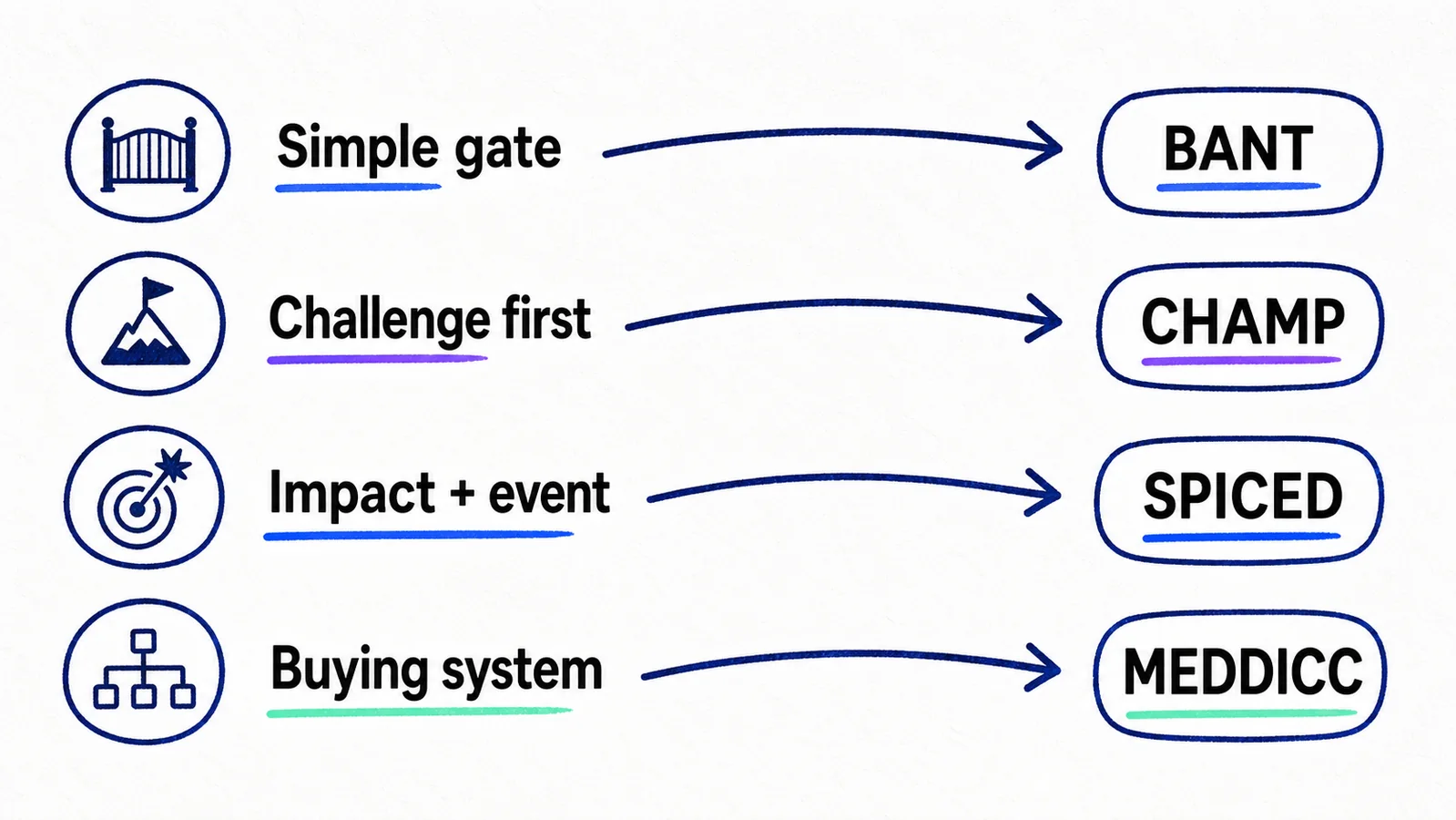
Sales qualification frameworks give a team shared criteria for deciding whether and how to pursue an opportunity. BANT checks budget, authority, need, and timeline. MEDDICC examines value, buying authority, decision mechanics, pain, a champion, and competition. SPICED connects the buyer's situation and pain to impact, a critical event, and a decision. CHAMP starts with the buyer's challenge, then tests authority, money, and priority.
The acronym is not the decision. Useful sales qualification depends on evidence quality, deal risk, and the next action the team is prepared to take.
Qualification is not discovery
Discovery is how a seller learns and tests the buyer's context. It includes research, questions, demonstrations, technical validation, stakeholder conversations, and direct observation of the buying process.
Qualification is a decision made from that evidence. The decision might be to pursue now, nurture for later, disqualify, reduce the resources assigned, or validate a specific gap before advancing.
The two activities inform each other, but they are not interchangeable. A discovery call can produce rich context without proving that an opportunity deserves a full pursuit. A qualification review can also reveal a question that requires more discovery.
Treating a framework as a discovery script causes two problems. The buyer experiences an acronym-shaped interrogation, and the CRM fills with answers that have not been tested. Use the framework behind the conversation, then record what the buyer said, what the team observed, and what remains uncertain.
Compare BANT, MEDDICC, SPICED, and CHAMP
| Framework | Named criteria | Strongest fit | Main blind spot |
|---|---|---|---|
| BANT | Budget, Authority, Need, Timeline | A compact early filter when the buying path is fairly direct | Can reduce a complex buying group to one authority and one date |
| MEDDICC | Metrics, Economic Buyer, Decision Criteria, Decision Process, Identify Pain, Champion, Competition | Complex, competitive opportunities with several decision risks | Creates administrative drag if every field is required before it can be known |
| SPICED | Situation, Pain, Impact, Critical Event, Decision | Recurring-revenue motions that need a shared customer context and event-driven urgency | Does not name budget, a champion, or competition as separate fields |
| CHAMP | Challenges, Authority, Money, Prioritization | Buyer-centered qualification where the problem and its priority should lead | Offers less detail on formal evaluation and purchasing processes |
The count above is structural. Seven fields do not make MEDDICC better than a four-field model. More fields increase coverage and implementation cost. The right question is whether the added fields expose material risks in your sales motion.

BANT: a compact purchase-readiness filter
BANT stands for Budget, Authority, Need, and Timeline. Salesforce describes BANT as a four-factor lead qualification framework and notes that it is not a universal fit for complex cycles.
BANT is useful when the team needs a consistent first pass:
- Is there a problem your offer can address?
- Is money available or plausibly obtainable?
- Who participates in the purchase decision?
- What event or condition shapes timing?
Apply those questions as evidence prompts, not hard gates. A buyer may not have a preallocated budget because the problem has only just become urgent. An initial contact may lack final authority but still provide access to the buying group. A stated timeline may be a preference rather than a consequence-backed date.
BANT is usually too thin when legal, security, procurement, technical evaluation, multiple executives, or a competitive replacement can change the outcome. It can still qualify the first conversation, but it should not pretend to describe the entire deal.
MEDDICC: inspect the buying system
MEDDICC has seven categories:
- Metrics: the quantified result the buyer expects
- Economic Buyer: the person with final authority over the investment
- Decision Criteria: the standards used to compare options
- Decision Process: the path from evaluation to a business decision
- Identify Pain: the problem and its consequences
- Champion: a buyer-side person with influence, motivation, and demonstrated action
- Competition: other vendors, internal alternatives, delay, or no decision
The variant names matter. MEDDICC's framework history defines MEDDIC as the original six-field model. MEDDICC adds Competition. MEDDPICC adds Paper Process to MEDDICC, bringing the explicit count to eight.
Paper Process covers the route from a decision to signature, including procurement, legal, contracting, and approval steps. Use MEDDPICC when those steps create enough risk to deserve their own evidence record. Do not label an eight-field implementation MEDDICC and then hide Paper Process inside Decision Process. Precision keeps coaching and CRM reporting coherent.
MEDDICC is strongest when a team must inspect several kinds of uncertainty at once. It separates the economic buyer from the sales champion, and it forces the seller to learn how the customer decides. It is not a discovery methodology by itself. It tells the team what evidence is missing, not exactly how every conversation should unfold.
SPICED: connect context to a critical event
SPICED stands for Situation, Pain, Impact, Critical Event, and Decision. Winning by Design defines SPICED as a diagnostic framework that can carry shared context across revenue handoffs.
Its sequence helps a team connect the buyer's current state to a reason for change:
- Situation: the relevant current context
- Pain: the problem within that context
- Impact: the consequence of leaving the problem unresolved or the value of changing it
- Critical Event: a date-bound event that makes timing meaningful
- Decision: the criteria, people, and process behind the choice
SPICED fits recurring-revenue teams that need discovery context to survive handoffs from sales development to sales, implementation, and customer success. The Critical Event field also improves timeline quality because it asks what happens on a date, not merely when the buyer hopes to purchase.
Its omissions are equally important. Budget, competition, procurement, and a champion are not separate acronym fields. A team should add evidence for those risks when its sales motion requires them, but it should avoid quietly rebuilding MEDDPICC under a different label.
CHAMP: lead with the buyer's challenge
CHAMP stands for Challenges, Authority, Money, and Prioritization. HubSpot's qualification comparison describes CHAMP as a model that puts the challenge before authority.
That ordering changes the opening posture. The seller first establishes whether the problem is real, material, and relevant. Authority becomes an account-mapping question rather than a reason to dismiss a useful contact. Money is assessed in relation to the challenge. Prioritization asks whether the issue can win attention against other initiatives.
CHAMP is a useful middle ground when BANT feels too seller-centered but MEDDICC would create more structure than the motion can maintain. It remains a compact model. Teams with formal evaluations, broad buying groups, or procurement risk need additional evidence outside the acronym.
Choose the framework by deal risk
Start with the buying motion, not framework popularity.
Use BANT when a small set of purchase-readiness questions covers most loss risk. Choose CHAMP when challenge severity and competing priorities deserve to lead. Choose SPICED when impact, a real critical event, and cross-team context are central. Choose MEDDICC when the buyer's decision system, champion strength, quantified value, and competition require separate inspection.
Use four tests before adoption:
- Risk coverage: Does the framework expose the reasons your qualified deals usually stall or lose?
- Evidence availability: Can sellers gather the evidence during a normal buying process?
- Inspection value: Will managers use the fields to change a pursuit decision or coaching action?
- Maintenance cost: Can the team keep the evidence current without turning every review into form cleanup?
A blended model is valid when each added field has a named decision use. It is not valid when leaders combine acronyms to signal rigor and leave reps with 20 required fields.
Turn the framework into CRM evidence
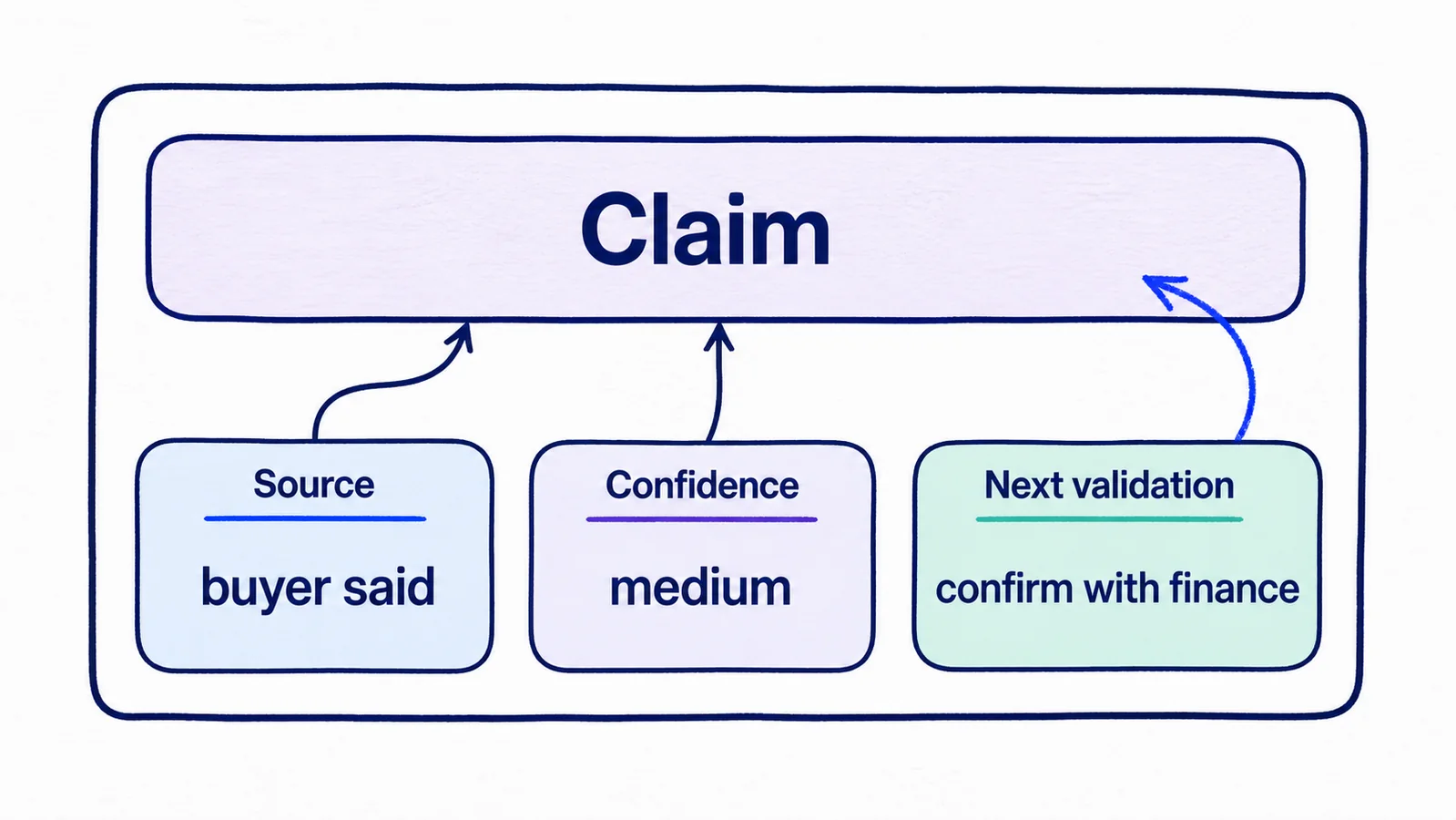
A checkbox says only that someone touched the field. A useful evidence record should contain four parts:
- Claim: what the team currently believes
- Source: who said it or which buyer action supports it
- Confidence: confirmed, inferred, contradicted, or unknown
- Next validation: the next conversation or event that can strengthen or reject the claim
For example, “Economic buyer: CFO” is weak. “Operations VP named the CFO as final investment approver; finance meeting requested; unconfirmed” is inspectable. It shows provenance, uncertainty, and the next test.
Map fields to stage decisions in sales pipeline management. Do not require every criterion at the first stage. Define which evidence should exist now, which can remain unknown, and which missing item prevents further resource allocation.
Run qualification as a continuous decision
Install the framework in five steps:
- Review recent wins, losses, and stalled opportunities for recurring risk.
- Select the smallest framework that makes those risks visible.
- Define acceptable evidence and an owner for each criterion.
- Add stage-specific inspection rules and next-validation fields.
- Revisit the pursuit decision when stakeholders, priorities, timing, or buying steps change.
The review should end with a decision, not a score recital. Keep pursuing, narrow the next action, return the account to nurture, disqualify it, or test one missing assumption. A mutual action plan can make buyer and seller commitments visible after the opportunity has enough evidence to justify coordinated execution.
Qualification evidence also improves sales forecasting methods, but the two disciplines remain distinct. Qualification decides how to pursue. Forecasting estimates the likely commercial outcome and timing.

Common implementation mistakes
- Treating the acronym as a fixed call order
- Marking fields complete from seller inference
- Requiring late-stage evidence during the first conversation
- Scoring every criterion equally despite different loss risks
- Confusing a friendly contact with a tested champion
- Keeping qualification static after the buying group changes
- Using MEDDIC, MEDDICC, and MEDDPICC as interchangeable labels
- Adding fields that no manager uses in a decision
The recurring failure is administrative certainty. A full record can still describe a weak opportunity. Evidence quality and decision consequence matter more than completion percentage.
Frequently asked questions
What is a sales qualification framework?
A sales qualification framework is a shared set of criteria for deciding whether and how to pursue a lead or opportunity. It gives sellers and managers a common language for evidence, gaps, and next actions.
Which sales qualification framework is best?
Choose the smallest framework that exposes the material risks in your sales motion. BANT suits a compact purchase-readiness check. CHAMP prioritizes the buyer's challenge. SPICED connects impact to a critical event. MEDDICC covers a complex buying system in greater detail.
Is MEDDICC the same as MEDDPICC?
No. MEDDIC has six categories. MEDDICC adds Competition. MEDDPICC adds Paper Process to MEDDICC. A team can choose any variant, but its training, fields, and reviews should use the selected name consistently.
Is discovery the same as sales qualification?
No. Discovery gathers and tests information about the buyer's context. Qualification uses that evidence to make a pursuit decision. Qualification can identify a gap that sends the seller back into discovery.
How should qualification be recorded in a CRM?
Record the current claim, its source, confidence, and next validation step. Tie required evidence to the relevant sales stage, and preserve unknown or contradicted states instead of forcing a positive answer.
Start with one risk
Take five recent stalled or lost opportunities and name the missing evidence that would have changed an earlier decision. Group those gaps by risk. The resulting pattern will tell you whether a compact framework is enough or whether the team needs deeper inspection.