


How to build a customer success strategy for SaaS
A customer success strategy defines how a SaaS company helps a customer segment reach agreed outcomes after purchase. It connects customer goals, lifecycle milestones, evidence, owned plays, and a review cadence. The result should tell the team who needs attention, why, what happens next, and what the customer did afterward.
That boundary matters in recurring revenue. Customer success is proactive and outcome-led. Support resolves questions and incidents. Account management owns commercial terms in many companies. One person may cover all three roles in an early startup, but the decisions still need separate triggers.
Salesforce describes customer success through proactive onboarding, ongoing engagement, and goal alignment. Those elements become a strategy only when they are specific enough to guide action for a real segment.
Start with the customer outcome
The first strategy decision is not how often a CSM should call. It is the result the customer expected to achieve.
For an analytics product, the outcome might be: a revenue leader can use one trusted dashboard in the weekly forecast meeting. Connecting a data source is a milestone. Publishing a dashboard is another. Logging in is activity. The forecast decision supported by the dashboard is closer to the outcome.
Write the outcome in language the customer can verify. Then name the observable behaviors and milestones that precede it. This keeps the success plan tied to customer progress rather than vendor activity.
The product cannot guarantee the customer's business result. It can help create the capability, behavior, or decision that supports that result. Be precise about that boundary when sales hands the account to customer onboarding.
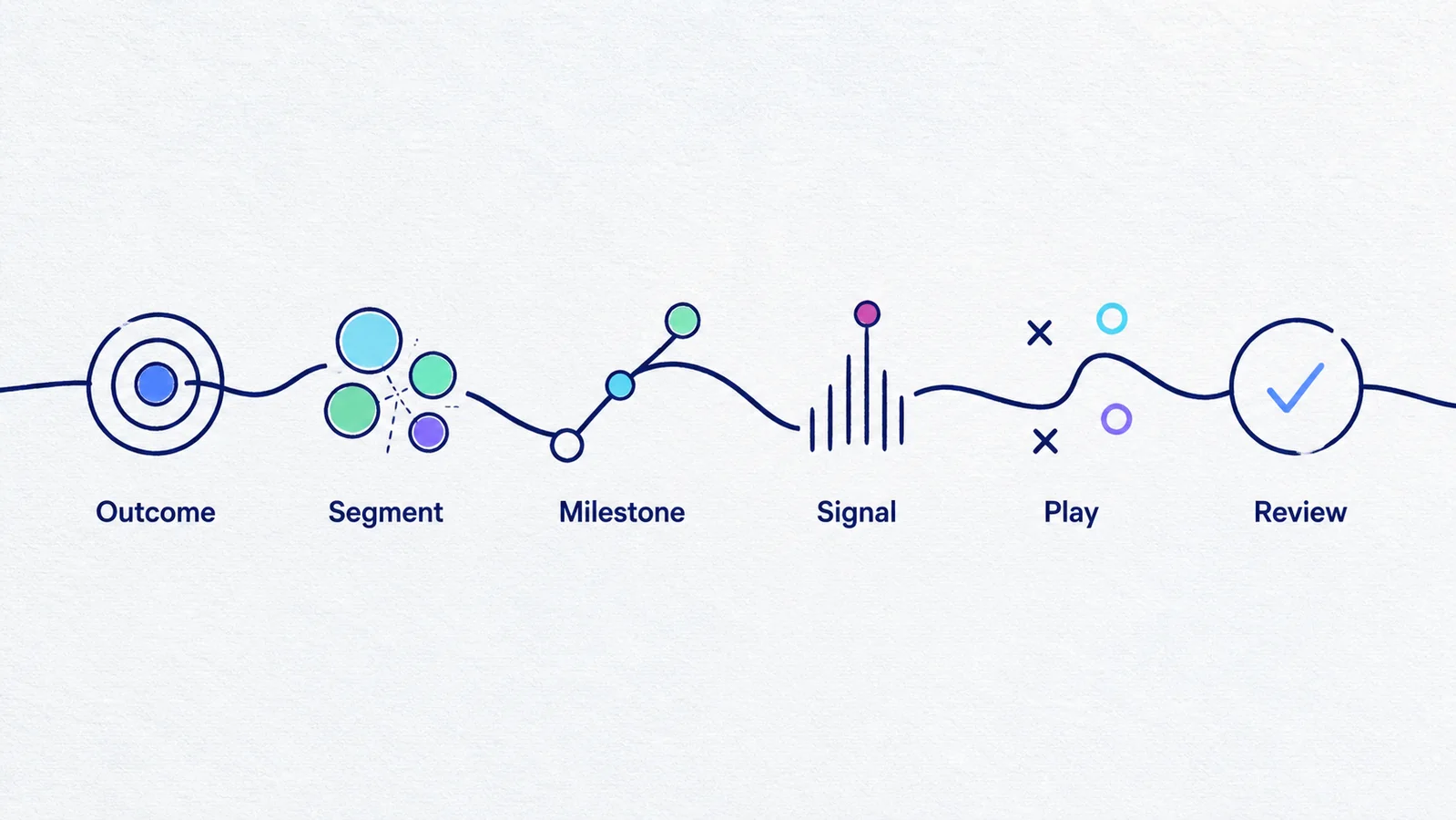
Build the strategy from six connected decisions
A lean customer success strategy needs six decisions.
1. Choose the segment
Segment customers by the conditions that change how they reach value. Useful dimensions include use case, product complexity, implementation effort, customer maturity, contract value, and support needs.
ARR alone is rarely enough. Two accounts with the same contract value can need different guidance because one has a technical implementation and the other can self-serve.
Choose a delivery model for each segment. High-complexity accounts may need named owners and joint success plans. Lower-complexity accounts may receive digital education with human help triggered by specific evidence. Gainsight's customer success guide distinguishes high-touch, low-touch, and digital-led models while tying them to segment complexity and value.
2. Map lifecycle milestones
Define the few customer moments that change the next action. A practical lifecycle often includes handoff, setup, first value, repeat use, broader adoption, renewal readiness, and expansion readiness.
Each milestone needs an entry condition and completion evidence. "Onboarding complete" is weak if it means the kickoff call happened. A stronger completion rule might require the integration to be live, an administrator trained, and one core workflow completed with real data.
3. Select useful signals
Signals should show progress, friction, relationship change, or commercial change. Combine product behavior with customer context.
Examples include setup completion, core workflow frequency, breadth across licensed users, unresolved critical tickets, milestone delay, sponsor engagement, stated outcome progress, renewal timing, and a changed team need.
Do not collect a signal simply because the data is easy to retrieve. Daily logins mean little for a quarterly planning product. A signal is useful when the team can explain the customer state it represents and the action it may justify.
4. Write triggered plays
A play is a defined response to a validated customer situation. It should include the trigger, required context, owner, action, expiry, and possible outcomes.
For example, a decline in core workflow completion may trigger a diagnosis play. The owner checks data quality, stakeholder changes, support history, and the customer's operating cadence before contacting the account. The play can end as recovered, blocked, false signal, product issue, or unresolved risk.
A customer who reaches a plan boundary may enter an expansion qualification play. The team should confirm delivered value and a larger need before routing the opportunity into an expansion revenue strategy.
5. Assign ownership and handoffs
One owner should accept each play. Shared visibility is useful. Shared accountability is usually ambiguous.
Pylon's SaaS customer success guide separates customer success from support and account management while emphasizing shared account context. Use that distinction to write handoffs:
- Support owns incident resolution and returns recurring friction to product and success.
- Customer success owns progress toward the agreed outcome and coordinates recovery.
- Product owns product capability, usability, and instrumentation.
- Sales or account management owns negotiated commercial changes.
- Marketing can deliver scaled education through customer marketing.
Record what the receiving owner must see and how they accept or reject the handoff. A routed task without context is not a handoff.
6. Set the review cadence
Review individual plays frequently enough to act while the evidence is current. Review the strategy less often so the team does not rewrite rules after every unusual account.
A lean cadence can include:
- Weekly review of new risks, stalled milestones, accepted handoffs, and overdue actions.
- Monthly review of play outcomes, segment patterns, false signals, and customer feedback.
- Quarterly review of lifecycle definitions, score inputs, delivery capacity, and business outcomes.
The cadence should change the model. Remove signals that create noise. Rewrite plays that end without a clear outcome. Adjust coverage when a segment consumes more attention than its needs justify.
| Lifecycle moment | Evidence | Trigger | Owner | Play | Recorded outcome |
|---|---|---|---|---|---|
| Handoff | Goal, use case, buyer promise | Required context missing | Sales | Repair handoff | Accepted or returned |
| Setup | Integration and admin tasks | Milestone overdue | Onboarding | Diagnose blocker | Complete, blocked, or rescoped |
| First value | Core result produced | Result not reached on time | Success | Value recovery | Reached or revised |
| Adoption | Relevant behavior repeats | Depth or breadth declines | Success | Adoption diagnosis | Recovered or risk confirmed |
| Renewal | Outcome evidence and stakeholder state | Readiness incomplete | Success or account management | Renewal readiness | Ready, at risk, or commercial issue |
| Expansion | Value proof and larger need | Qualified change appears | Sales or account management | Expansion handoff | Accepted, deferred, or rejected |

Make health signals specific and actionable
A health score compresses evidence. It does not explain the account by itself.
Build score components by segment and lifecycle stage. An onboarding account may be assessed on setup milestones, time to first value, administrator readiness, and unresolved blockers. A mature account may need outcome progress, relevant usage depth, stakeholder coverage, support severity, and renewal readiness.
Keep the components visible. If an account moves from green to yellow, the owner should see which evidence changed and when. Apply an expiry to subjective inputs so an old CSM opinion cannot remain permanently influential.
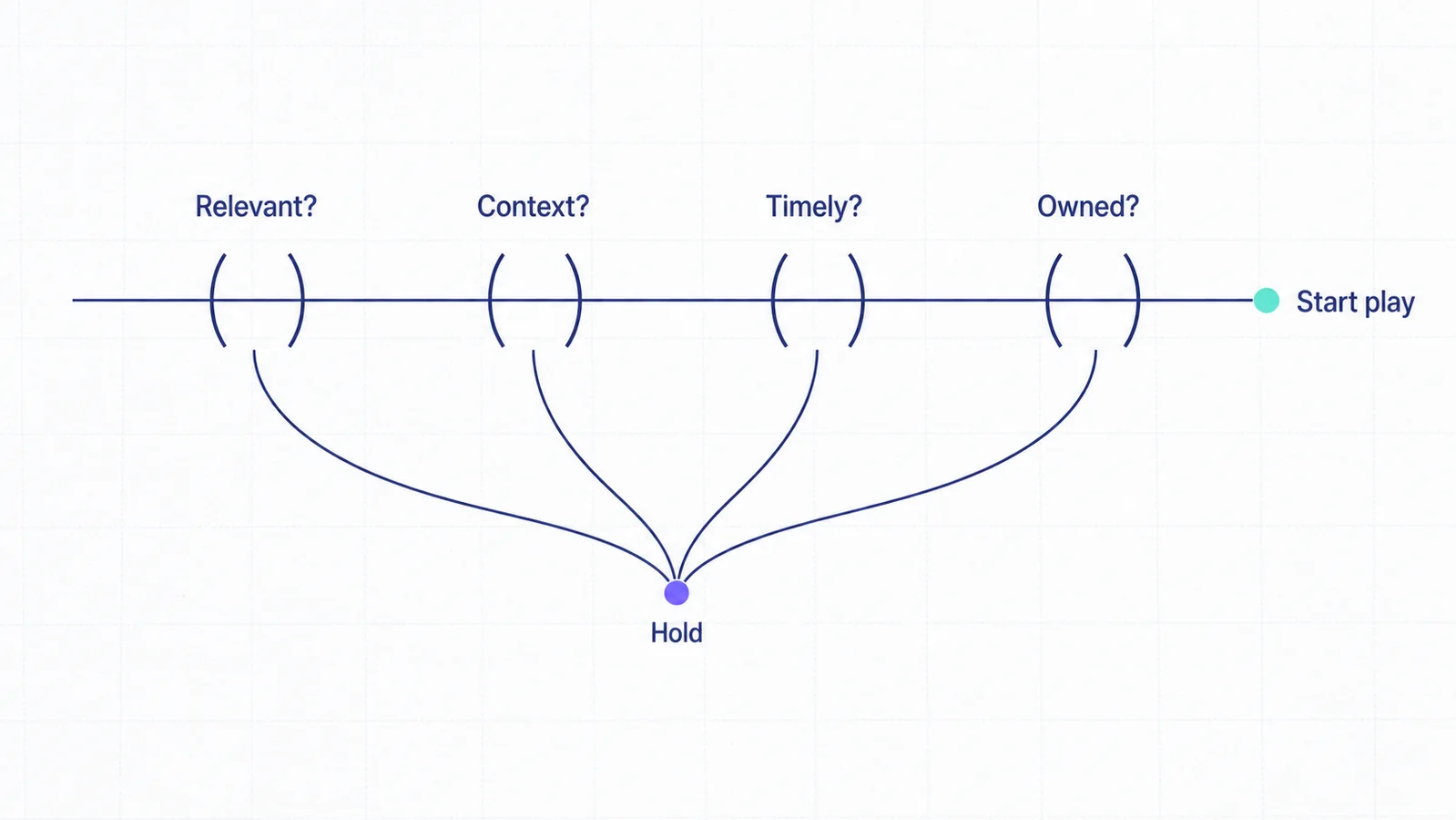
Test each candidate signal with four questions:
- Is it relevant to this segment and lifecycle stage?
- Does it include enough account context to interpret?
- Does it arrive while the team can still act?
- Does one owner know what response follows?
Measure customer progress and business outcomes separately
Use three metric levels.
Customer progress measures show whether the account is moving toward its outcome. Examples include milestone completion, time to value, relevant adoption depth, and achieved use-case results.
Operating measures show whether the model responds well. Examples include accepted play rate, time to owner acceptance, risk resolution, false-signal rate, milestone delay, and outcome recording completeness.
Business outcomes show what happened to the customer base and revenue. Track logo retention, revenue churn, GRR, NRR, and qualified expansion. Use cohort analysis so changing customer mix does not hide a weak segment.
SaaS Capital's 2025 private B2B SaaS survey reported median growth of 15%, 15%, 20%, 30%, 32%, and 44% across ascending NRR bands. Figure 5 excludes companies below $1 million ARR. The association shows why retention and expansion deserve operating attention, but it does not prove that NRR caused growth or that customer success alone produced either result.
Activity counts such as calls, emails, and business reviews can diagnose capacity or coverage. They should not be presented as customer success. A meeting held without customer progress is still a meeting.

A lean 30-day rollout
Week 1: choose one segment and outcome
Select a segment with enough customer evidence to learn from. Write the agreed outcome, lifecycle milestones, and role boundary. Review five recent accounts to test whether the language fits reality.
Week 2: define signals and one play
Choose a single lifecycle moment with visible friction. Define two or three signals, rejection rules, expiry, owner, and possible outcomes. Use existing product, CRM, and support data before buying another platform.
Week 3: run the play manually
Process a small account set. Record why each signal was accepted, rejected, or held. Track the customer response and final state. Manual review exposes missing context faster than automation.
Week 4: review and narrow
Compare customer progress, operating measures, and business outcomes. Remove weak signals. Clarify the handoff. Automate only the stable routing and reminders.
This sequence also fits a product-led sales motion. Product behavior can surface a situation, but a human or automated response still needs a qualified reason and a recorded result.
Common customer success strategy mistakes
Starting with a touchpoint calendar
Calls and QBRs are delivery methods. Begin with the customer outcome and evidence that should change the next action.
Using one health score for every customer
Expected behavior changes by segment, product, use case, and lifecycle stage. Keep separate component logic where those expectations differ.
Making retention a CS-only target
Retention reflects customer fit, sales promises, onboarding, product quality, support, pricing, success, and commercial decisions. Customer success can coordinate signals without owning every cause.
Automating before the play is understood
Automation can route a weak signal faster. It cannot supply missing context or define the right response.
Treating expansion as proof of success
Expansion can follow value, but it can also follow contract structure or temporary demand. Preserve customer outcome evidence and gross retention beside expansion.
Frequently asked questions
What is a customer success strategy?
A customer success strategy defines how a company helps a customer segment reach agreed outcomes after purchase. It connects lifecycle milestones, customer evidence, owned plays, role boundaries, and review cadence.
What should a customer success strategy include?
Include a target segment, agreed customer outcome, lifecycle milestones, leading and lagging signals, triggered plays, accountable owners, handoffs, and a cadence for reviewing customer progress and business outcomes.
How is customer success different from customer support?
Customer success proactively helps accounts reach outcomes across the lifecycle. Customer support responds to questions, defects, and incidents. The teams share context, but their triggers and primary responsibilities differ.
Which customer success metrics should a SaaS company track?
Track customer outcome milestones, time to value, adoption of relevant behaviors, risk resolution, logo retention, GRR, NRR, and expansion qualification. Keep activity counts diagnostic rather than treating them as success.
When should a startup hire its first customer success manager?
Hire when post-sale learning and customer guidance require a dedicated owner, the company can describe the role clearly, and founders can transfer a repeatable starting model instead of a queue of unrelated requests.
Start with one segment, one outcome, one lifecycle moment, and one play. A narrow model with recorded outcomes gives you something real to improve.