


How to build a SaaS customer onboarding process
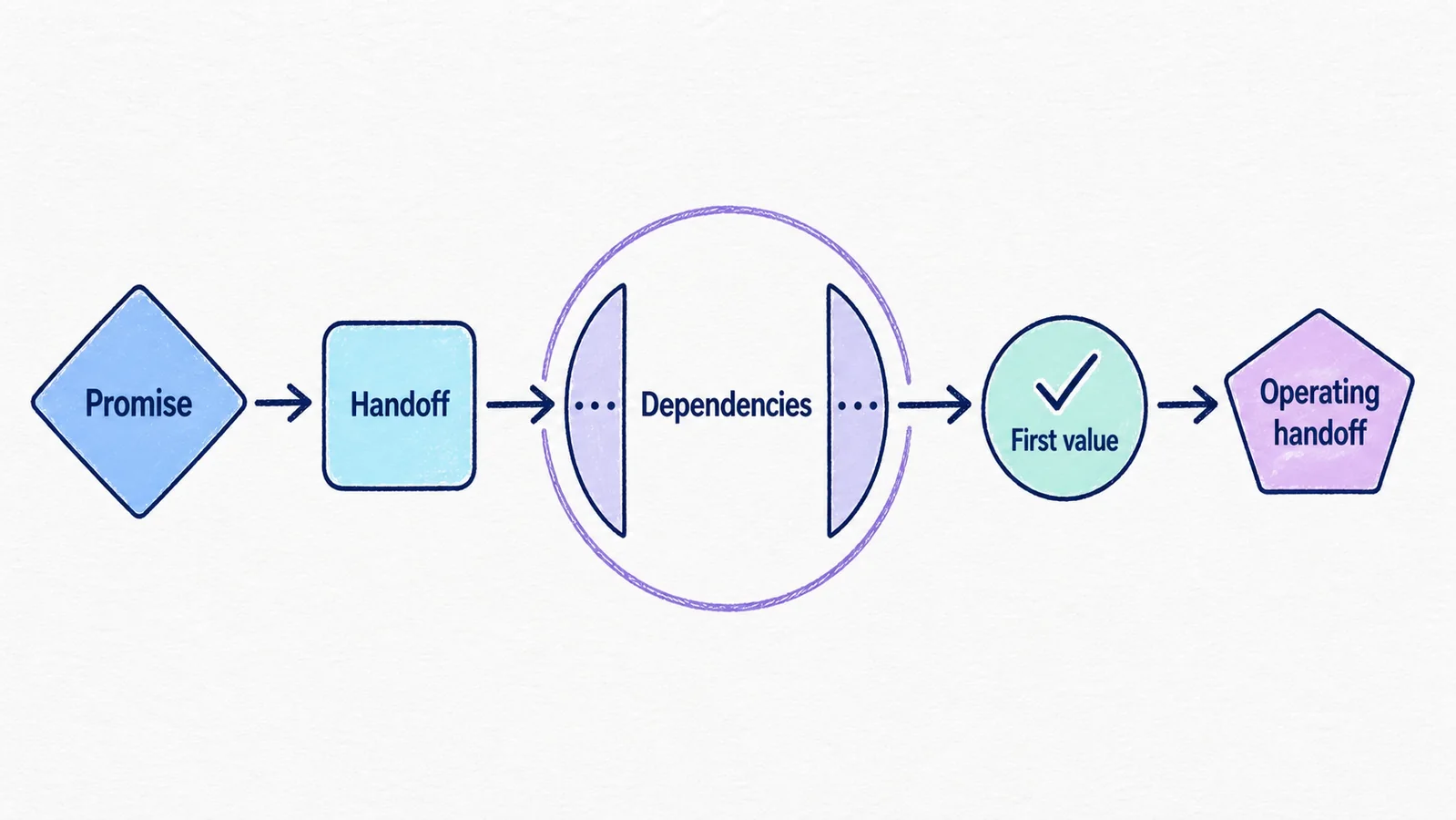
SaaS customer onboarding is the guided path from a defined start event, such as contract signature or account creation, to an agreed first-value event. It includes the context, dependencies, ownership, customer actions, product events, and support required to reach that outcome.
That boundary is stricter than a welcome sequence or setup checklist. A customer can attend training, connect an integration, and complete every assigned task without receiving the outcome they bought. The process succeeds when value evidence is visible and the account can move into its ongoing operating rhythm.
The practical model is to design customer onboarding backward from first value. Then choose the smallest set of steps that can produce that result without ignoring security, data, or stakeholder constraints.
Start with a first-value milestone
The first design decision is the event that stops the onboarding clock. It should describe a customer result, not an internal activity.
For an enrichment platform, first value might be a sales list enriched to an agreed level and accepted by the operator who requested it. For an analytics product, it might be a trusted dashboard populated with the customer's data and used in a real review. For a security product, it might be the first completed policy check with an actionable result.
A good first-value definition has four parts:
- Actor: Who receives or confirms the value?
- Action: What happened in the product or process?
- Evidence: Which event, record, or customer acknowledgement proves it?
- Window: From which start event and within which cohort window is it measured?
Write the milestone as a sentence: "A new revenue operations customer reaches first value when the primary operator imports an eligible account list, completes one enrichment, and accepts the output for live use."
That statement prevents setup from becoming the goal. It also gives time to value a real start and stop event. Gainsight's onboarding guidance similarly frames the process around helping customers realize value and tracking how quickly they get there.
Choose the touch model from the dependency pattern
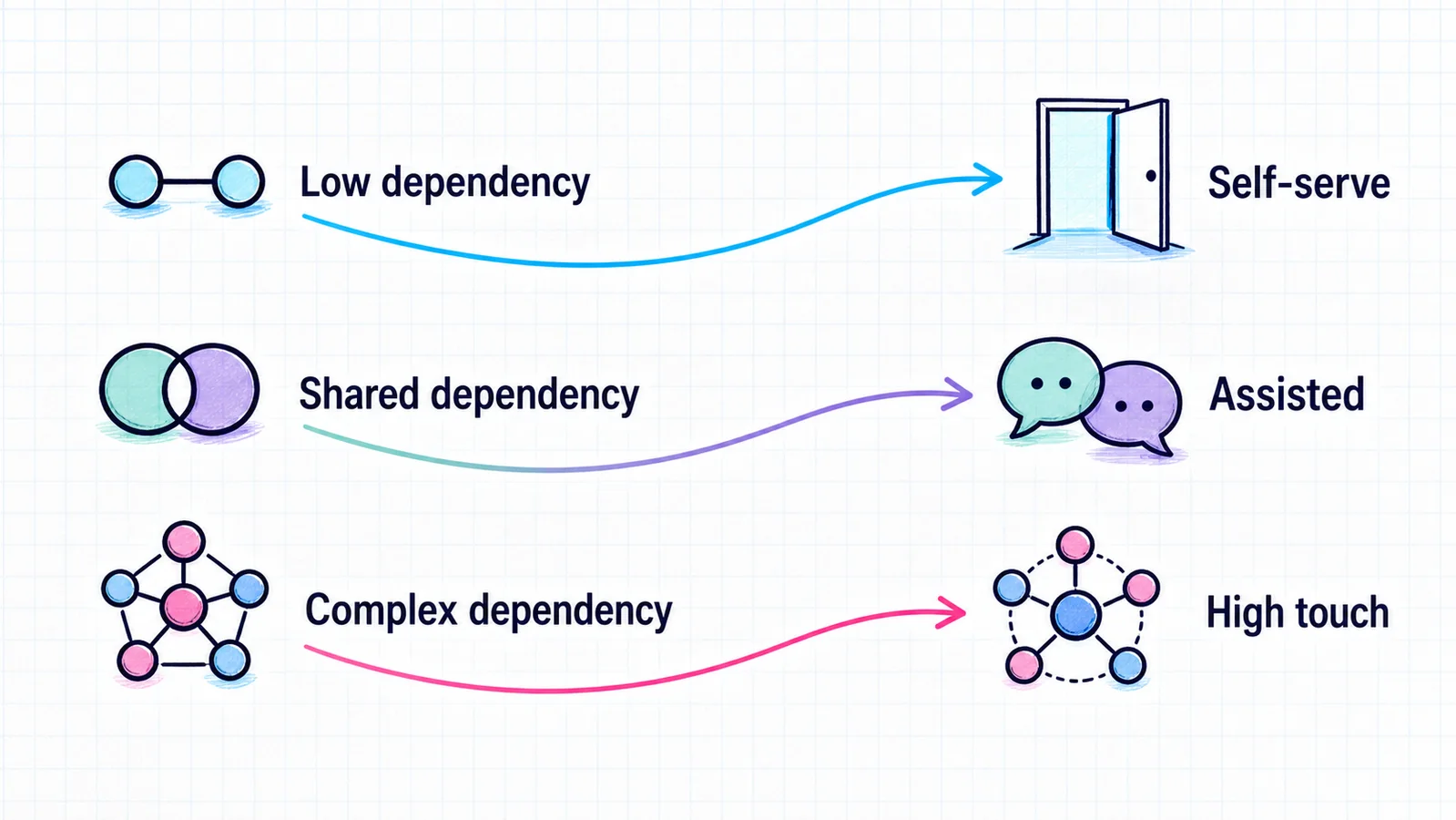
The right touch model depends on how much customer-specific coordination stands between purchase and first value. Annual contract value matters because it constrains delivery cost, but it should not make the decision alone.
| Model | Best fit | Delivery pattern | Main risk |
|---|---|---|---|
| Self-serve | Repeatable value path, low setup risk, one main operator | Product guidance, templates, triggered messages, support on demand | A silent blocker remains invisible |
| Assisted | Shared dependencies or moderate configuration | Product-led path plus scheduled human intervention at key events | Human help becomes an unplanned default |
| High touch | Complex data, security, change, or stakeholder coordination | Named plan, accountable owners, live checkpoints, and exception management | Activity expands without moving first value |
Use the ICP to identify recurring dependency patterns. Two customers of similar size may need different models if one can use a template while the other needs data mapping, security approval, and internal enablement.
The self-serve path also needs an escape route. A behavioral trigger should surface stalled accounts to a human before the customer abandons the attempt. A product-led sales motion can use the same signals to decide when commercial or technical help is useful.
Twilio Segment recommends segmenting onboarding by persona and stage. The useful operator move is to segment by value path and dependency pattern, not merely by job title.
Build the onboarding process in seven steps
1. Lock the sold outcome before the handoff.
Record why the customer bought, the agreed use case, the first-value milestone, key stakeholders, material promises, known risks, and commercial constraints. Do not make the next owner reconstruct the deal from call recordings and CRM notes.
Salesforce's customer-success training calls for an organized sales handoff. Make acceptance explicit: the onboarding owner either accepts the packet or returns it with missing fields.
2. Confirm the outcome with the customer.
Sales context is an input, not final proof. The onboarding owner should confirm the outcome, owner, evidence, and timing with the customer. If the buyer and primary user expect different results, resolve that difference before configuration begins.
Keep the plan visible to both sides. It should state what the vendor owns, what the customer owns, and which decision follows each missed dependency.
3. Map the minimum dependency path.
List every item required before first value, then challenge it. Each dependency should either enable the value event, protect a real risk, or establish the ongoing customer motion.
Common dependencies include data access, integration credentials, user permissions, security approval, configuration choices, source-file quality, and stakeholder availability. Put optional training, advanced features, and secondary use cases after first value unless they are genuinely required.
4. Assign an owner and acceptance rule to every handoff.
A handoff is complete when the receiver acknowledges the payload and owns the next action. Sending an email or changing a CRM stage is not acceptance.
For each transfer, record:
- sender and receiver;
- required context or artifact;
- acceptance criteria;
- due date;
- exception path;
- next observable event.
The account may move among sales, implementation, product, support, and customer success. Stage ownership can change. Accountability cannot disappear between teams.
5. Build guidance around the next required action.
Welcome messages, product tours, calls, checklists, templates, and documentation are useful only when they move a required dependency or value event. Intercom describes welcome and product education as common onboarding components. Treat them as tools inside the process, not proof that the process succeeded.
Trigger guidance from customer state when possible. A user who has imported data but has not mapped required fields needs different help from an account waiting on security approval. Time-based reminders alone cannot make that distinction.
6. Instrument events and exceptions.
Track the declared start event, each required milestone, the first-value event, and the operating handoff. Add reason codes for stalls, returns, and exits. Useful categories include customer input missing, technical defect, data quality, internal approval, stakeholder unavailable, scope mismatch, and no confirmed value.
Keep the taxonomy small enough to use consistently. Free-text notes can provide detail, but a stable reason code lets operators compare cohorts and decide where to intervene.
7. Transfer the account into its ongoing motion.
First value is a transition point. The receiving owner needs the achieved outcome, open risks, stakeholder map, product state, next customer goal, and review date. The next touch may belong to adoption, support, customer marketing, or expansion depending on the account.
Connect that transfer to lifecycle marketing only when behavior and customer context support it. A generic post-onboarding campaign should not replace a known next action.

Measure speed, completion, and failure separately
One metric cannot explain the full process. Use a small measurement set with fixed event definitions.
First-value rate is the share of eligible new accounts that reach the first-value event within a defined window.
First-value rate = Accounts reaching first value / Eligible new accounts x 100
Time to first value is the elapsed time between the declared start timestamp and the first-value timestamp. Report the median and a slower percentile. An average alone can hide a long tail.
Milestone conversion shows how many eligible accounts move from one required state to the next. It identifies the stage where progress stops.
Exception mix groups delays by reason and owner. It tells you whether the highest-friction issue is product setup, customer inputs, sales context, technical reliability, or internal coordination.
Review these measures with cohort analysis. Compare like with like: touch model, use case, segment, product version, start month, or implementation pattern. The broader go-to-market metrics cadence should keep definitions, owners, and review decisions explicit.
Userpilot's public benchmark provides a useful measurement caution. In its first-party subset of 62 B2B SaaS companies using an activation dashboard, median time to value was 1 day 1 hour 54 minutes, while average time to value was 1 day 12 hours 23 minutes. The source reports metric-specific sample and method details, but it does not establish a universal target. Activation events vary by product, and the sample represents Userpilot customers that tracked the metric.

A SaaS onboarding example
Consider a sales analytics platform sold to midmarket revenue teams. The sold outcome is a forecast view that sales leadership trusts for its weekly review.
The start event is the accepted sales handoff. First value occurs when the customer's administrator connects CRM data, the platform passes agreed quality checks, and the sales leader uses the forecast view in a real review.
The critical dependencies are CRM access, field mapping, opportunity-stage definitions, and leader availability. Product training for every rep is not required before first value, so it sits in the next phase.
The implementation owner accepts the sales context. The customer administrator accepts the data tasks. The sales leader accepts the resulting view. If field quality fails, the account enters a data exception path instead of advancing because a kickoff call happened.
That design gives the team observable progress, a defensible TTV calculation, and a clear transfer after the first review.
Common onboarding mistakes
The first mistake is using checklist completion as the primary outcome. A checklist measures assigned activity. It does not prove value.
The second is requiring every possible setup step before the customer sees a result. Advanced permissions, secondary integrations, and broad training often belong after first value.
The third is routing every account through one touch model. This either overspends on simple accounts or leaves complex dependencies unmanaged.
The fourth is treating a sent handoff as an accepted handoff. Missing context then appears later as delay, rework, or customer frustration.
The fifth is reporting one company-wide TTV average. Different start events, value events, segments, and touch models make that number hard to interpret.
Frequently asked questions
What is SaaS customer onboarding?
SaaS customer onboarding is the guided process that moves a new customer from a defined start event to an agreed first-value event, then transfers the account into its ongoing operating motion. It includes product actions, human support, customer dependencies, and evidence of value.
How long should SaaS customer onboarding take?
There is no universal duration. Set the target from the product's real dependency path and the customer's agreed value event. A self-serve tool may reach first value in one session, while an enterprise platform may require data, security, and stakeholder coordination. Compare similar cohorts and inspect the slower tail.
Who should own customer onboarding?
Assign one accountable owner for the current stage and a named owner for every dependency. Customer success often owns the account-level process, while implementation, product, support, sales, and the customer own specific inputs. The ownership model should follow the value path.
What is the difference between customer onboarding and user onboarding?
User onboarding helps an individual understand and use the product. Customer onboarding covers the account-level outcome, including stakeholders, data, approvals, change, implementation, and value evidence. In simple self-serve products, the two may look similar. In B2B platforms, they often differ substantially.
Which SaaS onboarding metrics should a team track?
Track first-value rate, median and slower-percentile time to first value, milestone conversion, exception reasons, and the operating-handoff rate. Define every start and stop event, then segment the results by use case, touch model, and customer cohort.
Start by writing one first-value sentence with an actor, action, evidence, and window. Then remove every pre-value step that does not enable that event, protect a real risk, or establish the next operating motion.