


Sales pipeline management: Stages, reviews, and metrics
Sales pipeline management is the process of keeping every active opportunity in the right stage, identifying risk early, and deciding what should happen next. It covers stage rules, opportunity quality, coverage, aging, inspection, ownership, and corrective action.
A sales pipeline is the set of active opportunities a team may convert into revenue. Managing it is different from maintaining a neat CRM board. A board can be complete and still be unreliable if stages reflect seller confidence, close dates are routinely pushed, or next steps have no buyer commitment.
Salesforce describes pipeline management as tracking and organizing opportunities through the sales process. That is a useful foundation. For a SaaS team, the harder task is making each position in that process evidence-based enough to guide staffing, coaching, and revenue decisions.
What a trustworthy pipeline should show
A trustworthy pipeline answers five questions without requiring a long explanation from the account owner:
- Why is this opportunity in its current stage?
- What buyer evidence supports the expected value and timing?
- What could prevent the deal from progressing?
- What specific event should happen next, with whom and by when?
- What should the team do if that event does not happen?
Those questions separate a pipeline from the wider SaaS sales funnel. The funnel describes how a market and a set of leads narrow over time. The opportunity pipeline describes named commercial decisions that have passed a qualification boundary.
Pipeline management also differs from forecasting. Management changes the condition of opportunities and the quality of the process. Forecasting estimates a future outcome from the available evidence. Better management can improve the input, but it does not remove uncertainty.
Design stages around buyer evidence
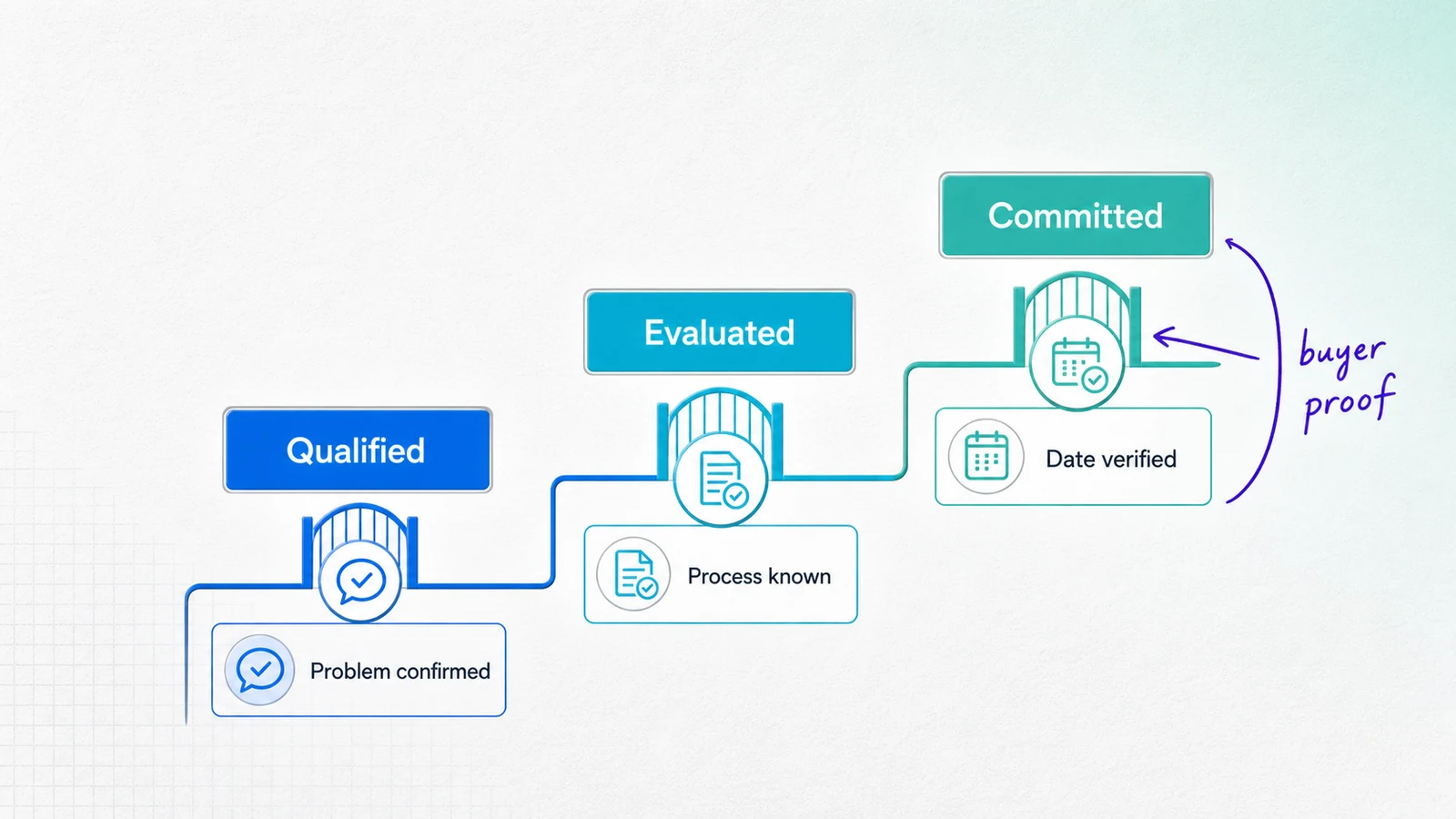
Stage names matter less than stage boundaries. A simple B2B SaaS pipeline might include qualified, discovery complete, solution evaluated, commercial process, and committed. Each stage needs an entry test and an exit test.
An entry test states what must already be true. An exit test states which buyer action or verified condition moves the opportunity forward. For example:
- Qualified: The problem, affected team, plausible value, and access to a relevant contact are confirmed.
- Discovery complete: The buyer has explained the current process, consequence of the problem, and decision context.
- Solution evaluated: The agreed evaluation has happened, and the buyer has responded to the result.
- Commercial process: Price, purchasing steps, legal or security requirements, and decision participants are known.
- Committed: The buyer has confirmed the intended decision and date, while remaining dependencies are explicit.
HubSpot's stage guide shows why teams use different labels and counts. The practical rule is consistency of evidence. A stage should represent a change in the buying process, not the completion of a seller task such as sending a deck.
Do not let probabilities define the stage. A probability is a forecast input. The stage should first describe what has happened. Historical conversion data can then estimate how opportunities with that evidence tend to behave.
Measure coverage without hiding the mix
Pipeline coverage compares the value of relevant open opportunities with the target for a period. The basic formula is:
Pipeline coverage = qualified pipeline value / remaining target
The calculation is easy. Interpreting it is not. One blended multiple can hide a weak enterprise segment, an overfilled low-value segment, or a quarter dominated by opportunities that cannot close in time.
Break coverage down by the dimensions that change conversion behavior:
- segment or ACV band;
- new business versus expansion;
- owner or team;
- expected close period;
- current stage;
- source or motion when the sales process differs materially.
Do not adopt a universal coverage target from a benchmark table. Calculate the coverage your team has historically required for each meaningful segment, then adjust for current capacity, conversion, cycle length, and target mix. If historical evidence is thin, use a range and show the assumptions in the go-to-market plan.
Coverage is a capacity signal, not proof of future revenue. Ten low-quality opportunities do not become safer because their values add up to a large number.
Inspect aging, momentum, and next-step quality
Deal age only becomes useful when compared with a relevant baseline. An enterprise evaluation can be healthy at an age that would make a small self-serve-assisted deal look stalled. Compare time in stage and total cycle time within similar segments.
Use three tests together:
- Age: Has the opportunity remained in the stage longer than comparable won and lost deals?
- Momentum: Has a meaningful buyer action happened recently?
- Next-step quality: Is the next event specific, mutual, dated, and connected to a decision?
“Follow up next week” is not a next step. “Security lead will review the data-flow document with our solutions engineer on Thursday” is testable. The difference is useful because a missed event creates new evidence. A vague reminder creates another reminder.
Gong's pipeline-data guidance emphasizes observable activity and participation signals. Use those signals to challenge stage position, not to replace context. A meeting count alone cannot confirm a buying decision.
Check stakeholder and seller-side coverage
Complex opportunities often fail when the relationship is concentrated in one contact or when necessary specialists join too late. Inspection should ask which buyer roles influence the decision, who has been reached, and whether the seller is relying on a single internal contact to carry the case.
Seller-side participation can also reveal risk. In Gong's analysis of 10,332 deals, adding one seller-side colleague was associated with double the solo-seller win-rate index, while three or more seller-side participants were associated with more than three times the index. The source does not disclose absolute win rates or prove causation.
The useful decision is not “add three people to every deal.” It is to identify important opportunities where product, technical, security, executive, or commercial expertise is missing. Participation should answer a buyer need. Unnecessary attendance can make a simple purchase harder.

Run a weekly pipeline inspection
A pipeline inspection should make decisions. It should not become a round-robin recital of every opportunity.
Start with the shape of the pipeline:
- Coverage by segment and period
- New pipeline created against the amount required
- Conversion movement by stage
- Aging and close-date movement
- Opportunities with weak next steps or concentrated relationships
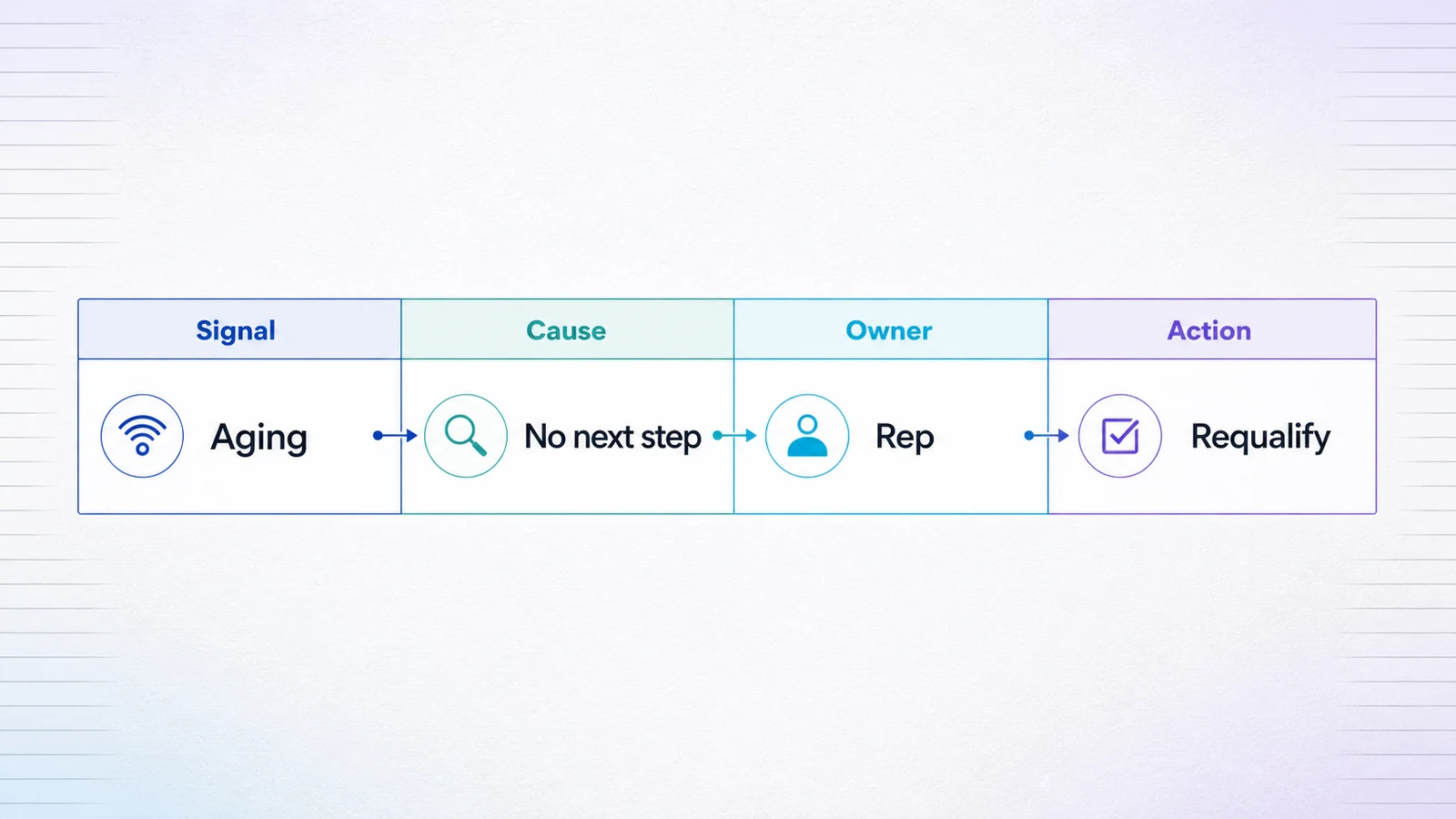
Then inspect exceptions. Select opportunities because a signal changed, not because the owner is next on the call. For each exception, choose one outcome: keep the stage, move it, requalify it, add a resource, change the next step, or close it out.
Signal-based selling provides a useful principle here: an observed change should trigger a relevant response. The same logic applies inside an active pipeline. A missed evaluation, a new executive participant, or a legal delay should alter the plan.
End with an owner and a deadline. At the next review, check whether the intervention changed the evidence. If nothing changes after repeated actions, the stage or close date should not remain protected by optimism.

Assign clear ownership
Account executives own opportunity evidence, next steps, and honest stage placement. Managers own inspection quality, coaching, and decisions about resources. RevOps owns definitions, reporting consistency, automation, and diagnosis of system-level patterns. Leadership owns targets, capacity tradeoffs, and the behavior it rewards.
CRM hygiene should follow those responsibilities. Required fields should exist only when they support a decision, handoff, or analysis. Automation can flag missing dates, unusual age, or absent contacts, but it cannot confirm that a buyer has agreed to the next event.
If reps routinely resist a field, examine whether it has a clear use. If managers ignore the field during inspection, the request for better data will not be credible.
Build the management process in six steps
- Define the opportunity boundary. State what must be true before a lead becomes pipeline.
- Write stage entry and exit tests. Use buyer actions and verified conditions.
- Set the minimum evidence. Keep only fields that support decisions, handoffs, or analysis.
- Establish segmented baselines. Track conversion, time in stage, cycle length, and value by meaningful groups.
- Run exception-based inspections. Focus on changed signals and end with an owned action.
- Revise the rules. When repeated exceptions reveal a bad stage definition or missing handoff, change the process.
An early team does not need months of perfect history before starting. In founder-led sales, the founder can begin with a small number of evidence-based stages, record the reason for each loss, and review every active opportunity weekly. Once patterns emerge, the team can add segmentation and automation.
Common pipeline-management mistakes
- Moving opportunities because the seller completed an activity
- Keeping expired close dates to protect the forecast
- Using one coverage target across unlike segments
- Treating every open opportunity as qualified pipeline
- Reviewing every deal with equal depth
- Measuring activity without checking buyer progress
- Adding fields that managers never use
- Coaching the number instead of diagnosing the cause
The recurring problem is false precision. More fields, probabilities, and dashboards do not make weak evidence reliable.
Frequently asked questions
What is sales pipeline management?
Sales pipeline management is the process of defining opportunity stages, keeping stage placement accurate, inspecting coverage and risk, and choosing actions that help qualified opportunities progress or exit.
How often should a sales pipeline be reviewed?
Most active B2B SaaS teams benefit from a weekly inspection, with faster checks near period end or when the sales cycle is short. The cadence should match how quickly evidence can change and how quickly the team can respond.
What are the most useful sales pipeline metrics?
Start with qualified pipeline created, segmented coverage, stage conversion, time in stage, sales-cycle length, close-date movement, next-step quality, and win rate. Interpret each metric within comparable segments.
What is the difference between pipeline management and forecasting?
Pipeline management improves opportunity evidence and directs action. Forecasting estimates a future result from that evidence. They share data, but they answer different questions.
How much pipeline coverage does a SaaS team need?
There is no universal multiple. Use historical conversion and cycle data for comparable segments, then account for the remaining target, time available, capacity, and current opportunity quality.
Start with one stage rule
Choose one current stage and write its exit test in plain language. Review every opportunity in that stage against the test. The resulting disagreements will show where the pipeline needs clearer evidence, better coaching, or a different stage design.