


How to build an expansion revenue strategy for SaaS
An expansion revenue strategy is the operating plan for increasing recurring revenue from existing customers. It connects a customer's proven value and changed needs to a relevant upgrade, added usage, additional seats, or an adjacent product. It also defines who acts, when they act, and how the result is measured.
The strategy should produce qualified opportunities, not a list of accounts due for a quarterly check-in. A calendar can start an account review. It cannot prove that a customer needs to buy more.
Know what counts as expansion
Expansion revenue is additional revenue from an existing customer. For a subscription company, it often appears as expansion MRR or ARR. Stripe separates expansion MRR into increases such as plan upgrades, added features, additional usage, and reactivation, while noting that an unchanged renewal is not expansion.
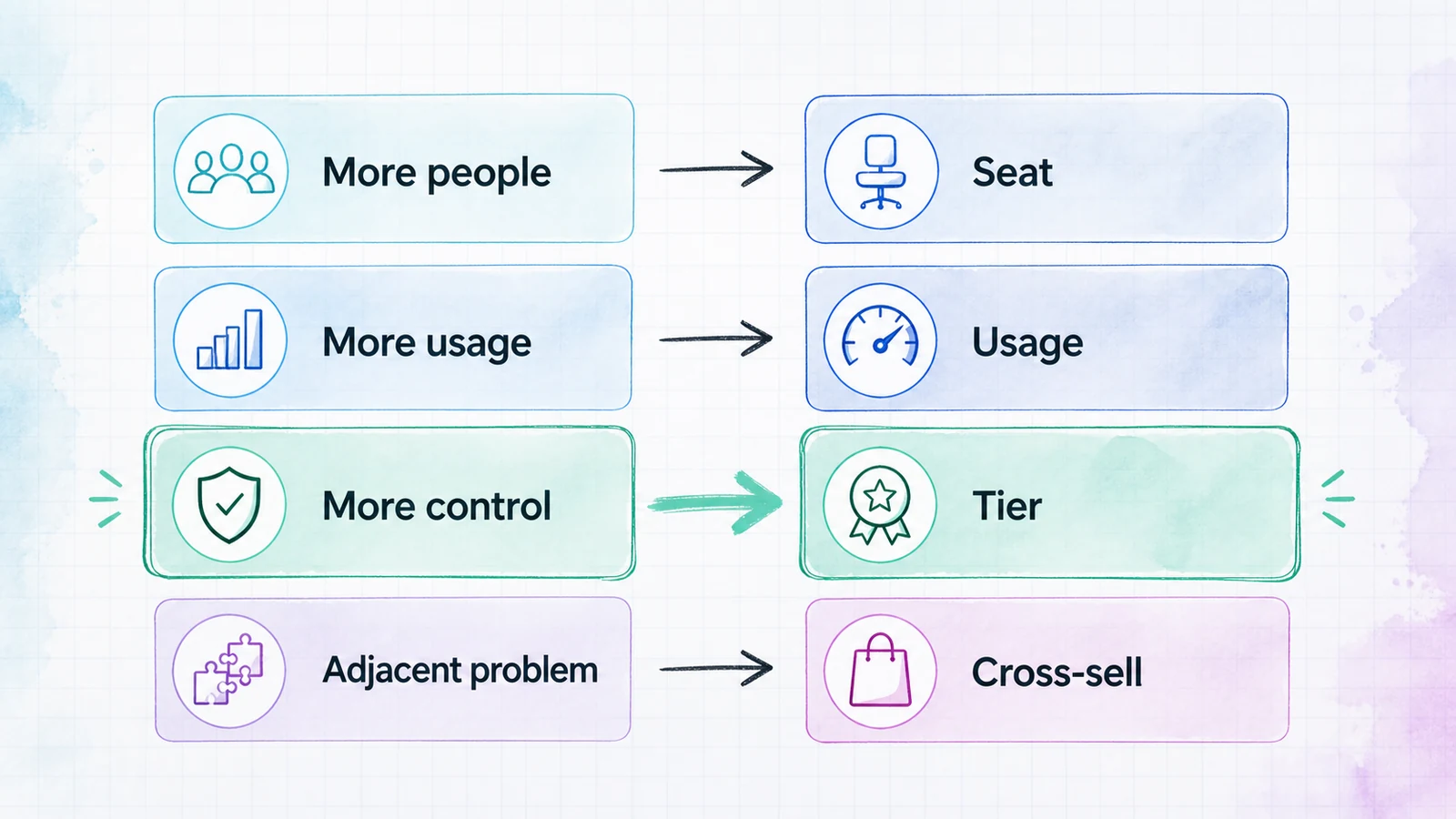
The common motions are:
- Seat expansion: More people need access.
- Usage expansion: The customer consumes more data, transactions, credits, or capacity.
- Tier upgrade: The customer needs stronger limits, governance, security, support, or service.
- Add-on: The customer needs one additional capability without changing the main plan.
- Cross-sell: The customer has an adjacent problem that another product can solve.
- Multi-team rollout: A proven use case spreads from one team, region, or business unit to another.
These motions require different evidence. Seat utilization can support a seat expansion. It says little about whether the buyer needs a second product. A request for enterprise controls may support a tier upgrade even when usage is flat.
Expansion starts with a credible path to more value
A SaaS company cannot create a repeatable expansion motion through customer-success effort alone. The product and commercial model need room for customers to receive more value and pay for it.
Check four conditions before setting an expansion target:
- Customers receive repeatable value. Retention and adoption show that the initial promise is being delivered.
- The account can develop a larger need. More users, usage, complexity, teams, or adjacent problems can emerge.
- The pricing model captures that change fairly. The value metric, packages, and contract terms create a sensible path upward.
- The company can detect the change. Product, billing, CRM, support, and conversation data expose useful signals.
If gross revenue retention is weak, an expansion push can hide the real problem. A few large upgrades can lift NRR while many customers downgrade or leave. Review both metrics. NRR includes expansion, contraction, and churn. GRR excludes expansion and shows how much starting revenue stayed.
For a young SaaS company, new customers still matter because there may not be a large installed base to expand. Expansion becomes a larger growth input as the customer base and product surface mature. ChartMogul's study of 6,525 software companies found that its outlier cohort received 15.4% of net-new MRR from expansion at $1M ARR and 34.7% at $20M ARR. That change describes the cohort. It does not establish a universal target or prove that expansion caused those companies to scale.

Build the expansion operating model
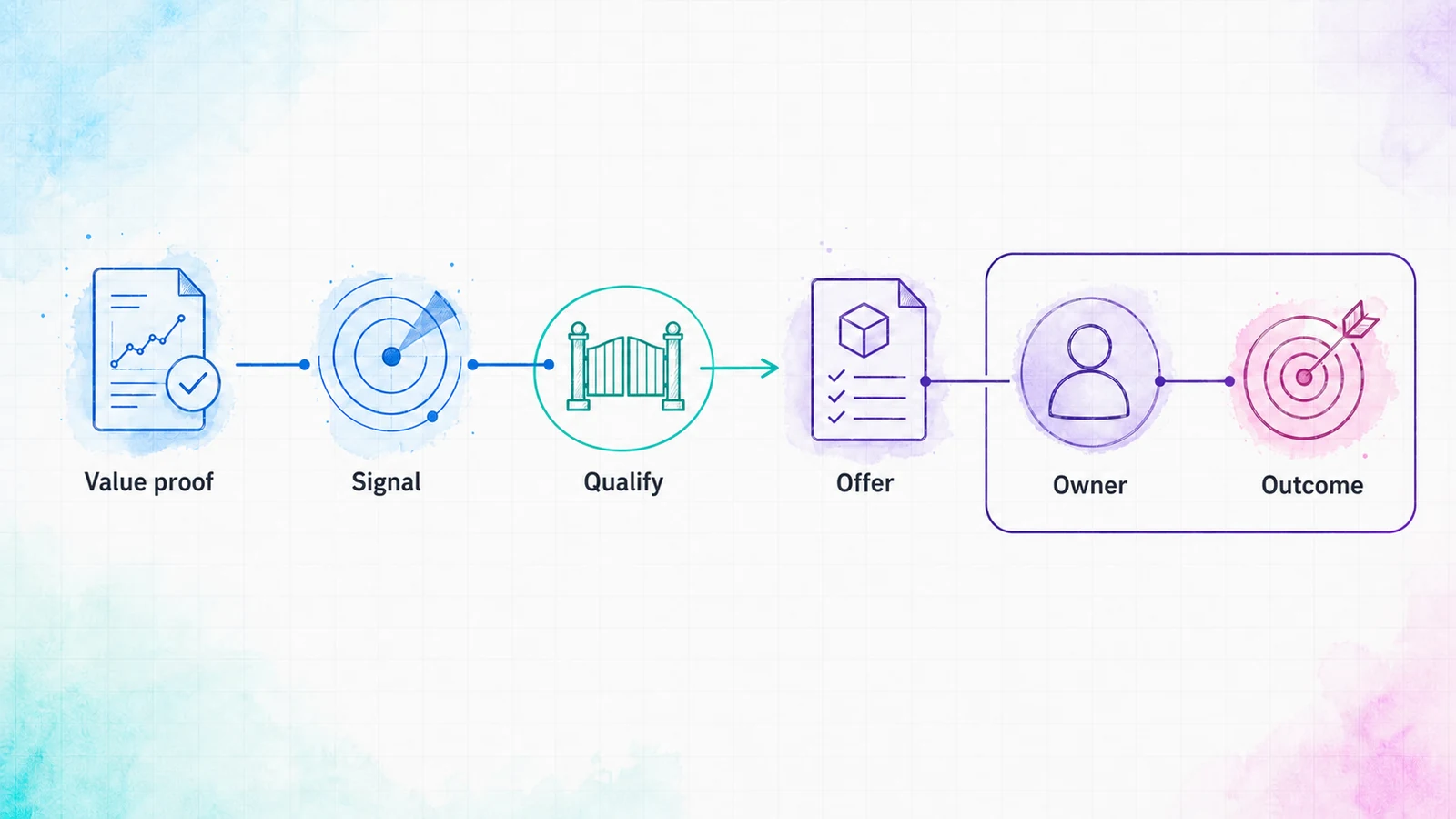
The model has six connected parts: surface, signal, qualification, offer, owner, and outcome.
1. Map the expansion surfaces
List every legitimate reason an existing customer could spend more. Tie each reason to a customer change rather than an internal revenue target.
| Customer change | Expansion surface | Example |
|---|---|---|
| More people need the product | Seats | A support team adds 20 agents |
| Usage grows with customer activity | Consumption | API calls cross a sustained threshold |
| Risk or complexity increases | Tier | The account needs SSO and audit logs |
| A neighboring problem becomes active | Cross-sell | A CRM customer needs enrichment |
| A proven use case spreads | Multi-team | One regional team expands company-wide |
Remove surfaces that do not add clear customer value. If an upgrade only removes an artificial restriction, it may increase short-term revenue while weakening trust and churn rate.
2. Define evidence of readiness
For each surface, write down the observable change that could make an expansion relevant. Use several evidence families:
- Product usage: sustained activity, limit proximity, feature depth, or multi-user adoption.
- Customer outcomes: a confirmed result, completed implementation, or repeated use case.
- Account change: team growth, new region, acquisition, leadership change, or compliance requirement.
- Conversation evidence: the customer names a new goal, constraint, budget, or stakeholder.
- Commercial evidence: contract timing, current ACV, procurement path, and existing terms.
A signal is a reason to inspect the account. It is not permission to pitch.
3. Add a qualification rule
Qualification keeps the queue useful. A simple rule can require:
- Evidence that the customer has received value.
- A specific changed need.
- A matching expansion surface.
- A relevant stakeholder.
- No unresolved adoption, support, or renewal risk that should come first.
- A timing reason for acting now.
The last rule prevents an expansion queue from becoming a second list of every healthy account. Gainsight's customer expansion model uses account health and customer-success-qualified leads to surface and hand off opportunities. The portable idea is not the software. It is the explicit transition from observed evidence to an accepted commercial opportunity.
4. Match the offer to the need
The offer should resolve the change that triggered the opportunity.
If usage is rising, show how the next capacity level supports that growth. If more teams are joining, show the administration and collaboration benefits of a broader rollout. If the customer has a new adjacent problem, confirm the problem before introducing a cross-sell.
Packaging sets the commercial path. A flat plan with no natural expansion dimension forces the team to manufacture upgrades. A value metric that grows with customer outcomes can make expansion easier to understand, but only when the customer sees the connection between additional spend and additional value.
5. Assign ownership and handoffs
Expansion often crosses product, customer success, account management, sales, finance, and RevOps. Shared participation is normal. Shared accountability is not.
Use one accountable owner for each opportunity:
- Product owns automatic, self-serve usage expansion.
- Customer success identifies needs and protects outcome context.
- Sales or account management owns negotiated upgrades and cross-sells.
- RevOps owns definitions, routing, pipeline fields, and reporting.
- Finance owns revenue recognition and commercial-policy controls.
Define the handoff in fields, not meeting folklore. Capture the signal, evidence, customer goal, stakeholder, proposed motion, risk, owner, and next action. The receiving owner should accept or reject the opportunity. Rejections need a reason so the qualification rule can improve.
6. Record the outcome
Every qualified signal should end as won, lost, deferred, disqualified, or returned to customer success. Record why. A lost cross-sell because the problem was weak is different from a deferred upgrade waiting on budget.
This outcome data turns scattered activity into a learning loop. It tells you which signals predict expansion, which offers fit, and where handoffs fail.

Measure expansion without hiding retention
Start with a small hierarchy:
- Expansion MRR or ARR: Added recurring revenue from existing customers.
- Expansion pipeline: Qualified potential expansion revenue by stage and expected date.
- Expansion conversion: Won opportunities divided by qualified opportunities, segmented by play.
- Time to expansion: Time from the qualifying event or initial purchase to the increase.
- Expansion CAC: Sales and marketing expense associated with expansion divided by expansion ARR.
- NRR and GRR: Net and gross views of the installed base.
- Contraction and churn: Revenue lost through downgrades and cancellations.
Use consistent periods and cohorts. MRR is useful for monthly subscription movement. ARR can provide the annualized view. Do not mix bookings, invoiced revenue, and recognized revenue under one expansion label.
Benchmarks need context. Benchmarkit's 2025 study of more than 500 B2B SaaS companies reported a 40% median contribution from expansion ARR to total new ARR. It also reported a $1.00 median expansion CAC ratio versus $2.00 for new-customer CAC ratio. Company size, ACV, pricing, and participant mix affect those values. Compare your segments and plays before treating an aggregate as a target.
Review LTV:CAC ratio beside expansion efficiency. Expansion can improve customer economics, but a high NRR does not excuse poor acquisition quality or weak GRR.
A practical 30-day setup
Week 1: choose one motion
Pick one segment and one expansion surface. Use a motion with visible customer evidence, such as sustained seat utilization or a clear governance need. Define the added value and commercial offer.
Week 2: define signals and qualification
Select two or three signals. Add expiry windows, required context, and rejection rules. Review recent accounts manually to see whether the rules surface real opportunities.
Week 3: assign the handoff
Define the accountable owner, required fields, acceptance rule, and next-action deadline. Create one pipeline view for expansion rather than mixing unqualified signals into the new-business pipeline.
Week 4: run and review
Process a small account set. Review accepted, rejected, won, lost, and deferred outcomes. Change the signal or qualification rule only when the evidence supports it.
This sequence is deliberately narrow. A SaaS growth strategy should address the current constraint. Expansion deserves priority when retained customers have a larger need and the company can serve it well.
Common expansion mistakes
Treating health as buying intent
A healthy customer may be satisfied at the current level. Require a changed need, not only a positive score.
Asking customer success to sell every account
Customer success should preserve outcome context. Commercial ownership can shift to sales when negotiation, procurement, or multi-product design becomes complex.
Measuring NRR alone
High expansion can mask downgrades and logo loss. Keep GRR, contraction, and churn visible.
Building plays before packaging
If the pricing and product model have no credible path upward, more outreach will not create a durable motion.
Automating before learning
Manual review exposes false signals and unclear handoffs. Automate after the team can explain why the play succeeds or fails.
Frequently asked questions
What is an expansion revenue strategy?
An expansion revenue strategy defines how a company increases recurring revenue from existing customers through relevant upgrades, seats, usage, add-ons, or cross-sells. It connects signals, qualification, ownership, offers, handoffs, and measurement.
When should a SaaS company prioritize expansion?
Prioritize expansion after a customer segment receives repeatable value and the product has a credible path for customers to buy more. Companies still searching for retention or product-market fit should fix those conditions first.
Who should own expansion revenue?
Ownership should follow motion complexity. Product can own self-serve usage expansion, customer success can identify and qualify needs, and sales or account management can own negotiated commercial changes. One person should remain accountable for each opportunity.
Which signals indicate a customer is ready to expand?
Useful signals include sustained usage near a plan limit, more teams adopting the product, a newly stated business goal, requests for governance or security, growing stakeholder participation, and a confirmed adjacent problem. Each signal still needs value evidence and account context.
How should expansion revenue be measured?
Track expansion MRR or ARR, qualified expansion pipeline, conversion by play, time to expansion, and expansion CAC. Review those beside NRR, GRR, contraction, and churn so successful upgrades cannot hide customer loss.
Start with one segment, one expansion surface, and one accepted handoff. Thirty reviewed accounts will teach you more than a large automated queue with no qualification history.