


How to design a SaaS sales compensation plan
A SaaS sales compensation plan is a written contract that connects credited results to variable pay. A defensible plan states what the company is trying to change, which role can influence that result, what event earns credit, how quota is assigned, what the seller earns at target, and how exceptions are handled.
Design those decisions in order. Starting with a fashionable pay mix or commission rate creates a formula before the company has defined what it wants to buy from the role.
Keep the core terms separate
Compensation design becomes unreliable when six different numbers are treated as synonyms.
| Term | What it means | What it does not mean |
|---|---|---|
| Company target | The aggregate business outcome leadership wants | An individual seller's assignment |
| Sales quota | A time-bound expectation assigned to a seller, territory, or team | The likely result |
| Sales forecast | The current evidence-based estimate of what will happen | The desired result or assigned expectation |
| Base pay | Fixed salary for the role | Total compensation at target |
| Variable pay | Compensation earned under the plan formula | Guaranteed salary |
| On-target earnings | Base pay plus target variable pay at 100% attainment | Base pay plus an extra OTE amount |
Targets guide resource planning. Quotas assign expectations. Forecasts change as evidence changes. A seller can miss quota while the forecast remains accurate, or hit quota after an earlier forecast proved too low. Sales forecast accuracy measures the estimate, not the compensation assignment.
Design the plan in sequence
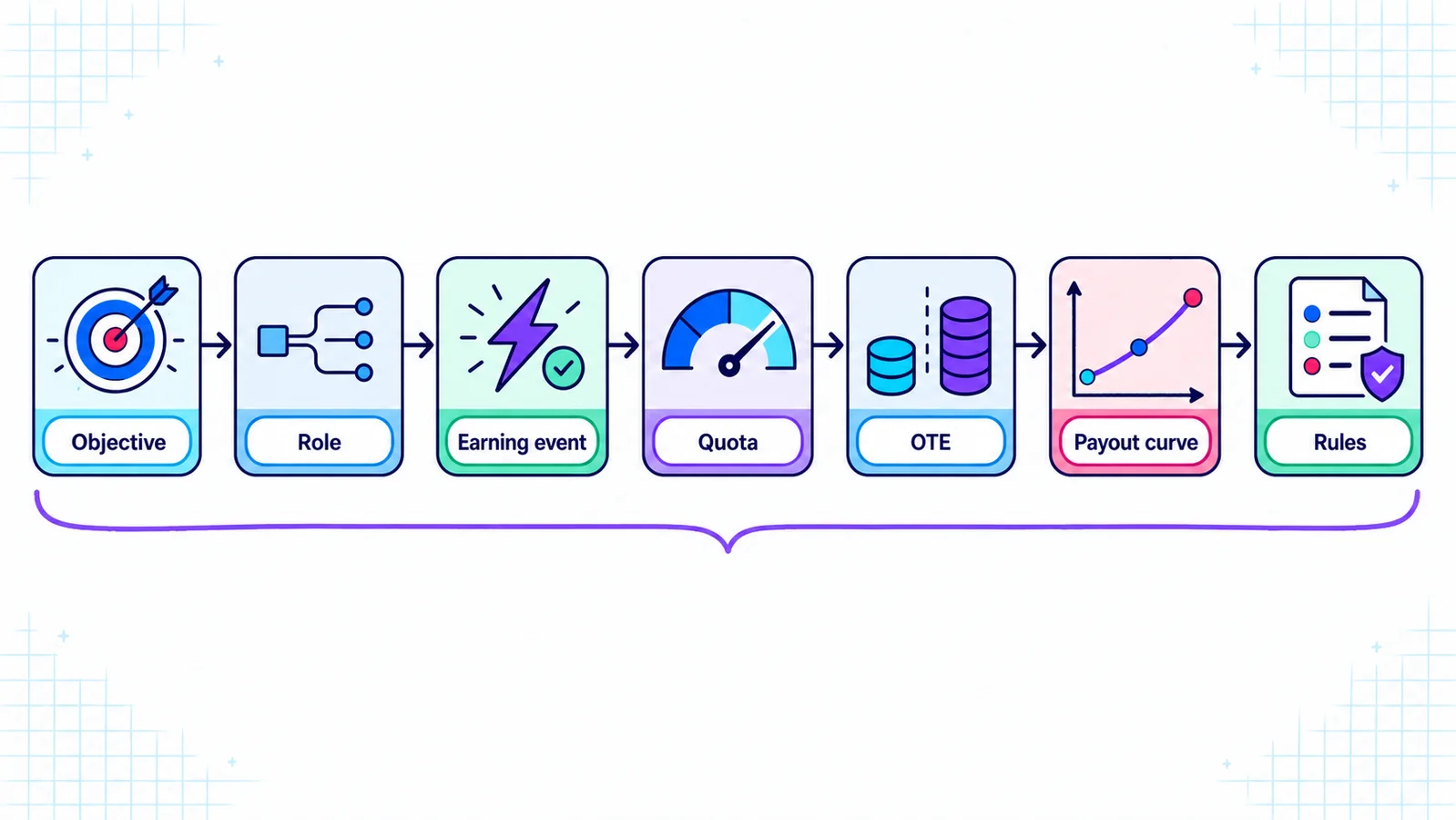
The design sequence is a dependency chain:
- Name the business objective.
- Define the role and the result it can influence.
- Choose the earning event and source record.
- Set quota from capacity, territory, and ramp assumptions.
- Set market-relevant OTE and pay mix.
- Derive the rate and payout curve.
- Write timing, credit, reversal, and exception rules.
- Test representative scenarios before launch.
Salesforce's compensation overview names many of the same components, including quota, accelerators, decelerators, clawbacks, and OTE. The important design choice is how those components connect for one specific role.
Start with one business objective
Choose the behavior the company is willing to pay for. New-logo ARR, expansion ARR, retained ARR, qualified opportunities, gross margin, and cash collection represent different outcomes. Combining several in one plan can create conflicting incentives.
The objective also needs a quality constraint. Paying only for booked ARR can reward discounts, weak-fit customers, or unusual contract terms. The plan might therefore define eligible ARR, require an approved price floor, or delay part of the payout until a verifiable event. The constraint should address a real failure mode, not add decorative complexity.
Design by role
An SDR can control qualified meetings more directly than closed revenue. An AE can influence new bookings but may have little control over implementation. An account manager may own expansion, renewal, or both. A manager may be measured on team attainment rather than individual deals.
| Role | Plausible primary measure | Boundary to define |
|---|---|---|
| SDR | Accepted qualified opportunity | Acceptance criteria and rejection window |
| New-business AE | Eligible new ARR or ACV | Credit date, discount rules, and split ownership |
| Account manager | Expansion and retained revenue | Renewal baseline and churn ownership |
| Sales manager | Team quota attainment | Ramp vacancies, transfers, and overlay credit |
One plan should not force every role onto the same measure simply because all four roles touch revenue.
Choose a measure the seller can influence
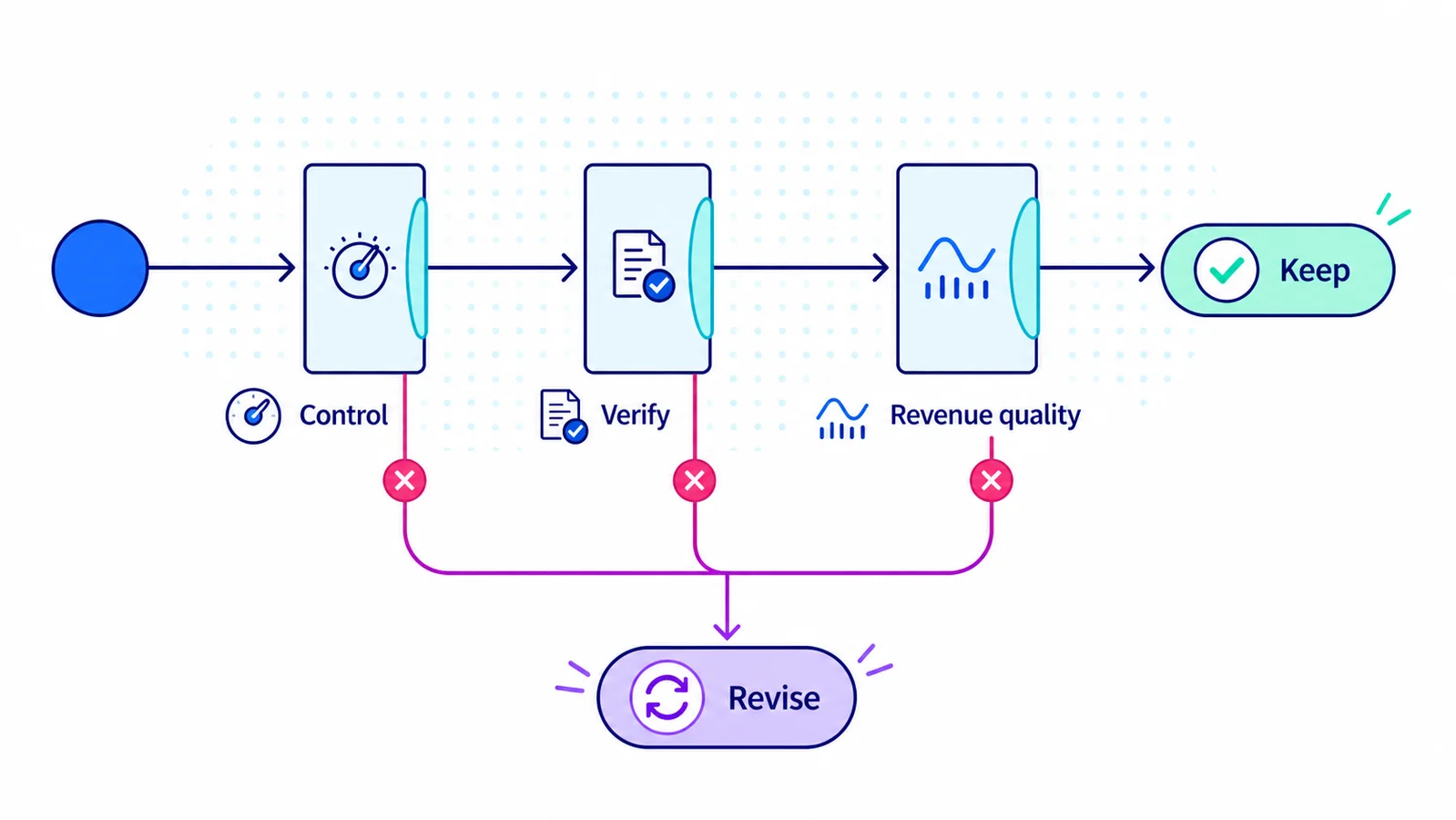
The earning event is the hinge of the plan. Test each proposed measure against three questions:
- Can the seller materially influence it?
- Can Finance verify it from a named source?
- Does it support the intended revenue quality?
For a SaaS AE, contract signed, booking approved, first invoice paid, and customer live are different events. Each shifts timing and risk between the company and seller. A long implementation delay makes go-live a weak primary event when the AE does not control onboarding. Paying at signature without cancellation rules can leave the company carrying avoidable risk.
Define the eligible measure, currency, contract treatment, product exclusions, discount policy, credit date, source system, and approval owner. If Sales and Finance can read the same deal record and calculate different credit, the earning rule is incomplete.
Set quota from capacity, not the forecast
Start with the company target, then model what each territory and role can reasonably carry. Use historical win rates, deal size, cycle length, available accounts, ramp time, seasonality, product constraints, and planned headcount. Sales pipeline management supplies evidence for capacity, while sales forecasting methods estimate the likely outcome from current evidence.
Do not set the quota equal to the latest forecast. The quota is an assigned expectation for a defined period. The forecast should move when pipeline evidence changes. Rewriting quota every time the forecast changes destroys the baseline used for performance and pay.
Document how quota changes for a mid-period start, leave, territory transfer, open role, or material product interruption. The rule should exist before an exception occurs.
Connect OTE, pay mix, and the target rate
OTE has two parts:
OTE = Base pay + Target variable pay at 100% attainment
Base pay is fixed. Target variable pay is the amount available when the seller reaches the stated quota under the stated plan. Actual variable pay can be lower or higher. OTE is therefore not guaranteed annual compensation.
Pay mix describes the split between base and target variable pay. A 50/50 mix may appear often in benchmark material, but it is not a rule. More variable exposure is easier to defend when the seller has direct control, a shorter feedback loop, reliable territory potential, and measurable credit. More base exposure fits roles with shared outcomes, long cycles, or substantial non-selling responsibilities.
An older QuotaPath survey found that 50% of OTE was the most common base-pay share among its respondents. The survey covered more than 300 people in Sales, RevOps, and Finance in August 2022. Treat that as historical market context, not a prescribed split.
For a linear revenue plan, the target commission rate is:
Target commission rate = Target variable pay / Quota
The formula connects the earning promise to the assigned expectation. If the quota changes but target variable pay does not, the rate changes. If OTE changes while quota stays fixed, the rate changes. Those effects should be intentional.
Write payout and exception rules
A rate alone is not a complete plan. State whether the payout curve includes a threshold, decelerator, accelerator, cap, or bonus. For each tier, say whether the higher rate applies only to the amount above the threshold or retroactively to all credited revenue.
Accelerators reward results beyond quota. Use them when the company wants more of the same eligible outcome and can support the added commission cost. Avoid rewarding volume beyond a point where discounting, service capacity, or customer quality becomes harmful.
Define these rules in plain language:
- When commission is earned, approved, and paid.
- How split credit and overlays are calculated.
- How multi-year, usage-based, expansion, and renewal deals are treated.
- What happens after cancellation, nonpayment, refund, or contract reduction.
- How transfers, departures, leave, and territory changes affect credit.
- Which source record controls and who resolves disputes.
The U.S. Department of Labor notes that commissions may be paid in addition to salary or instead of salary, while the Fair Labor Standards Act does not itself require commissions. State rules and employment terms can add material requirements. Have qualified counsel review earning, deduction, reversal, and termination language for every jurisdiction where sellers are employed.
Model the plan before launch
Consider a hypothetical new-business AE plan:
- Annual new-ARR quota: $800,000
- Base pay: $90,000
- Target variable pay: $90,000
- OTE: $180,000
- Rate through 100% attainment: 11.25%
- Marginal rate above 100%: 16.875%, a 1.5x accelerator
| Attainment | Credited new ARR | Variable pay | Total cash pay |
|---|---|---|---|
| 80% | $640,000 | $72,000 | $162,000 |
| 100% | $800,000 | $90,000 | $180,000 |
| 120% | $960,000 | $117,000 | $207,000 |
At 120%, the first $800,000 earns $90,000. The next $160,000 earns 16.875%, or $27,000. This is a marginal accelerator. A retroactive accelerator would produce different economics.
These figures illustrate plan arithmetic, not market benchmarks. Backtest the proposed formula against historical deals and hypothetical edge cases. Include one large deal, a split deal, an early cancellation, a heavily discounted contract, a mid-year transfer, and performance far below and above quota. Compare payout cost with the gross margin and revenue quality the company wants. SaaS pricing strategy matters here because compensation can reinforce or undermine packaging and discount discipline.

Issue one written plan
The final document should include definitions, effective dates, quota, eligible measures, crediting rules, formula, tiers, examples, payout timing, exception rules, dispute process, amendment policy, and acknowledgement. Name the system and field that control each calculation.
Give sellers examples they can reproduce. Managers, Finance, and the plan owner should use the same version. Sales enablement strategy should cover the manager conversation and calculator, but it cannot replace precise plan language.
Review the plan as a distribution
Review attainment, payout, and behavior at a regular cadence. The Bridge Group's 2026 study reported 48% of reps at quota across 158 B2B companies, down from 51% in its 2024 edition. The online survey ran in Q1-Q2 2026. It is observational research from a self-selected B2B sample, not a universal healthy-attainment threshold and not evidence that compensation design caused the change.
Inspect the distribution by ramp status, territory, segment, manager, and tenure. Then review:
- Variable payout as a share of eligible revenue and gross margin.
- Revenue quality, discounting, contract term, and early churn.
- Concentration of earnings in a few unusually large deals.
- Credit disputes, manual adjustments, and payment errors.
- Seller ability to predict payout from the plan.
Go-to-market metrics need clear definitions, owners, and actions. Compensation metrics deserve the same discipline. A low-attainment team may have an unrealistic quota, weak territories, poor pipeline, a product issue, or a hiring problem. The distribution tells you where to inspect; it does not supply the diagnosis by itself.

Common mistakes
The first mistake is choosing the commission rate before defining the earning event and quota.
The second is paying a role on an outcome it cannot control. That turns variable pay into volatility rather than a usable incentive.
The third is treating the company target, assigned quota, and forecast as one number. They serve different planning and accountability purposes.
The fourth is advertising OTE without showing how 100% attainment produces the target variable amount.
The fifth is adding several modifiers before testing the base formula. Complexity increases disputes and makes seller behavior harder to predict.
The sixth is changing rules after results are known. Prospective changes with effective dates preserve a stable earning contract.
Frequently asked questions
What should a SaaS sales compensation plan include?
Include the role, eligible measure, earning event, quota, base pay, target variable pay, OTE, target rate, payout curve, payout timing, crediting rules, reversals, edge cases, dispute process, examples, and effective dates.
How should quota and OTE connect?
At 100% quota attainment, the formula should produce the target variable pay. Add that amount to base pay to get OTE. The connection must be mathematically reproducible from the written plan.
Does every SaaS AE plan need a 50/50 pay mix?
No. Choose the mix based on role control, cycle length, territory reliability, shared responsibilities, and the hiring market. Benchmark data can frame the decision, but it cannot replace the role economics.
How should sales accelerators be structured?
State the threshold, higher rate, eligible measure, and whether the rate is marginal or retroactive. Model the cost at several attainment levels and confirm that added payout still rewards revenue the company values.
How often should a sales compensation plan be reviewed?
Inspect attainment, payout cost, revenue quality, and disputes during the year, then run a full design review before the next plan period. Use prospective amendments when a material assumption changes. Everstage's SaaS compensation guide also recommends recurring review, but the cadence should match your sales cycle and payroll process.
Start with one role and one earning event. Write the formula, model six edge cases, and ask Sales and Finance to calculate the same payout independently. Any disagreement identifies the next rule to clarify.