


Sales qualification
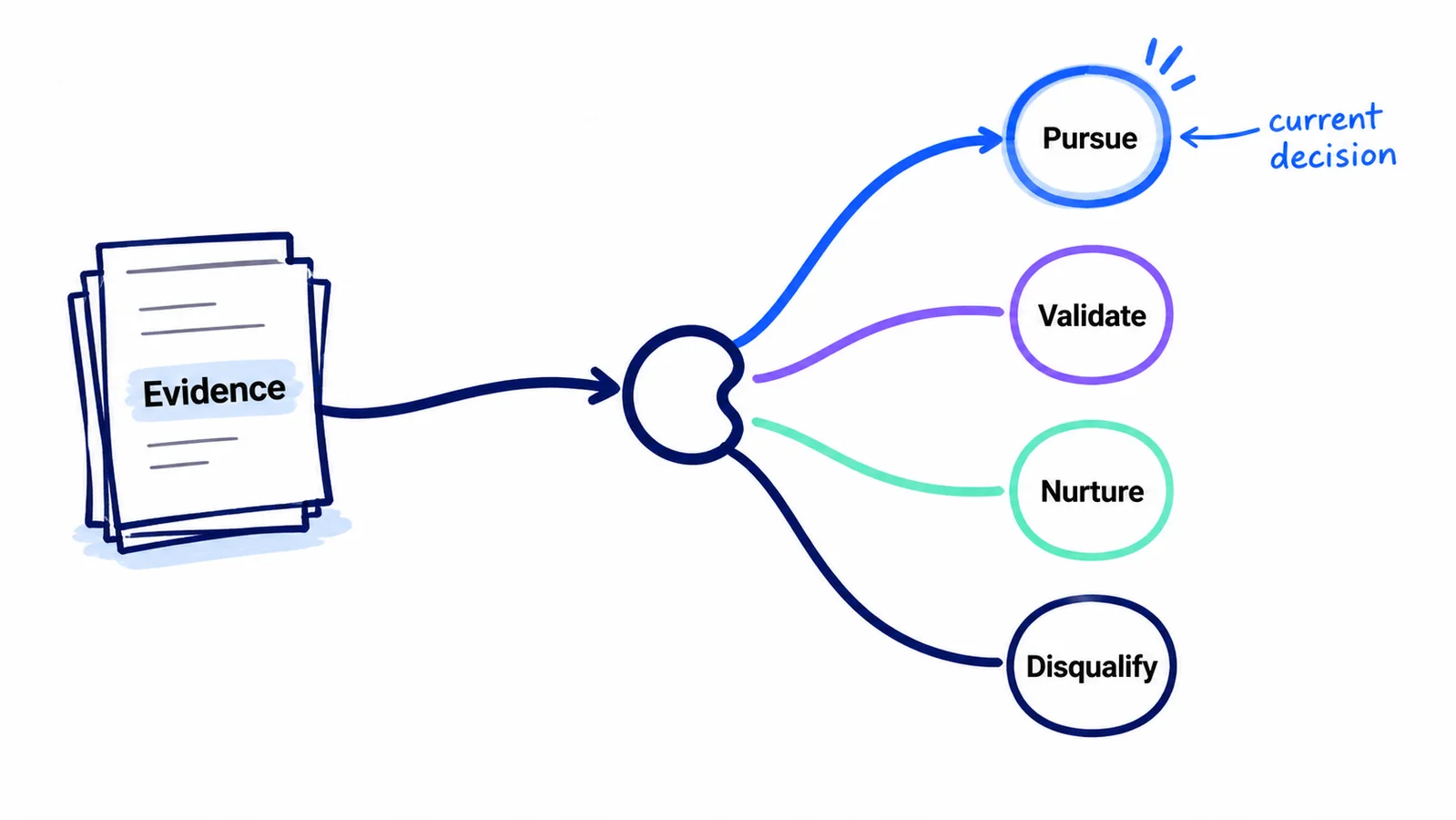
Sales qualification is an evidence-based decision about whether and how to pursue a lead or opportunity. A team evaluates current evidence about customer fit, the problem, buying ability, timing, process, and risk, then chooses an action such as pursue, validate next, nurture, or disqualify.
Qualification is not the same as discovery. Discovery gathers and tests information through research and buyer conversations. Qualification uses that information to make a pursuit decision. It also differs from lead scoring, which ranks records through attributes and behavioral signals.
Why sales qualification matters
Seller time, technical support, executive attention, and proposal effort are limited. Qualification helps a team assign those resources to opportunities that have enough evidence to justify the next step.
It also creates a shared boundary for the sales pipeline. Without one, a booked meeting can become an opportunity, seller enthusiasm can become stage progress, and missing evidence can disappear inside a confident forecast.
Strong qualification does not guarantee a purchase. It makes uncertainty visible. A manager can see why the team is pursuing the account, what could change the decision, and which assumption needs testing next.
How sales qualification operates
Start with criteria that reflect the actual sales motion. A simple cycle may need fit, need, authority, money, and timing. A complex cycle may also need quantified impact, an economic buyer, a tested sales champion, decision criteria, procurement steps, and competition.
For each criterion, record four things:
- The current claim
- The source of that claim
- Whether it is confirmed, inferred, contradicted, or unknown
- The next event that can validate it
The decision should be explicit. Pursue means the next investment is justified. Validate next means one bounded test comes before more resources. Nurture means the problem or timing may become relevant later. Disqualify means the account does not meet the current pursuit boundary.
Revisit the decision when a stakeholder leaves, a priority changes, a critical event moves, or procurement adds a requirement. Qualification is current evidence, not a permanent CRM stamp.

SaaS example
A security SaaS vendor receives an inbound request from a mid-market company. The technical lead confirms a real audit problem and a target date. That supports need and timing, but budget ownership and the approval path remain unknown.
The seller does not mark the opportunity fully qualified or reject it. The current decision is “validate next.” The seller asks for a meeting with the finance owner and security director. After the buyer confirms funding, decision criteria, and the evaluation sequence, the team commits a solutions engineer and advances the opportunity.
Those same fields later support sales forecasting, but qualification and forecasting answer different questions. Qualification asks how to pursue. Forecasting estimates the likely result and date.
Common mistakes
The first mistake is treating qualification as a one-time gate at the top of the funnel. Evidence can decay.
The second is forcing positive answers into required fields. “Unknown” is more useful than an unsupported claim.
The third is confusing activity with buyer progress. A completed demo does not prove authority, priority, or a decision process.
The fourth is asking every framework question in one call. Discovery should follow the buyer's context, while the framework organizes evidence behind the conversation.
Treat qualification as a current decision
The practical standard is not “Is this deal qualified?” Ask, “What decision does the evidence support now?” Then record the reason, owner, and next validation step. When the opportunity becomes coordinated enough for shared commitments, a mutual action plan can make those commitments visible without replacing qualification.