


Expansion revenue
Expansion revenue is the gross increase in recurring revenue from customers who were already active when a measurement period began. It comes from existing accounts paying more through added seats, higher usage, plan upgrades, recurring add-ons, or cross-sold products.
For subscription businesses, the calculation is:
Gross expansion revenue = sum of positive recurring-revenue increases from active existing customers
New-customer revenue, contraction, churn, and reactivation are separate movements. They should not be added to or subtracted from gross expansion revenue.
Why it matters
Expansion shows where an existing account has increased its financial commitment. That can reveal which plans, features, usage limits, or product combinations create a credible path to more revenue after the first sale.
It also explains part of the movement in MRR or ARR. A company can split recurring-revenue growth into new business, expansion, contraction, churn, and reactivation instead of reading one blended total.
Expansion is also an input to NRR. Strong expansion can offset losses from downgrades and cancellations, but it does not erase those losses from the underlying reporting. Gross expansion and gross retention answer different questions.
How it works
Start with customers who were active at the beginning of the period. Record each positive change in their normalized recurring revenue.
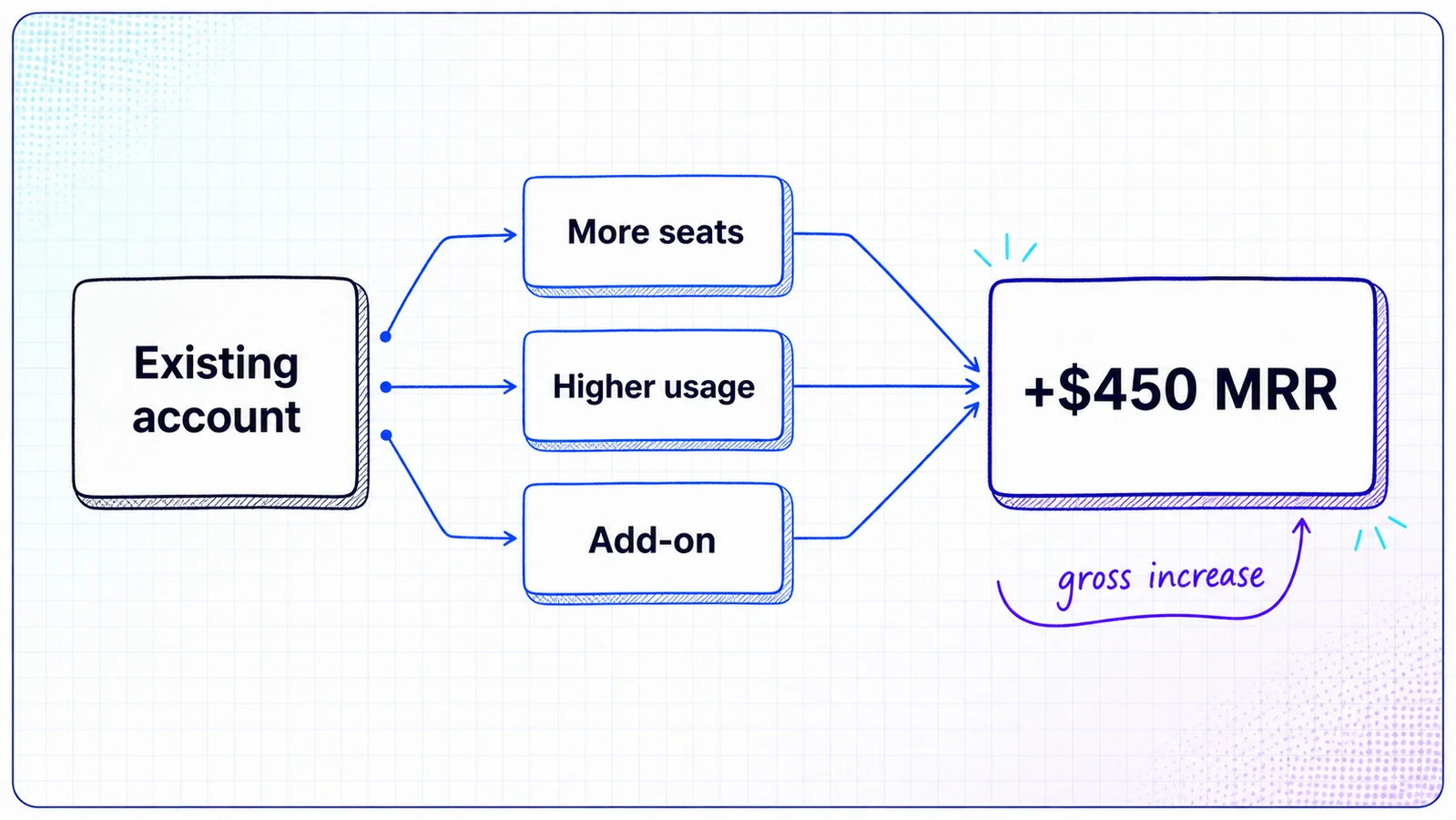
An account that moves from 20 seats to 30 seats creates expansion if the added seats increase its recurring charge. A usage-based customer creates expansion when higher billable usage increases recurring revenue under the company's measurement policy. A plan upgrade or recurring add-on creates expansion equal to the increase, not the account's full subscription value.
Keep the revenue grain consistent. Expansion MRR uses monthly normalized recurring revenue. Expansion ARR uses annual normalized recurring revenue. One-time implementation fees and professional services are normally excluded from both.
A standard renewal at the same recurring value is not expansion. A returning churned customer is better classified as reactivation. Keeping those events separate lets RevOps and finance reconcile billing movements without changing the definition from one report to another.

SaaS example
Suppose a customer cohort starts the month with $80,000 MRR. Active accounts add $4,000 through seats, $2,000 through higher usage, and $1,000 through a recurring add-on.
Gross expansion MRR is $7,000.
During the same month, the cohort loses $2,000 through contraction and $5,000 through churn. Those losses do not reduce the expansion figure. They enter the NRR calculation separately:
($80,000 + $7,000 – $2,000 – $5,000) / $80,000 = 100% NRR
In a product-led growth motion, expansion may follow seat growth, deeper usage, or adoption of a paid capability. In a sales-led motion, it may follow an account review, a new team rollout, or a cross-sell.
Common mistakes
The first mistake is calling all revenue from existing customers expansion. Renewals without an increase do not qualify.
The second is subtracting contraction and churn from expansion, which converts a gross movement into a net result.
The third is mixing MRR and ARR or changing currency treatment across reports.
The fourth is counting a reactivated customer as expansion without documenting that policy.
How we see it
Expansion revenue is useful as an event ledger, not as a broad claim about customer health. The useful question is which account behavior created the increase and whether that path repeats within the same segment.
Track expansion by source, product, customer size, and cohort. Then read it beside contraction, churn, and retention. A few large upgrades can produce a strong total while most accounts stay flat. The movement detail shows whether expansion is repeatable or concentrated.