


ARR
ARR means annual recurring revenue. It is the annualized value of active recurring subscriptions and contracts at a point in time.
For a subscription business with stable monthly billing, a common formula is:
ARR = MRR x 12
ARR includes predictable recurring charges. One-time implementation, training, hardware, and professional-service revenue are normally excluded.
Why it matters

ARR gives SaaS companies a consistent annual view of their recurring revenue base. It helps leaders compare growth, plan hiring, communicate scale, and understand how new sales, expansion, contraction, and churn affect the business.
The same growth rate can represent different performance at different ARR stages. SaaS Capital's 2025 growth benchmark surveyed more than 1,000 private B2B SaaS companies. Median 2024 growth was 40% below $1 million ARR, 28% at $1 million to $3 million, 24% from $3 million through $10 million, and 20% above $10 million. These are peer benchmarks, not targets or forecasts for an individual company.
The metric is particularly useful when customers have different billing cycles. Monthly, quarterly, and annual contracts can be normalized into one annual measure.
ARR is not recognized accounting revenue or cash collected. It is an operating metric, so the company must document its rules and apply them consistently through RevOps and finance systems.
How it works
First, identify active recurring subscription and contract amounts.
Second, normalize each amount to a yearly value. Monthly recurring revenue is multiplied by 12. Quarterly recurring revenue is multiplied by four. Annual recurring contracts already use the right period.
Third, remove one-time charges and non-recurring services.
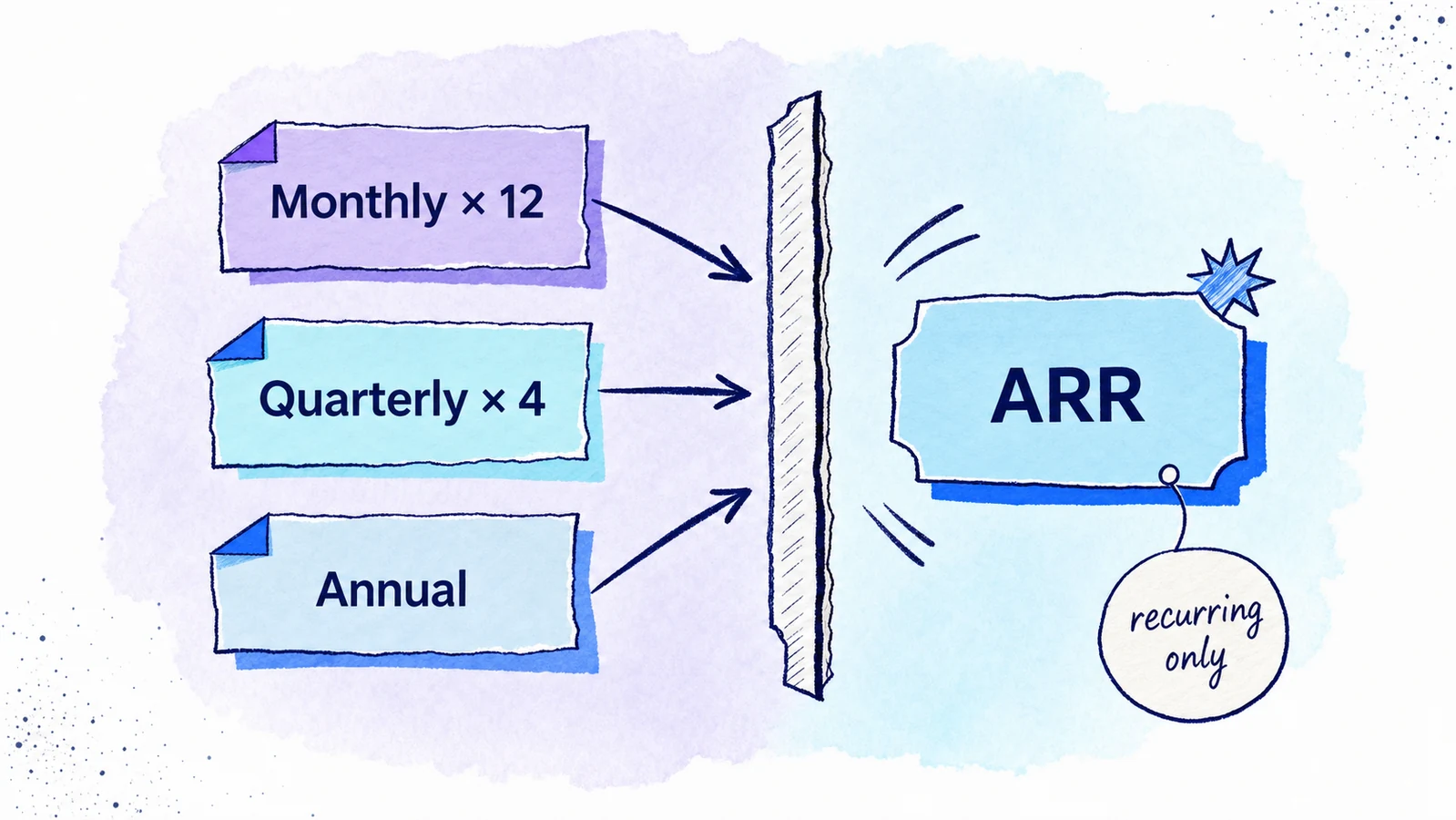
ARR can be analyzed through components: new ARR, expansion ARR, contraction ARR, churned ARR, and reactivated ARR.
It differs from ACV. ARR measures the company's recurring revenue base, while ACV usually normalizes the recurring value of an individual customer contract.
It also connects with NRR, which measures how recurring revenue from an existing customer cohort changes over time.
The normalization rule should remain consistent across reporting periods.
SaaS example
Suppose a company has $100,000 in MRR. Its annualized recurring revenue is $1.2 million, assuming the current recurring base remains unchanged.
A separate $80,000 implementation project does not belong in ARR because it is not expected to recur.
If customers expand by $50,000 ARR and churn by $30,000 ARR, the recurring base increases by $20,000 before new customer ARR is included.
Common mistakes
The first mistake is including bookings or total contract value at full value.
The second mistake is including one-time fees.
The third mistake is treating ARR as guaranteed future revenue.
The fourth mistake is changing normalization rules between reports.
How we see it
ARR is a clean scale and momentum metric when its definition is disciplined. It becomes misleading when recurring, contracted, billed, and recognized revenue are mixed into one number without explanation.
Keep the calculation policy stable and documented. Decide how to treat usage revenue, multi-year discounts, pauses, and contracted expansion before reporting ARR. Consistency makes period-to-period comparisons far more useful. Reconcile ARR to the underlying contracts and explain policy changes whenever reporting rules change. Report new, expansion, contraction, and churned ARR separately so operators can see whether growth comes from acquisition, existing customers, or temporary pricing effects.