


Product-led sales: How to add sales to a product-led motion
Product-led sales uses product behavior, account fit, and buying context to decide when a human sales action can help. The product still creates the first experience of value. Sales enters when a user or account has a problem that self-serve cannot resolve efficiently.
That might be a team asking about security, an account spreading across several departments, or a user reaching a limit that signals a larger deployment. The point is not to send every active user to a rep. It is to identify the few situations where a relevant conversation can help the customer progress.
What product-led sales means
Product-led growth makes the product a primary route for acquisition, activation, conversion, and expansion. Product-led sales adds a sales-assisted path to that model. Product evidence helps the company decide which account needs help, why it needs help, and which action a rep should take.
The distinction matters at the moment of contact. A standard inbound process might route a form fill based on company size and job title. Product-led sales can add evidence that the person has completed a core workflow, invited colleagues, reached a usage limit, or encountered a governance requirement.
Salesforce describes the model as using product interaction data to identify qualified prospects and guide sales engagement in its product-led sales explainer. McKinsey reaches a similar conclusion from a broader market view: product-led and sales-led models increasingly overlap because different buyers and segments need different paths. Its analysis of product-led sales draws on 107 public B2B SaaS companies and a survey of 625 SaaS buyers.
For a fuller comparison of the two starting points, see product-led versus sales-led growth.
Check readiness before adding sales
Adding a rep does not repair weak activation. If users rarely reach the product's useful moment, sales will receive a list of accounts that have not yet experienced enough value to support a credible conversation.
A company is ready to test product-led sales when five conditions are present:
- Users reach repeatable value. The team knows which behaviors correlate with a meaningful outcome inside the product.
- Product events are reliable. Events have stable definitions, account identity is resolved, and the data arrives quickly enough to guide action.
- The ideal customer is defined. The team can distinguish an attractive account from a highly active account that will never buy a larger plan.
- Human help has a purpose. The rep can remove a known obstacle, support evaluation, or coordinate a larger purchase.
- The account can support the cost. Expected annual contract value, margin, and expansion potential justify human involvement.
Failing one test does not mean sales can never enter. It identifies the next constraint. A team with poor identity resolution needs better data. A team with no repeatable activation path needs product improvement. A team with low account value may need automated assistance instead of a salesperson.
Build the qualification rule before the score
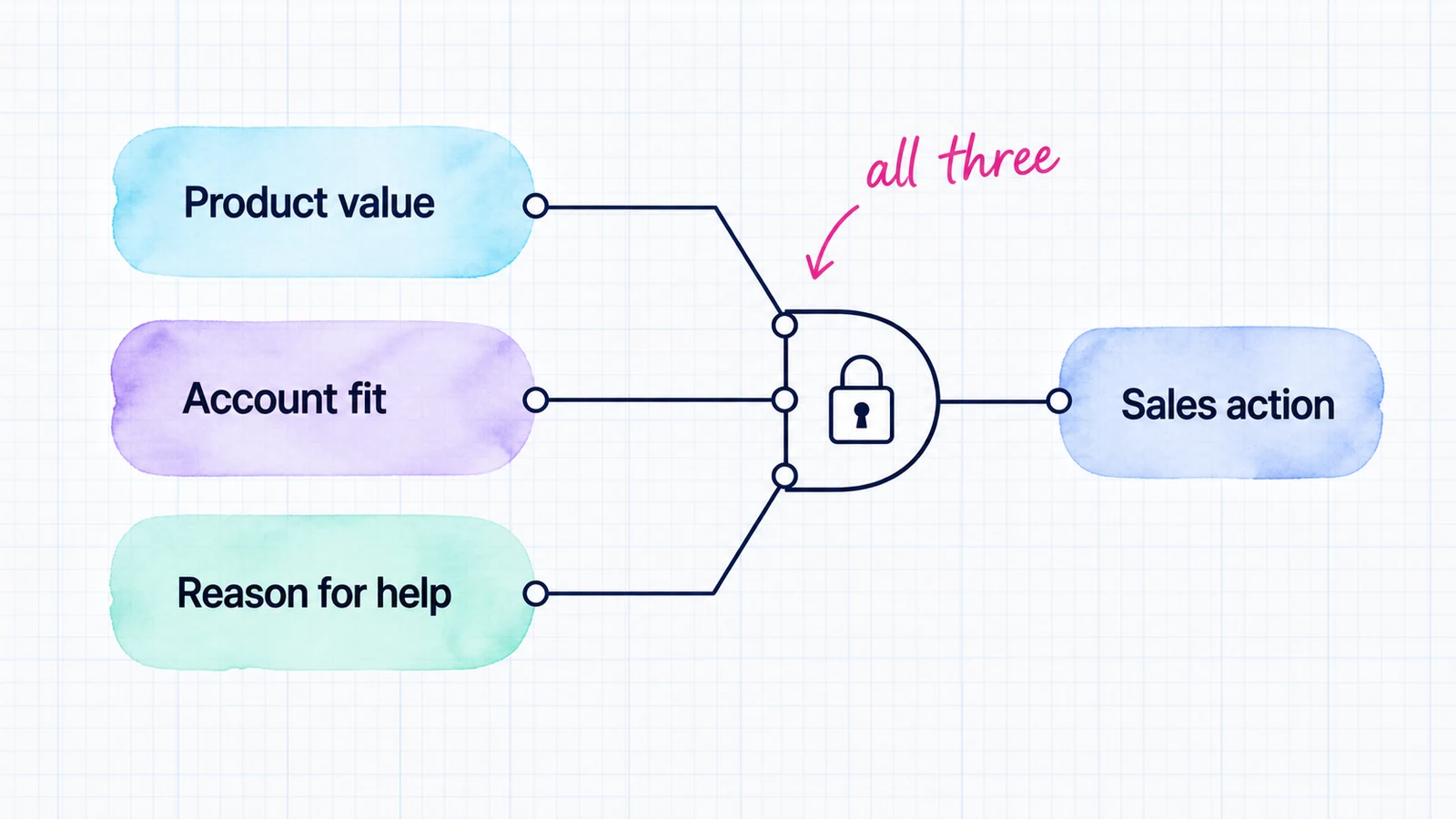
A useful rule combines three forms of evidence: product value, account fit, and a reason for help.
Product value asks whether the user or team has completed behavior that represents a real outcome. Account fit asks whether the company, use case, size, region, and technical environment match the customers the business can serve well. The reason for help asks what a human can do now that the product or lifecycle message cannot do alone.
This is stricter than ordinary lead scoring. A score can rank activity without proving that the activity means value. Ten logins may show interest, confusion, or an automated process. A completed workflow shared across a team may be a stronger signal even if it happens once.
Start with a small rule that a rep can inspect. For each signal, record:
- The event and the value it represents
- The account conditions that must be true
- The action the signal should trigger
- The time window in which the action is useful
- The outcome that will confirm or reject the rule
Avoid a long weighted score at the start. A short list of explicit conditions makes false positives easier to diagnose.
Choose PQL or PQA as the operating unit
A product-qualified lead is a person whose usage indicates potential readiness for a sales action. It is useful when one user controls the purchase or when the next step is personal assistance.
A product-qualified account, often called a PQA, combines behavior across users in one company. It is usually the better unit when adoption spreads across a team, a manager or buyer has not used the product, or the purchase requires security and procurement.
The choice changes the rep's context. A PQL record might say that one user completed a key workflow and requested help. A PQA record might say that eight users across two teams are active, one administrator is configuring controls, and no economic buyer has joined the evaluation.
Many companies need both. The PQL identifies the person closest to the product problem. The PQA shows whether the account contains a credible commercial opportunity.
Map every signal to a useful action
Signals are only valuable when they produce a specific response. A practical motion normally contains three types of sales action:
- Assist: help a user reach value when setup, integration, or product complexity creates friction.
- Convert: help a qualified free or trial account evaluate a paid plan when fit and usage support the conversation.
- Expand: help an existing customer coordinate broader adoption, governance, or a new use case.
The labels come from established product-led sales practice, including the Pocus 2022 playbook. The action still needs to be specific to the product. "Contact active user" is not a play. "Offer an architecture review after a target account connects its production data source" is one.
Some signals should produce no outreach. A user may be active but outside the target market. A team may be exploring a feature that needs better in-product education. A customer may already have an open support case. Suppression rules protect the user experience as much as qualification rules protect rep time.
Build the signal-to-action workflow
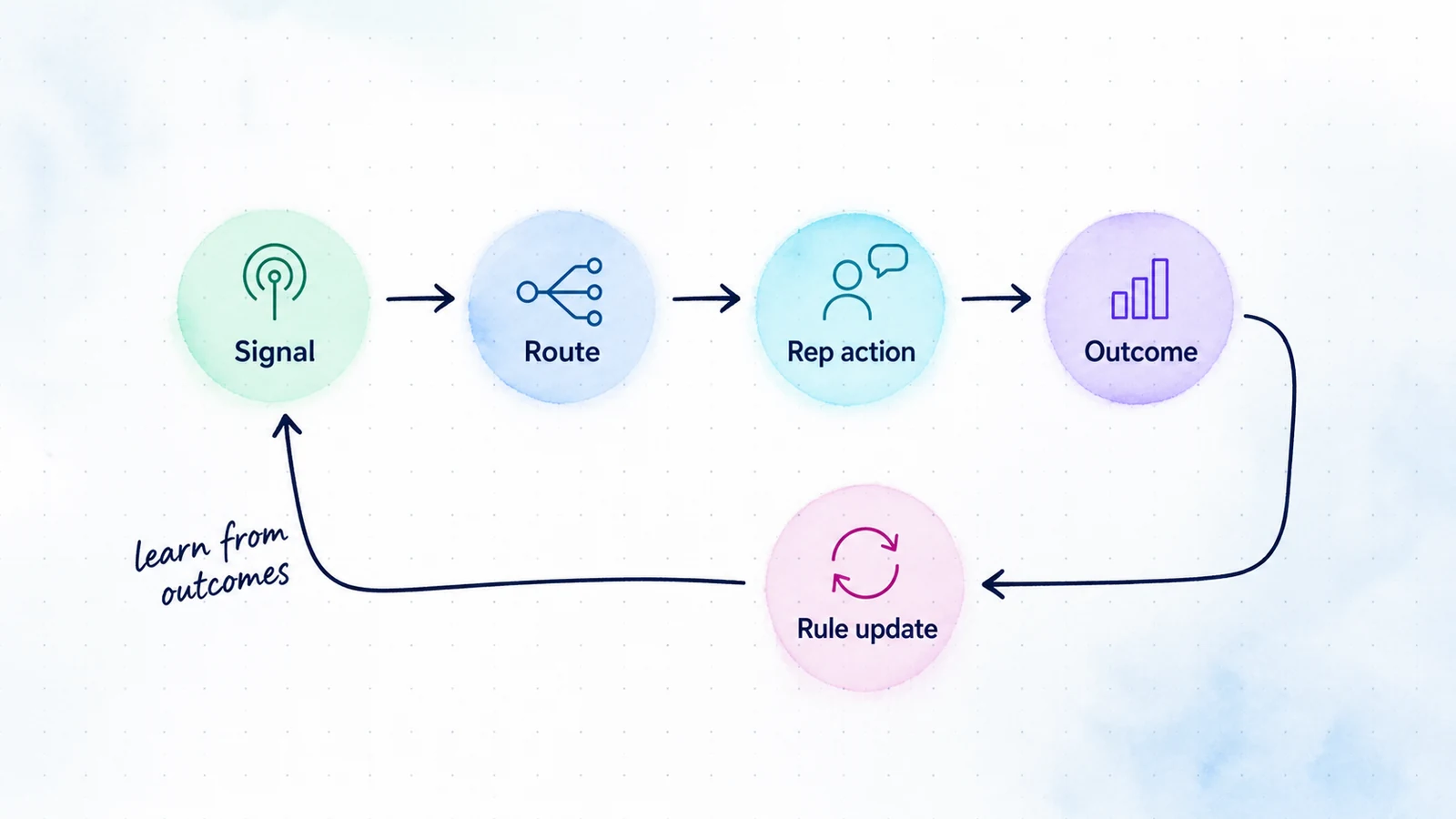
The operating sequence is straightforward:
- Capture a meaningful product event.
- Resolve the user to an account.
- Add firmographic, plan, lifecycle, and ownership context.
- Apply the qualification and suppression rules.
- Route the account with the reason, evidence, and recommended action.
- Record the rep's action and the customer's response.
- Feed the outcome back into the rule.
Revenue operations usually owns data reliability, identity, CRM fields, and routing. Product or growth should define what the event means. Sales should define the conversation and record the outcome. One named owner must decide when a signal is changed, removed, or split by segment.
The rep should never receive a bare alert. The record needs the event, relevant account context, recent activity, existing owner, open support issue, and the reason the alert exists. Otherwise the rep repeats questions the product data already answered.
The motion can exist before a dedicated platform
A dated benchmark still makes one useful distinction: product-led sales practices and product-led sales software adoption are separate decisions.
In the 2022 Pocus sample, 49% of respondents reported a product-led sales motion. Fifty-two percent reported using product signals to identify enterprise opportunities, and the same share reported outbound to PQLs. Only 12% reported implementing a third-party PLS platform. The report included more than 200 respondents from product-led companies, but it did not disclose a representative sampling frame or geographic mix on the cited pages.
The numbers show how that sample operated in 2022. They do not estimate 2026 adoption, and they do not show that a platform caused better results. Pocus later published a 2023 benchmark report with more than 170 respondents, which is useful for comparing how teams refined qualification and sales plays after the earlier survey.
For an early test, a warehouse query, CRM rule, and a clear rep play may be enough. Buy specialized software when the team has proven the signal, the manual process causes delay, and the platform can solve a named operational constraint.

Measure the decision, not alert volume
Alert count is an activity metric. It does not tell you whether the rule finds accounts that benefit from sales.
Track the motion in layers:
- Signal quality: accepted signals, rejected signals, duplicates, and false positives by segment
- Execution: time to action, action rate, and completion of the assigned play
- Customer progression: meeting acceptance, evaluation milestone, paid conversion, expansion, or a useful assist outcome
- Commercial result: qualified sales pipeline, revenue, sales cycle, and acquisition cost for the affected segment
Compare qualified accounts with a sensible baseline. A rule may find accounts that were already likely to buy, so conversion among alerted accounts is not proof that outreach created the result. Tests, holdouts, or staged rollouts can produce a better answer when volume allows.
Close the feedback cycle
The first rule will be wrong in specific ways. It may trigger too early, favor one persona, miss account-wide adoption, or route expansion signals to an acquisition team.
Review outcomes with product, growth, RevOps, and sales on a fixed cadence. Ask which signals led to useful conversations, which arrived without enough context, and which customer needs had no matching play. Then change one part of the rule and observe the next cohort.
This is the practical extension of signal-based selling: a signal has value only when its meaning, timing, and action remain connected.

A simple SaaS example
Consider a collaboration product with self-serve team adoption. The company notices that some target accounts invite several users, create shared assets, and then open the permissions page repeatedly.
The event alone is ambiguous. The qualification rule requires a target-market account, activity from at least two roles, use of the shared workflow, and repeated permissions exploration. The assigned action is a short governance review, not a generic demo.
If the account accepts, the rep helps the team map roles, controls, and rollout needs. If the account declines because it is only testing, that outcome updates the threshold. If support already owns a permissions issue, the sales alert is suppressed.
The product created the evidence. Account context shaped the decision. Sales supplied help that matched the evidence.
Common mistakes
The first mistake is treating all activity as intent. The second is adding a platform before a useful play exists. The third is sending alerts without account context. The fourth is measuring meetings while ignoring false positives and customer friction.
Another failure is leaving ownership vague. Product understands events, RevOps understands routing, and sales understands the conversation. Without one motion owner, each team can improve its own component while the full sequence gets worse.
Our view is simple: do not ask how many signals you can send to sales. Ask how few signals you need to create timely, credible assistance for the right accounts.
Frequently asked questions
Is product-led sales the same as product-led growth?
No. Product-led growth uses the product as a main route to acquire, activate, and retain customers. Product-led sales adds human assistance when product evidence and account context indicate that a conversation can help.
When should a PLG company add sales?
Add sales after users reach repeatable value, product events are reliable, the ideal customer is clear, and a named sales action can solve a real customer problem. High activity by itself is not enough.
Should we qualify PQLs or PQAs?
Use PQLs for person-level assistance and PQAs for account-level purchases involving team adoption, buyers, security, or procurement. Many B2B SaaS companies use both records for different decisions.
Who should own product-led sales?
Assign one motion owner. Product or growth defines event meaning, RevOps manages data and routing, and sales owns the customer action. The motion owner decides how the rule changes after outcomes are reviewed.
Do we need a product-led sales platform?
No. Prove the signal, route, and sales play with existing data and CRM systems first. A dedicated platform becomes useful when a proven motion needs faster signal processing, richer account context, or easier rule management.
For practical GTM analysis like this, join the GTMpreneur newsletter.