


Customer onboarding
Customer onboarding is the guided path from purchase, signup, or another declared start event to an agreed first-value milestone. It coordinates the people, product actions, data, approvals, and support required for a new customer to receive a result they recognize as useful.
Setup can be part of onboarding, but setup is not the outcome. A customer may connect an integration, invite users, and finish training without receiving the result they bought. Onboarding is complete when value evidence is recorded and the account is ready to enter its ongoing operating rhythm.
Why customer onboarding matters
The sales process creates expectations about outcomes, timing, and responsibility. Onboarding turns those expectations into an executable customer plan. A weak handoff forces the next owner to rediscover the use case, stakeholders, promises, and risks after the deal closes.
That delay matters because a subscription begins before the customer has received value. The onboarding process should reduce avoidable waiting while keeping necessary security, data, and change requirements intact.
It also gives customer success a clear starting record. The ongoing team can see what the customer expected, which result was achieved, which risks remain, and what should happen next.
How customer onboarding works
The process begins by confirming the sold outcome with the customer. Sales context is an input, but the buyer, administrator, and end user may define success differently. The onboarding owner should resolve that difference before configuration begins.
Next, the team maps the minimum dependency path. Each required step should enable the first-value event, protect a real customer risk, or establish the next operating motion. Optional training, advanced features, and secondary use cases can follow later.
Ownership then moves with the process. Sales transfers context. An implementation or customer-success owner coordinates the plan. Product and support may resolve technical issues. The customer supplies access, decisions, and internal approvals. Each handoff needs an acceptance rule, not merely a sent message.
The last event is first value. The evidence might be a report accepted by a manager, a campaign sent to a real audience, or a policy check completed with an actionable result. The account then transfers to its ongoing owner with achieved outcomes, open risks, product state, stakeholders, and the next customer goal.
Customer segments can require different paths. The ICP helps identify recurring dependency patterns, while lifecycle marketing can support relevant follow-up after the first outcome. Neither should force every account into one generic sequence.
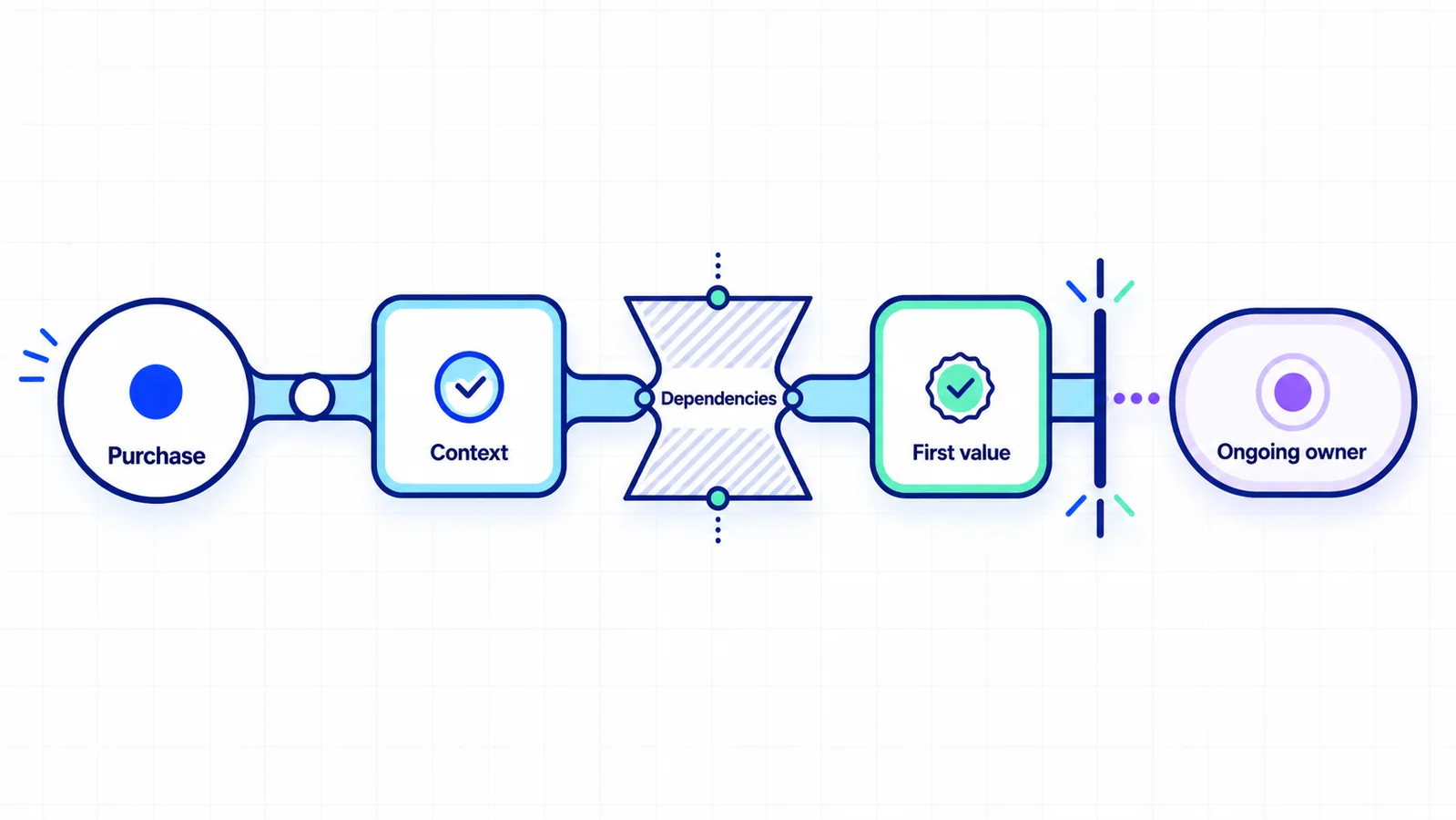

SaaS example
A revenue intelligence platform sells a forecasting use case to a midmarket sales team. The start event is an accepted sales handoff. First value occurs when CRM data passes agreed quality checks and the sales leader uses the resulting forecast in a weekly review.
The customer administrator owns CRM access and field decisions. The implementation owner manages data mapping and quality exceptions. The sales leader accepts the final view. Broad rep training is useful, but it is not required before the first forecast review, so it belongs in the next phase.
If the same product offers a self-serve trial, its user path may be shorter and mainly in-product. A product-led sales motion can add human help when product behavior reveals a valuable account or a blocker.
Common mistakes
The first mistake is treating checklist completion as customer value. Tasks measure activity, while the value event measures an outcome.
The second is using one path for every customer. A low-risk self-serve account and a security-sensitive enterprise account may share a product but not a dependency model.
The third is leaving handoffs implicit. Missing context and unclear ownership surface later as delay and repeated customer questions.
The fourth is extending onboarding indefinitely. Adoption, support, customer marketing, and expansion continue after the first-value boundary, but they belong to the ongoing customer motion.
An operator view
The useful test is simple: can the team name the start event, first-value event, evidence, required dependencies, and current owner for every new account? If any field is missing, the process is tracking activity without a defensible completion rule.