


Revenue churn
Revenue churn is the percentage of recurring revenue lost from an existing customer base during a period. The loss can come from cancellations or from customers reducing seats, plans, or usage commitments.
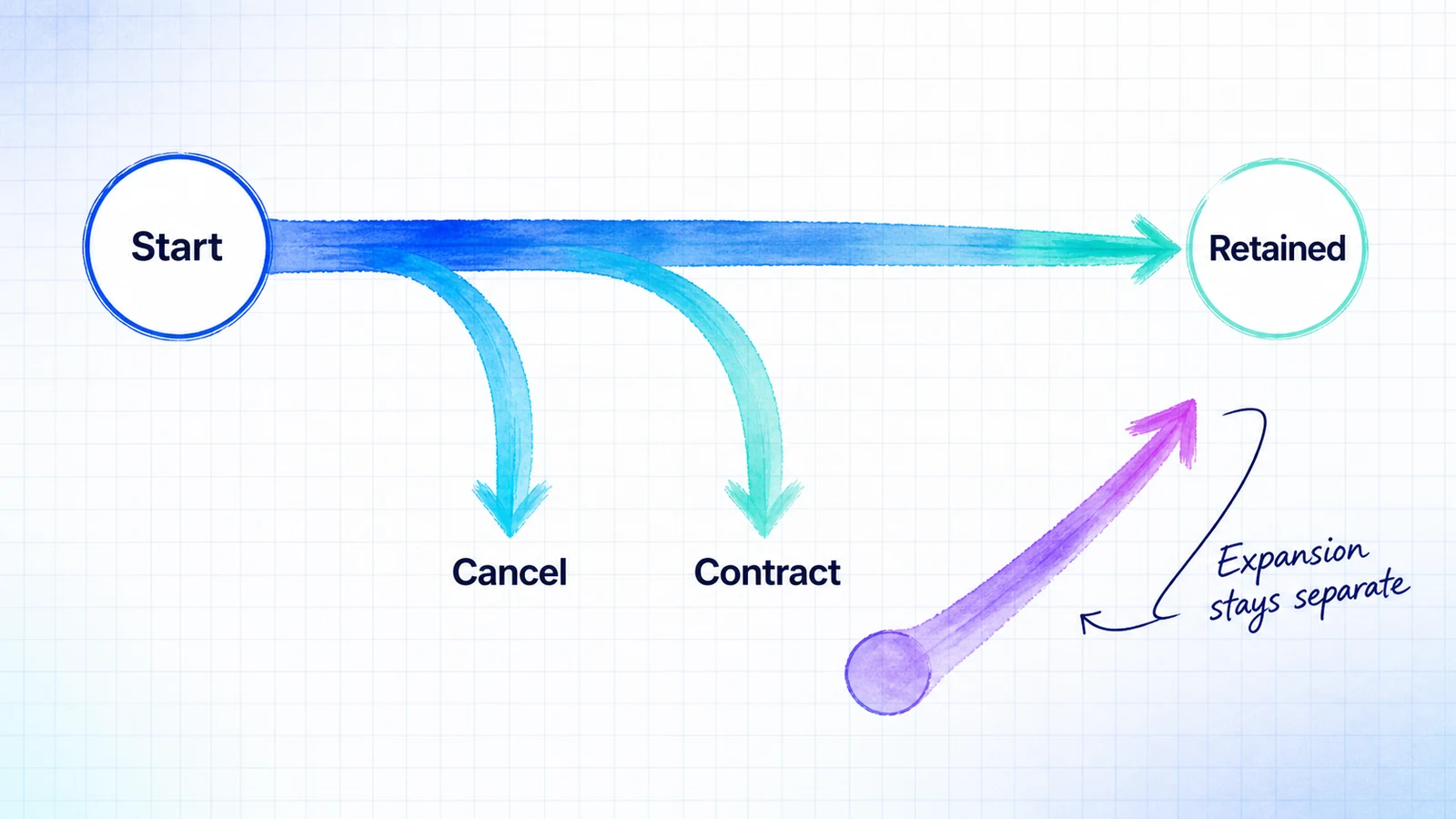
Gross revenue churn excludes expansion revenue. Net revenue churn includes expansion and reactivation, which means it can fall below zero when expansion exceeds losses. State which version you use before reporting the number.
Why revenue churn matters
Customer counts do not show the economic weight of each loss. Losing five small accounts and losing one enterprise account may produce the same logo churn but very different revenue outcomes.
Revenue churn connects retention to the recurring revenue base. It helps a SaaS company see whether cancellations and contraction are eroding MRR, even while new sales keep total revenue growing.
It also changes how teams prioritize retention. A high-value segment with modest account churn may deserve more attention than a low-value segment with a larger number of cancellations.
How revenue churn works
For gross monthly revenue churn, use the recurring revenue lost from the starting customer base:
Gross revenue churn = (Churned MRR + Contraction MRR) / Starting MRR x 100
Do not add new customer revenue to the denominator or subtract it from losses. New business belongs to acquisition performance, not retention performance.
Use consistent rules for active, past-due, paused, and cancelled subscriptions. A billing tool may mark a subscription as churned at a different event from the CRM or data warehouse. The metric is only comparable over time when those event rules remain stable.
NRR expresses the retained side of the same revenue movement while including expansion. Gross revenue retention excludes expansion. Revenue churn should therefore be labeled gross or net so a reader can reconcile it with the retention metric.

SaaS example
A SaaS company starts the month with $100,000 in MRR. Customers cancel subscriptions worth $6,000 and downgrade by another $2,000. Gross revenue churn is 8%.
Other customers expand by $10,000. That expansion does not change gross revenue churn. It does, however, lift net retention above the level implied by the gross losses.
The team then uses cohort analysis to find where the $8,000 loss originated. If most contraction comes from one acquisition channel or plan, the next action may involve qualification, onboarding, pricing, or product usage rather than a broad retention campaign.
Common mistakes
The first mistake is calling customer churn revenue churn. One counts accounts. The other weights losses by recurring revenue.
The second is mixing monthly and annual billing events without normalizing them into the same recurring period.
The third is allowing expansion to reduce a metric labeled gross revenue churn. That turns a gross measure into a net one.
A fourth mistake is treating every lost dollar as a customer-success failure. Poor ICP selection, discounts, product gaps, billing failures, and contract changes can produce the same metric. We use revenue churn to locate the loss, then inspect the underlying accounts before deciding what to fix.