


Time to value
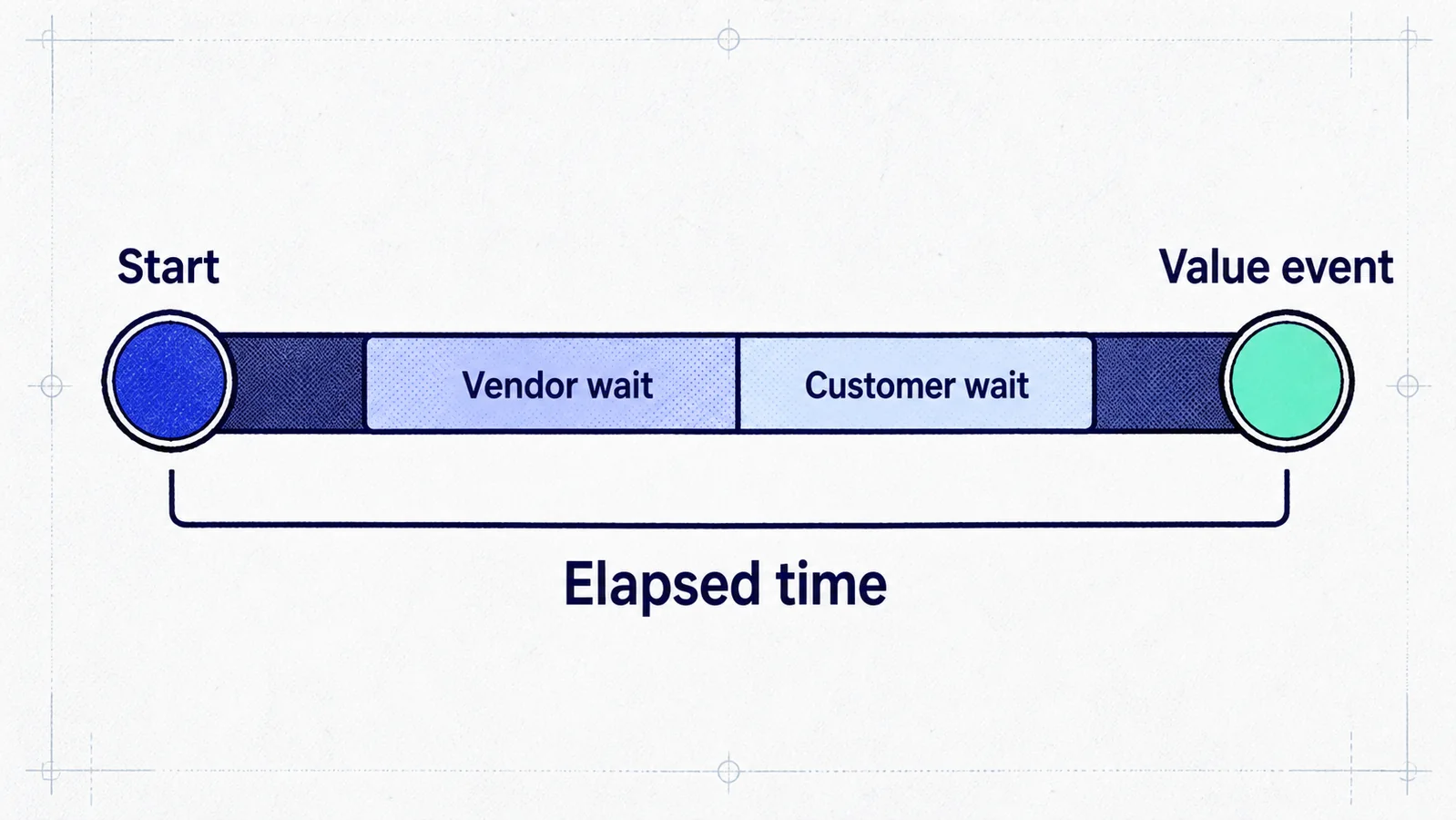
Time to value, or TTV, is the elapsed time between a declared start event and the customer's first meaningful value event. In SaaS, the start may be contract signature, account creation, kickoff, or first product access. The stop event is the first observable result the customer recognizes as useful.
The endpoints make the metric. A login is not value unless access itself is the purchased outcome. Setup completion is not value unless the completed setup produces the promised result. Changing either event between customer groups makes the number difficult to compare.
Why time to value matters
TTV exposes the delay between a commercial promise and customer evidence. It helps teams see whether customer onboarding is moving accounts toward an outcome or merely completing internal tasks.
The measure also separates two operational questions. First-value TTV asks how quickly the customer receives an initial useful result. Time to full value asks when the broader outcome or expected return is achieved. The first can guide onboarding. The second may span adoption, change, and repeated product use.
A shorter interval is not automatically better. Removing a required security review or data check may reduce elapsed time while creating risk. The goal is to remove avoidable delay and protect the dependencies that make the value event credible.
How time to value works
Choose one start event and one stop event for a comparable customer cohort.
Time to value = Value event timestamp - Start event timestamp
Record both events in a system that can be queried consistently. Product telemetry may capture a self-serve activation event. A complex implementation may require product data plus customer acknowledgement. Either method can be valid when the rule is explicit.
Include all elapsed time between the events. Vendor queues, customer approvals, missing data, weekends, and technical delays remain part of the customer's experience. Track reason codes separately if you need to assign causes.
Report the median for the typical observed account and a slower percentile to expose the tail. An average can be pulled upward by a small number of long implementations. Use cohort analysis to compare similar use cases, touch models, segments, and product versions.
Customer success can use the measure to inspect account progress, while a broader go-to-market metrics review can assign owners to recurring delay categories.

SaaS example
A revenue analytics platform defines the start event as an accepted sales handoff. Its first-value event occurs when CRM data passes agreed quality checks and the sales leader uses the generated forecast in a weekly review.
One account reaches the event after four days. Another takes 18 days because required fields are missing and the customer's administrator is unavailable. Both delays belong in elapsed TTV. Reason codes show that the second account waited on data quality and customer availability rather than product processing.
For a self-serve product, the interval might begin at account creation and end when the user completes a meaningful product action. In a product-led sales motion, that event may also signal that human help or a commercial conversation is relevant.
Common mistakes
The first mistake is choosing a flattering stop event, such as login or tour completion, that does not prove value.
The second is mixing start events. Contract signature, kickoff, and first login can be days apart.
The third is excluding customer-caused waits. Removing them may help diagnose vendor execution, but it no longer describes elapsed customer time.
The fourth is comparing unlike cohorts. A self-serve trial and a security-sensitive enterprise deployment should not share one target without segmentation.
The fifth is reporting only an average. Median, slower percentile, milestone timing, and delay reasons provide a more useful operating view.
An operator view
A defensible TTV metric can answer four questions without interpretation: what started the clock, what stopped it, which evidence proves value, and which accounts belong in the comparison. Until those rules are stable, the number is a label attached to inconsistent events.