


How to re-engage closed-lost opportunities using buying signals
Re-engage closed lost opportunities when you can connect a verified change to the reason the buyer previously stopped evaluating. Recover the original context, check whether the account and contact are still eligible, and send a message about the changed condition. Reopen pipeline only after fresh qualification confirms a real buying process.
The useful unit is a changed buying decision, not an old email address. A funding announcement might justify research. A released capability that directly addresses a documented blocker might justify contact. Neither automatically creates an opportunity.
This is a specific application of signal-based selling: the prior evaluation gives you a question to test against each new signal.
Preserve the reason the buyer said no
A Closed Lost stage records the outcome of a sales cycle. It does not tell you whether the account was a poor fit, chose another vendor, postponed the project, or lacked a required capability.
Start with the buyer's actual constraint. "Price" could mean an unavailable budget, an unconvincing business case, an unacceptable contract structure, or a competitor offering sufficient capability for less. Those are different reactivation conditions.
Review the opportunity notes and relevant call passages. Preserve the CRM reason and add a more specific interpretation with its supporting evidence. Do not silently replace a historical field with an AI-generated answer.
Keep an explicit unknown state. If the buyer stopped responding and nobody established why, "no response" is an observation, not proof of a budget problem.
Prior evaluations can matter in subsequent buying. 6sense's 2025 research reports a previously evaluated winning vendor in 86% of deals improving existing capabilities, 81% adding new capabilities, 89% renewing or continuing a solution, and 85% replacing capabilities.
The underlying main study surveyed just under 4,000 B2B buyers globally across software, services, and physical goods. Those percentages describe prior evaluation, not recovery of closed-lost opportunities. They provide context for preserving evaluation memory, not a predicted win rate for your campaign.

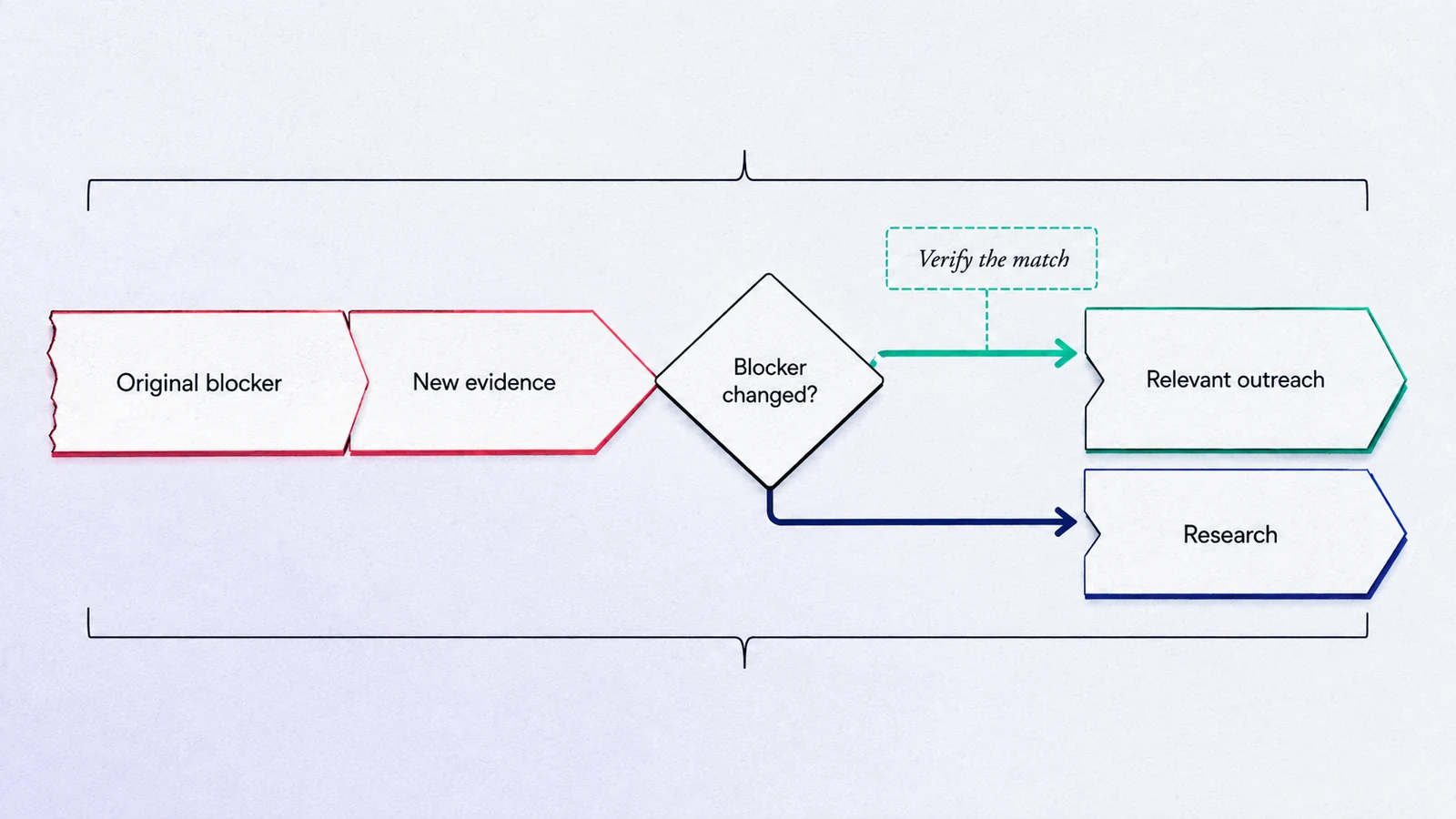
Match the signal to the original blocker
Write the matching rule before connecting a monitoring source.
The rule should complete a specific sentence: "We lost because of this constraint; this new evidence may change that constraint; this check will tell us whether it did."
| Recorded blocker | Relevant change | What still needs verification | Proportionate response |
|---|---|---|---|
| Missing audit-history capability | That capability is released | Required scope, availability, and limitations | Offer evidence tied to the old requirement |
| No approved category budget | A budget owner confirms a new planning window | Whether the initiative has allocation and priority | Revisit the business case |
| Chose a competitor | A known contract review approaches | Actual dates, notice terms, and willingness to review | Ask about evaluation criteria |
| Sponsor left | A relevant replacement joins | Their remit and ownership of the problem | Research, then introduce the prior context |
| Project postponed | Buyer confirms the project is restarting | Current need, team, and decision process | Run fresh qualification |
A public funding event alone does not establish approved category budget. A new executive does not necessarily inherit the old sponsor's priorities. Account-level intent data cannot identify the private intentions of a named person.
Likewise, a website revisit can have several explanations. Check identity confidence and account state before turning it into a seller task. The visit may justify inspecting the record; it does not demonstrate that the old blocker disappeared.
Use a buyer-requested follow-up date when one exists. Otherwise, set review timing around the relevant condition, not an arbitrary rule that every lost deal should receive another email after six months.
Build a reviewable reactivation queue
Clay's June 3, 2026 account of its own closed-lost workflow describes importing opportunity context from Snowflake, analyzing linked Gong transcripts with Claygent, and updating Salesforce with extracted intelligence. It also describes matching newly shipped capabilities to previously documented product gaps.
That is a useful operating example. It is not a published recovery-rate experiment, and an extracted loss reason still needs supporting evidence.
Give each queue item enough context for an owner to accept or reject it:
- Original opportunity ID, account ID, loss date, and previous owner.
- Original CRM reason and evidence-linked interpretation.
- Relevant requirement, competitor context, and prior stakeholders.
- New event, source, event date, and observation date.
- Why the event may change the original constraint.
- Current account status, contact role, suppression state, and ownership.
- Proposed action, expiry condition, reviewer, and result.
AI can draft the interpretation and message. Require it to distinguish an explicit buyer statement from an inference, cite the source passage, and return unknown when evidence is insufficient. Treat transcript content as evidence, not instructions to the automation.
Use data enrichment only to answer a specific eligibility question. Is the former contact still there? Does the company still match the segment? Is another opportunity already active? Suppress or route those active accounts to the current owner before creating duplicate outreach.
Start with a reviewed pilot of at most 10 records if using Clay. Check the run limit and cost estimate before execution. Keep a record of rejected matches so the next version does not repeat the same error.

Write to the changed condition
A reactivation message needs three pieces: remembered context, a relevant change, and a small question that tests whether the change matters now.
Consider a fictional data-quality software seller. A prospect paused because the product lacked audit history. The seller has now released the relevant capability and verified that it covers the original requirement.
A possible message body is:
Maya, your team paused the evaluation because administrators could not review who changed the routing rules. The audit-history release now records those changes, including the user and timestamp. Is that still a requirement for your next review? I can send the relevant example before we revisit a demo.
The specificity comes from the buyer's old requirement and the verified release. It does not need an invented urgency claim or a discount.
For a budget-related loss, avoid treating a fundraise as permission to restart the sales cycle. A less presumptive body might read:
Daniel, the data-quality project was paused during your last budget review. Are you revisiting that initiative in the current planning cycle? I can update the scope and cost assumptions from our earlier discussion if that would help.
These are illustrative message bodies, not complete send-ready emails. Add the required sender information and opt-out handling through your approved sending process.
A sales champion moving to another company needs different handling. Confirm the new role and account fit, and ask whether the problem is relevant there. That is a new-account motion informed by a prior relationship, not reopened pipeline at the old employer. Do not transfer confidential details from the former company's evaluation.
Keep the broader outbound sales strategy consistent: proportionate contact, clear ownership, and a stop when the buyer declines.
Reopen pipeline only after requalification
Keep four events separate: signal detected, outreach approved, buyer re-engaged, and opportunity qualified.
A positive reply can establish interest without establishing a buying process. Fresh sales qualification should confirm a current problem, relevant stakeholders, a reason to evaluate, and an agreed next step. Recheck the buying committee; last year's participants may no longer own the decision.
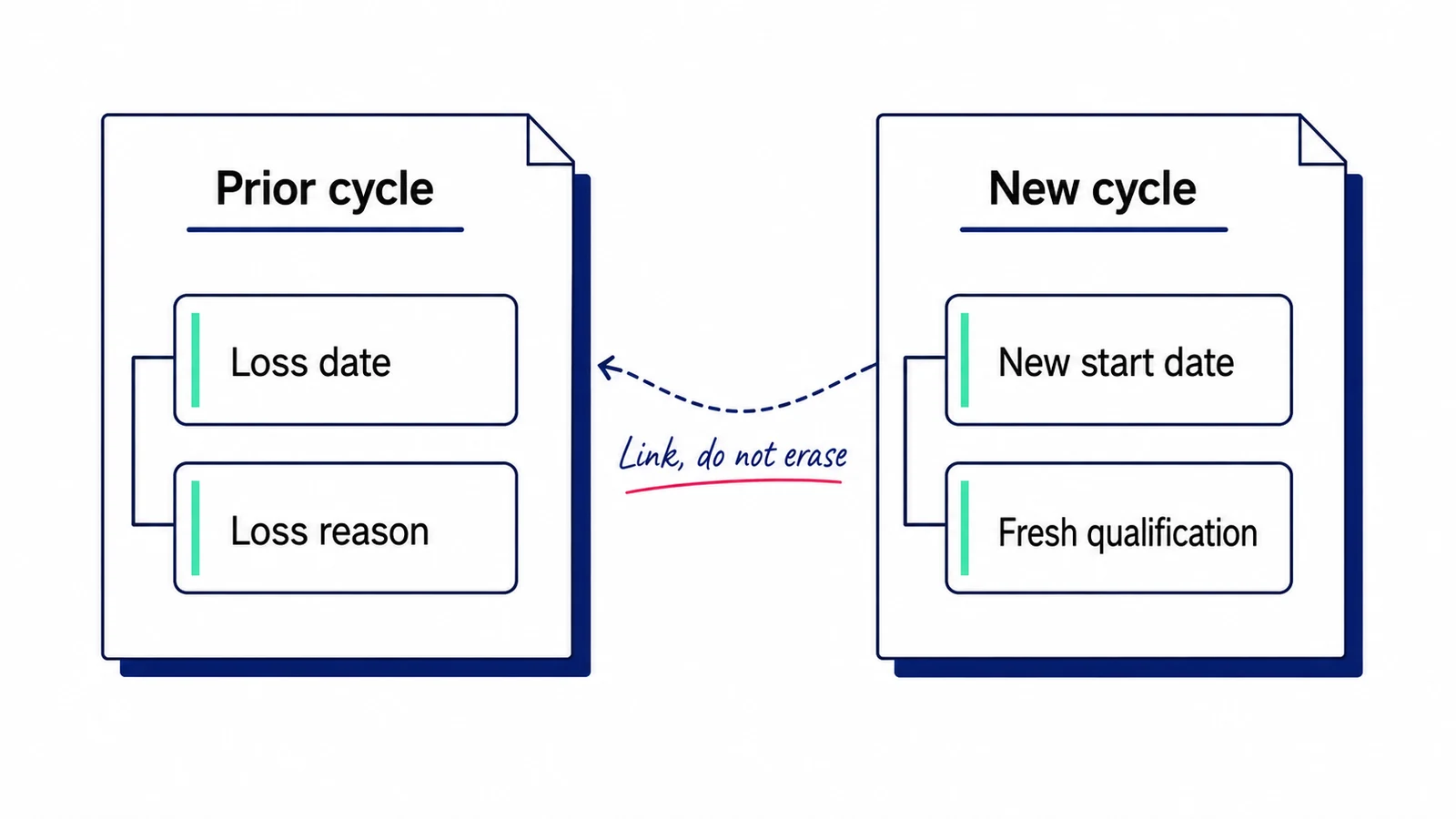
Choose the CRM record policy deliberately. If the same paused evaluation resumes with materially unchanged scope, your process may reopen the original record. If a genuinely new buying cycle begins, a linked new opportunity can preserve the old loss while giving the new cycle its own start date and qualification history.
Whichever policy you choose, retain the original loss date, reason, and opportunity reference. Do not count the same amount as both revived and net-new pipeline.
Check platform behavior before automating transitions. HubSpot's deal-property documentation explains that close dates can update on moves into closed stages, while moving from closed to open does not automatically clear the date unless the relevant setting is enabled.
Those details affect cycle reporting. Your sales pipeline management process should define which timestamp represents reactivation and which measures the new evaluation. Changing a stage should not rewrite the story of the original loss.
Measure qualified recovery rather than activity
Report the motion as a funnel with named denominators.
Start with eligible closed-lost records, then count verified blocker matches, owner-approved contacts, relevant replies, requalified opportunities, and eventual wins. Report suppression and rejected-match counts too.
A message sent is not a recovered opportunity. An opportunity added to the CRM is not proof that the signal caused incremental pipeline.
Define the requalification rate as requalified opportunities divided by the eligible records actually contacted. Separately report the win rate among requalified opportunities that reached a decided outcome. Keep still-open opportunities visible instead of classifying them as wins or losses prematurely.
Compare results by loss reason, signal type, time since loss, and customer segment. Track new buying cycles separately from continuations. Where volume allows, compare similar eligible accounts receiving the play with a holdout group under a defined policy.
For small samples, report counts and inspect conversations. One large deal should not turn an uncertain experiment into a claimed universal advantage.
Set clear stop conditions
Stop automated contact for opt-outs, invalid identities, unresolved eligibility concerns, active opportunities owned elsewhere, or a confirmed continuing blocker. A later signal does not override a do-not-contact instruction.
The FTC's CAN-SPAM guidance covers B2B commercial email. It requires accurate sender information, non-deceptive subjects, appropriate commercial identification, a valid postal address, and an opt-out mechanism with timely handling. Other jurisdictions may impose additional requirements.
A prior sales conversation is useful context. It is not a blanket exemption from your current sending obligations.
Frequently asked questions
What are closed lost opportunities?
They are sales opportunities recorded as unsuccessful at the end of a buying cycle. The account may have chosen another vendor, postponed the project, or failed to meet qualification requirements. Preserve the actual reason rather than assuming every loss is temporary.
When should you re-engage a closed-lost opportunity?
When a buyer-requested follow-up date arrives or verified evidence changes a relevant constraint. Recheck the account and contact before outreach. Time elapsed alone does not show that budget, product fit, or buying priority has changed.
Which buying signals justify reactivation?
A released capability matching an old blocker, a confirmed project restart, or a relevant contract review can justify a conversation. Funding, hiring, and website activity often justify research first. The strength comes from the match to the loss reason, not the signal category alone.
Should you reopen the original opportunity or create a new one?
Use a documented policy that distinguishes continuation of the same evaluation from a new buying cycle. Preserve original loss history either way. A linked new record is useful when the new cycle needs separate qualification and timing, but it is not mandatory for every resumed discussion.
Can AI automate closed-lost re-engagement?
AI can extract candidate loss reasons, match evidence, prepare review queues, and draft messages. Keep uncertain extraction visible, verify important claims, enforce suppression, and require fresh qualification before pipeline entry. Automation should not convert an inferred reason into an unquestioned fact.
Start with one loss reason
Choose one recurring product gap or postponed initiative. Review the original evidence, define what would meaningfully change the decision, and test a small set of matched accounts. Expand only after the owner can explain why each contact is relevant.
For more practical opportunity reactivation guidance, join the newsletter below.