


Data enrichment
Data enrichment is the process of adding, correcting, or updating information on an existing record. In B2B GTM, it can turn a company name, domain, or email address into a fuller profile with industry, size, location, role, contact details, technology, funding, hiring, and other useful fields.
Enrichment does not create value simply by adding more columns. The fields must improve a decision, workflow, message, route, or measurement.
Why it matters
Incomplete records create friction across prospecting, CRM routing, qualification, reporting, and personalization. Sales may contact the wrong role. Marketing may segment accounts incorrectly. RevOps may struggle to explain duplicate or inconsistent data.
Enrichment helps teams apply the ICP, build account lists, support lead scoring, and prepare relevant research. It can also fill fields required for territory assignment, compliance checks, and analytics.
The benefit depends on accuracy and coverage. A populated field can still be wrong, old, inferred, or matched to the wrong company.
The operating priority is visible in Salesforce Research's 2026 State of Sales survey: 79 percent of high-performing sales professionals said they prioritize data hygiene, compared with 54 percent of underperformers. The 25-point gap does not show that hygiene caused performance. It supports validating fields, setting overwrite rules, and assigning ownership before maximizing enrichment coverage.
How it works

The workflow begins with an identifier such as domain, company name, LinkedIn URL, email, phone number, or CRM record ID.
An enrichment provider matches that identifier to its data and returns selected attributes. Company data may include industry, size, revenue band, region, funding, and technology. Contact data may include title, seniority, department, business email, or phone.
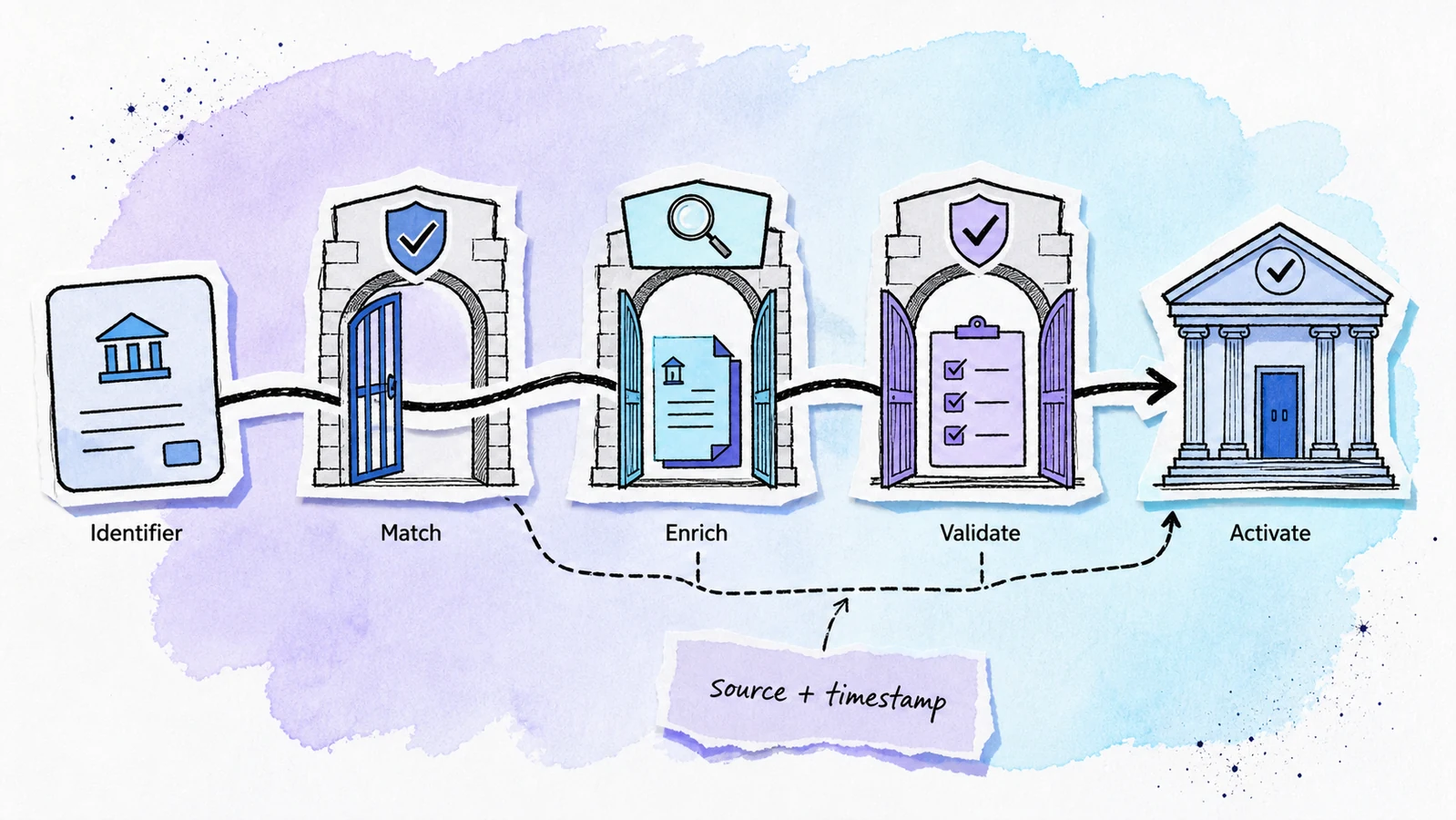
The team then validates critical fields, resolves conflicts, records the source and timestamp, and writes approved values into the correct system.
Waterfall enrichment may query several providers in sequence until a field is found. This can improve coverage, but it also needs clear rules for source priority, cost, and confidence.
Enrichment can combine with intent data, but the two are different. Enrichment describes the account or contact. Intent signals describe possible research or activity.
SaaS example
Imagine a form submission containing only a work email. Enrichment can identify the company, employee range, role, CRM technology, and region. The workflow can then route an enterprise account to sales, send a small account to self-serve onboarding, or flag an uncertain match for review.
A BDR may also use enriched fields to decide which account deserves research before outreach.
Uncertain matches should go to review.
Common mistakes
The first mistake is enriching every possible field without a defined use.
The second mistake is overwriting trusted CRM data with an unverified provider value.
The third mistake is ignoring freshness, confidence, and source provenance.
The fourth mistake is using inferred personal data without privacy and compliance review.
How we see it
Data enrichment should make GTM decisions more reliable. Coverage is useful, but trustworthy fields, clear ownership, and controlled activation matter more than a record that merely looks complete.
The operating policy matters too: define the canonical system, overwrite rules, refresh frequency, and treatment of uncertain matches. Without those controls, enrichment creates conflicting records instead of useful context.