


How to build an outbound sales strategy for B2B SaaS
An outbound sales strategy defines which accounts to contact, why they qualify, what evidence shapes the message, how channels coordinate, and how responses become qualified pipeline. The sequence is the delivery mechanism, not the strategy itself.
Strong outbound begins before the first email or call. It depends on a clear market, reliable data, a credible problem, and an offer proportionate to the evidence.
Salesforce's outbound sales overview describes a proactive process where sellers initiate contact. The practical challenge is deciding who deserves that contact and what the team should learn from each outcome.
Check readiness before adding volume
Outbound can help a company reach a defined market, test a message, open strategic accounts, or create pipeline where inbound demand is limited. It becomes expensive when the company cannot explain who fits or why a buyer should respond.
Before launch, confirm five inputs:
- A specific ideal customer profile
- A repeatable buying problem
- Credible positioning
- A role-relevant value proposition
- A next step that matches the buyer's likely interest
If those inputs are unstable, keep the first campaign narrow. Treat it as a controlled test with explicit learning goals. Do not scale list size to compensate for weak response.
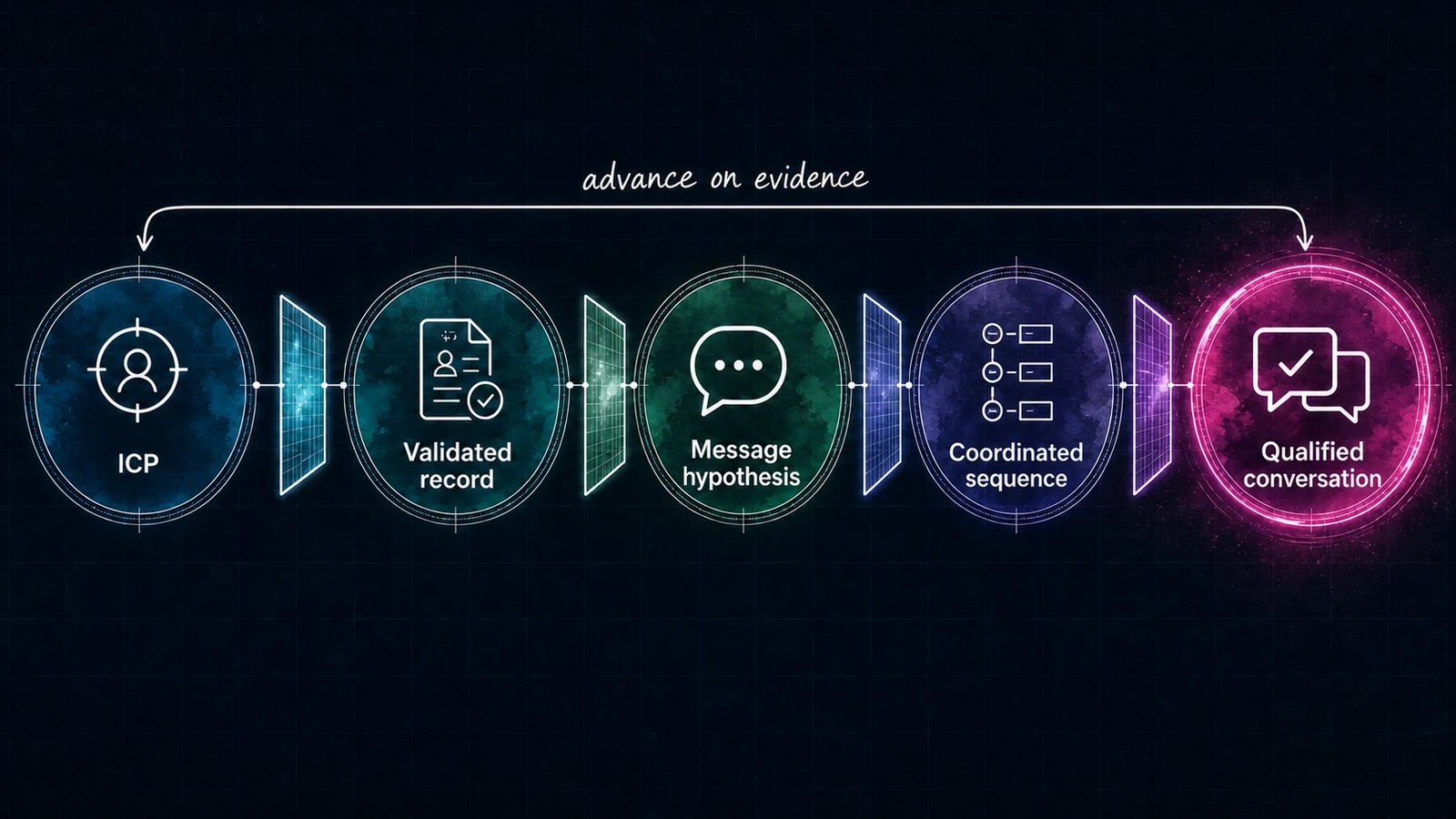
Use five gates from account to conversation
A practical outbound sales system moves through five gates.
| Gate | Required evidence | Failure meaning |
|---|---|---|
| ICP | Account fits documented conditions | Market selection problem |
| Record | Account, contact, and data are verified | Data-quality problem |
| Message | Verified condition supports a relevant claim | Research or relevance problem |
| Sequence | Channels have distinct roles and safe delivery | Execution problem |
| Conversation | Response meets the qualification standard | Offer or qualification problem |
A record should advance only when its gate passes. This protects sender quality, seller time, and measurement clarity.

Define the ICP and exclusions
Firmographics are a starting point. Add operating conditions that explain why the account can adopt and benefit from the product.
A useful ICP record may include:
- Industry and business model
- Company size and relevant team size
- Geography and sales motion
- Current process or technology
- Trigger or timing evidence
- Required integration or security conditions
- Buying roles
- Contract potential
- Explicit disqualifiers
Exclusions are as important as positive criteria. Remove companies that cannot use the product, fall outside supported regions, have poor adoption conditions, or already asked not to be contacted.
The buyer persona adds role-level needs. It should not replace account fit. A suitable title inside an unsuitable company remains a poor outbound target.
Validate every record before enrollment
List size can hide record defects. Validation should answer five questions:
- Is the company real, active, and inside the ICP?
- Is the contact still employed in the relevant role?
- Is the contact data current and permitted for the intended channel?
- Is the contact reason based on verifiable evidence?
- Is the person or domain on a suppression list?
Data enrichment can fill missing firmographic or contact fields, but enrichment is not proof of a buying problem. Record the source and retrieval date for facts that shape the message.
Apollo's outbound process guidance covers list and sequence setup from a platform perspective. Regardless of tool, the team needs a human-readable reason each record entered the campaign.
Use intent data carefully. A signal may change research priority, but it rarely proves purchase intent by itself. Verify what the signal measures before making it visible in copy.
Write one message hypothesis
A message hypothesis links one observed condition to one plausible consequence for one role. It then asks for a small next step.
Use this structure:
Observed condition: A verified change, process, trigger, or constraint.
Likely consequence: A role-relevant cost, risk, delay, or missed opportunity.
Credible claim: How the company addresses that consequence, supported by suitable proof.
Proportionate ask: A question, comparison, short diagnostic, or meeting request that fits the evidence.
For example, a generic message says, "We help revenue teams grow pipeline." A researched hypothesis may note that several product-intent sources route through separate owner rules, then ask how the team handles conflicts between them.
The second version still requires care. The observed condition must be true, and the consequence should be framed as a question when it is not confirmed.
Avoid false familiarity, manufactured urgency, and praise unrelated to the buying problem.
Give each channel a distinct role
Email, calls, and social touches should not repeat one pitch.
Email can state the evidence, consequence, proof, and next step in a form the buyer can inspect later.
Calls can test whether the problem exists, learn the language used internally, and determine whether another role owns it.
Social touches can establish context through useful public material or a relevant interaction. They should not become disguised automation.
A sequence can combine these roles, but no universal touch count fits every market. Account value, buyer role, channel norms, data confidence, and response signals should shape cadence.
Set stop rules before launch. Stop after a direct opt-out, a disqualifying reply, a confirmed wrong role with no referral path, an invalid record, or a defined no-response limit. Suppression must apply across channels.
Protect sender quality and compliance
Outbound email needs accurate identity, authenticated domains, list hygiene, honest subject lines, and reliable opt-out handling.
Google's email sender guidelines explain authentication and sending requirements for mail reaching personal Gmail accounts. Requirements can change, so the team should review the current platform guidance before altering sending infrastructure.
For United States commercial email, the FTC's CAN-SPAM compliance guide describes requirements including accurate headers, non-deceptive subject lines, a physical address, and a functioning opt-out. Company counsel should assess the rules that apply to each market and channel.
Compliance is the minimum boundary. A technically permitted message can still be irrelevant or damaging. Relevance, restraint, and suppression protect the market relationship.
Diagnose each outbound stage separately
Outbound performance is not one conversion rate. Delivery, connection, response, meeting, qualification, opportunity, and revenue each reveal a different problem.
Gong's analysis of more than 300 million cold calls reported a 5.4% average connect rate and 13.3% for the top quartile. Among conversations, the reported meeting-set rates were 4.6% for average performers and 16.7% for the top quartile.
Connect rate is measured per call, while meeting-set rate is measured per conversation. They must remain separate. The analysis uses Gong platform data, and the source page does not disclose geography or the observation window. The differences are descriptive and do not show what caused stronger performance.
Use the benchmark to understand stage separation, not to set a universal quota.

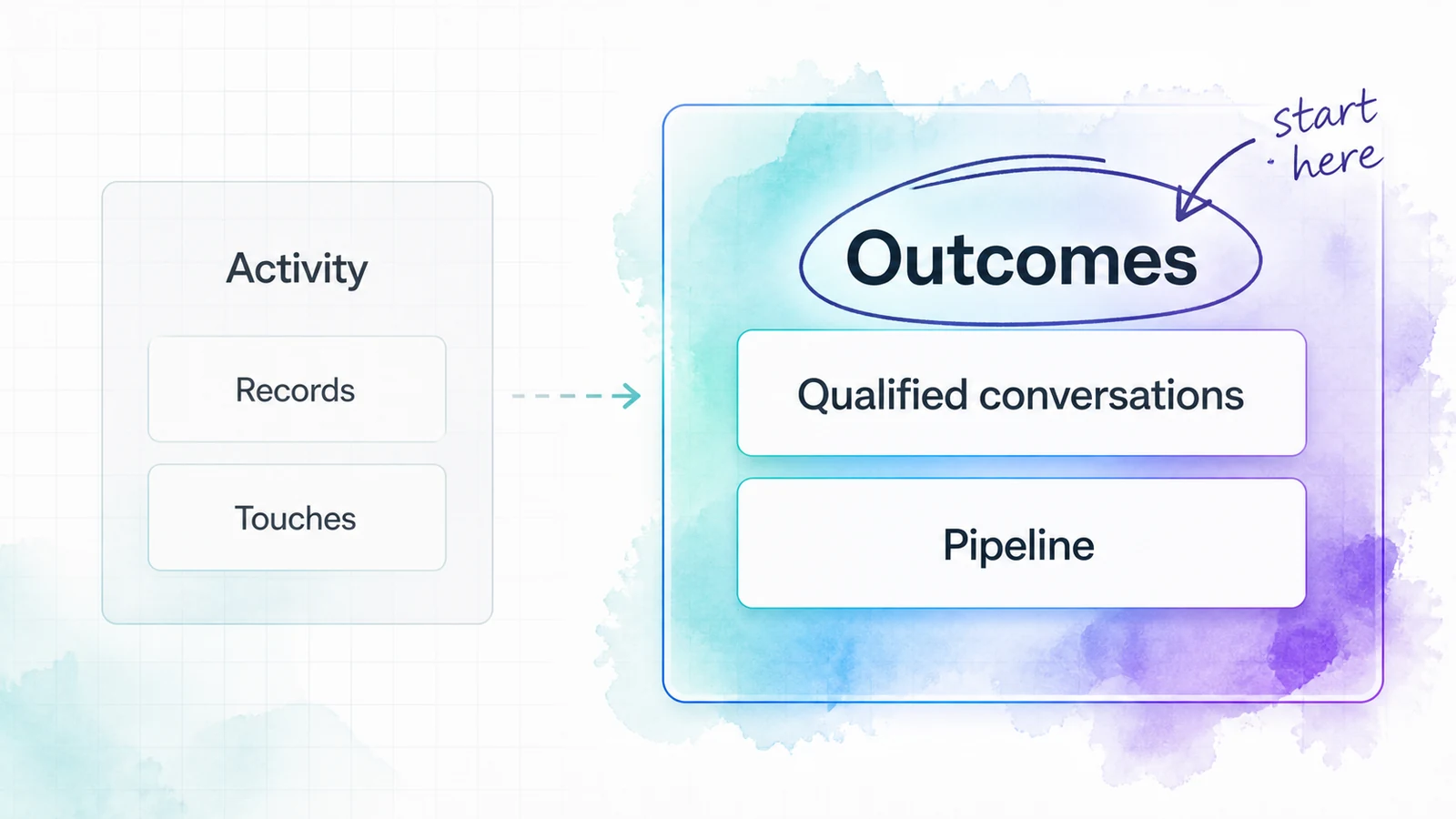
Measure outcomes before activity
Build the dashboard from commercial outcomes backward.
Revenue and pipeline: sourced revenue, opportunity value, qualified opportunity rate, stage progression, and sales-cycle patterns.
Conversation quality: qualified meetings, correct-role conversations, problem confirmation, and accepted next steps.
Response: positive replies, negative replies, referrals, objections, and opt-outs.
Connection and delivery: call connects, email delivery, bounce rate, spam complaints, and domain health.
Activity: records researched, contacts enrolled, calls placed, and messages sent.
Activity helps explain capacity. It should never substitute for the sales pipeline.
Lead scoring may help prioritize inbound or mixed records. For outbound, retain the underlying fit and evidence fields so the team knows why a score changed.
Run controlled message experiments
Change one major variable at a time. Test an audience segment, observed condition, consequence, proof point, ask, or channel role while holding the outcome definition steady.
Set the hypothesis before launch. For example: finance leaders at usage-based SaaS companies may respond more often to forecast variance than to generic efficiency claims. Define the account filter, exact message difference, suitable response, and review threshold.
Qualitative evidence matters. Replies can reveal that the role is wrong, the problem is named poorly, the trigger is stale, or the ask is too large. Feed those findings into the next cohort.
The signal-based selling guide explains how verified changes can influence account priority without turning every signal into a message token.
A focused SaaS example
Consider a SaaS company selling data-routing software to mid-market revenue teams. It selects companies using several intent and product-data sources, with a defined sales team and visible routing complexity.
Researchers validate the account, relevant operations leader, technology evidence, and contact data. The message asks how the team resolves ownership conflicts when multiple signals arrive for one account. Email states the hypothesis. A call tests ownership and language. Public content explains routing models without pretending to know the account's internal process.
The team reviews delivery, connects, relevant replies, qualified meetings, opportunities, and rejection reasons. If calls connect but meetings remain weak, it inspects the message and ask. If delivery fails, it fixes data and sender controls before changing copy.
Common mistakes
Buying a broad list: Record volume rises while fit and data confidence fall.
Using facts without relevance: The message proves research occurred but never connects the fact to a buying problem.
Repeating one pitch across channels: Every touch adds pressure without adding context.
Ignoring suppression: Opt-outs and disqualifying evidence fail to reach every channel.
Changing several variables together: The team cannot tell whether the audience, message, offer, or channel caused the result.
Optimizing meetings without qualification: Calendar volume increases while opportunity quality declines.
Frequently asked questions
When should a B2B SaaS company start outbound sales?
Start after defining a credible ICP, buying problem, value claim, proof, and next step. Keep the first cohort narrow enough to inspect every record and response.
What is the difference between an outbound strategy and a sequence?
The strategy defines the market, evidence, message, channel roles, guardrails, and outcomes. The sequence schedules and distributes selected actions.
How many touches should an outbound sequence include?
There is no universal count. Use account value, buyer role, channel norms, evidence confidence, response signals, and explicit stop rules to set the cadence.
Should outbound combine cold email and cold calling?
It can when each channel has a distinct role and the contact data is suitable. Email supports inspection, while calls can test ownership, urgency, and language.
Which outbound metrics should I track first?
Track delivery, connection, relevant response, qualified meeting, opportunity creation, and pipeline. Keep activity measures as diagnostic inputs, not final success measures.
Build a controlled outbound system
Useful outbound starts with exclusion and evidence. Select the market, validate every record, state one message hypothesis, coordinate channel roles, protect sender quality, and inspect each outcome stage separately.
Book a GTM consultation to design the ICP gates, message tests, sequence roles, and measurement model for your sales motion.