


Signal-based selling: How to prioritize accounts by fit and timing
Signal-based selling is a sales approach that uses observable account or buyer changes to decide which accounts deserve attention now. A usable system combines those timing signals with ICP fit, checks the evidence for relevance and recency, and maps each accepted signal to a specific next action.
The output is a working queue, not a list of interesting events. Each account should land in one of four states: act now, research, monitor, or deprioritize. The reason for that decision should remain visible. A funding announcement, job change, product action, or pricing-page visit can change the order of work. None proves that a purchase will happen.
Fit, intent, and signals answer different questions
ICP fit asks, "Could this account reasonably buy, succeed with, and matter to us?" The answer comes from the market, segment, use case, and motion choices made in the go-to-market strategy. Fit changes slowly.
Intent data records behavior that may indicate research or interest at a person or account level. A timing signal is recent evidence that a relevant problem, initiative, evaluation, or organizational change may be active. A trigger event is a discrete change, such as a leadership hire, job move, product action, fundraising announcement, or technology change.
Signal confidence asks how much weight the interpretation deserves. It depends on source quality, identity confidence, specificity, and corroborating context. These concepts answer different questions:
| Concept | Question it answers |
|---|---|
| Fit | Could they buy and succeed? |
| Intent data | What might they be researching? |
| Timing signal | What changed recently? |
| Signal confidence | How much should we trust this interpretation? |
| Play | What should we do next? |
A team can represent fit and engagement separately. For example, HubSpot documents fit, engagement, and combined scores, plus time filters, positive and negative points, group caps, and engagement-score decay. That is one implementation option, not a universal scoring standard.
Six signal families and what each can support

Signals become useful when you state what was observed, what it may mean, what else could explain it, and how to verify the interpretation.
| Signal family | Observable example | What it may mean | Alternative explanation | Verification question | Proportionate action |
|---|---|---|---|---|---|
| First-party engagement | Known stakeholders return to product or commercial pages | An evaluation may be active | Existing users are checking documentation | Is the identity valid, and is there a relevant open motion? | Review account context and route |
| Product usage | A trial account reaches a relevant workflow | The user encountered the problem your paid offer addresses | A single user is exploring without authority | Is usage sustained across the right roles? | Offer help tied to the workflow |
| People change | A RevOps leader joins | Priorities or ownership may change | The new leader may retain the current plan | Does the role own the problem you solve? | Research the remit before contact |
| Company event | Funding is announced | New initiatives may become possible | Capital may be reserved for unrelated work | Is a relevant initiative visible? | Monitor or research, based on fit |
| Technographic change | A relevant tool is added or removed | A workflow is being rebuilt | The detection may be delayed or wrong | Can another source confirm the change? | Verify before choosing a play |
| Third-party research | Account-level interest rises on a relevant topic | More people may be researching the problem | Identity or topic matching may be broad | Is there first-party or account context to corroborate it? | Add to research, not automatic outreach |
A seller-facing action deserves more weight than a weak research trace, but it usually arrives after the buying group has already done substantial work. The 2025 6sense Buyer Experience Report surveyed nearly 4,000 buyers. It found that 94% had ranked their shortlist before seller contact, 79% initiated that contact themselves, and 77% spoke first with the vendor they ultimately selected. First contact therefore reflects an existing preference more often than it creates one.
Detection tools can monitor these events at scale. Clay's documentation, for example, describes monitoring new hires, promotions, job changes, brand mentions, and company news or fundraising for supplied records. The operator chooses filters and recurrence. The detected event still needs interpretation.
Prioritize accounts by fit and timing

Fit sets the boundary for where the team wants to win. Timing evidence changes queue order inside that boundary. This keeps a noisy event from pulling an off-market account above a strong-fit account without current evidence.
The basic matrix produces four decisions:
- Act now: High fit with strong, relevant timing evidence. Assign the appropriate play after identity, CRM-state, and suppression checks.
- Research: Low fit with strong timing evidence, or relevant evidence whose fit or interpretation is uncertain. Resolve the uncertainty before spending seller time.
- Monitor: High fit with weak or stale timing evidence. Keep the account in the target market without forcing a trigger-led message.
- Deprioritize: Low fit with weak timing evidence. Remove it from the active queue for this motion.
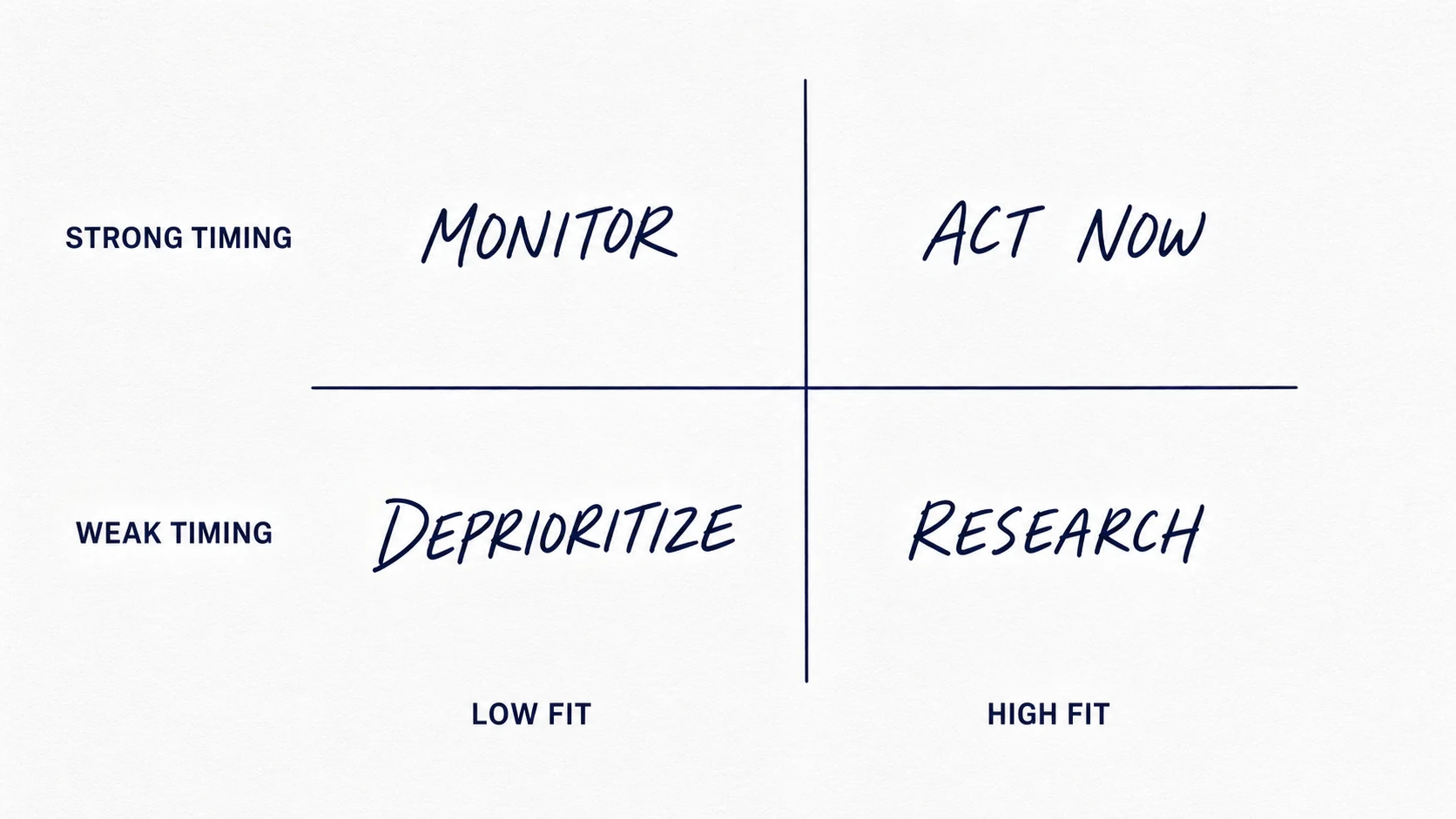
This model aligns with Common Room's account-prioritization method, which ranks accounts using fit, timing, and momentum and separates dynamic priority bands from static tiers. Keep any vendor's sample thresholds illustrative. Your thresholds must reflect your own product and motion.
Recency and confidence modify the matrix decision. They do not need to become a hidden third axis. Every signal should have a recorded date and an expiry rule. The first freshness window is an internal hypothesis. Shorten or extend it only after comparing aging signals with useful downstream outcomes.
Confidence controls how assertive the action can be. Verified activity from multiple known stakeholders can support direct outreach or routing. A weakly identified account-level topic signal may support research. An unverifiable event may warrant suppression.
At minimum, each queue item should contain:
- Account and relevant people
- ICP fit and exclusion reason, if any
- Signal source, event, and observed date
- Possible meaning and alternative explanation
- Identity and source confidence
- Corroborating context
- Current customer, opportunity, and ownership state
- Decision, owner, next action, and expiry
An opaque total score can sort records, but it cannot explain the rank. Keep the fields that created the decision available to the operator who must challenge it.
Build an explainable signal queue

Start narrow. Choose one ICP and one use case where a change could alter account timing. Define a small set of accepted signals, alternative explanations, exclusions, and proportionate plays before connecting more sources.
Capture the event and preserve its source and timestamp. Then verify whether the identity is person-level, account-level, or inferred. Do not turn anonymous account activity into the claimed behavior of a named buyer.
Check CRM state before creating work. Suppress current customers when the play is meant for prospects. Suppress or route open opportunities to the owner. Remove competitors, bots, students, irrelevant roles, duplicates, and records without a legitimate account match.
Enrich only what the decision needs. A company event may require segment, team size, current technology, or role ownership. More fields do not automatically improve the decision. The GTM engineer or another technical owner can connect capture, enrichment, routing, and logging, while RevOps keeps ownership and process rules inspectable.
Assign the play after qualification. The play should state the owner, action, channel, message context, suppression logic, and review point. "Act now" could mean route an existing opportunity, call a known evaluator, send relevant help, or research a buying group before contact. It does not always mean email.
Finally, set an expiry and record the result. A stale event with no reinforcement should lose priority. A source that repeatedly produces ambiguous identities or irrelevant work should lose weight or leave the system.
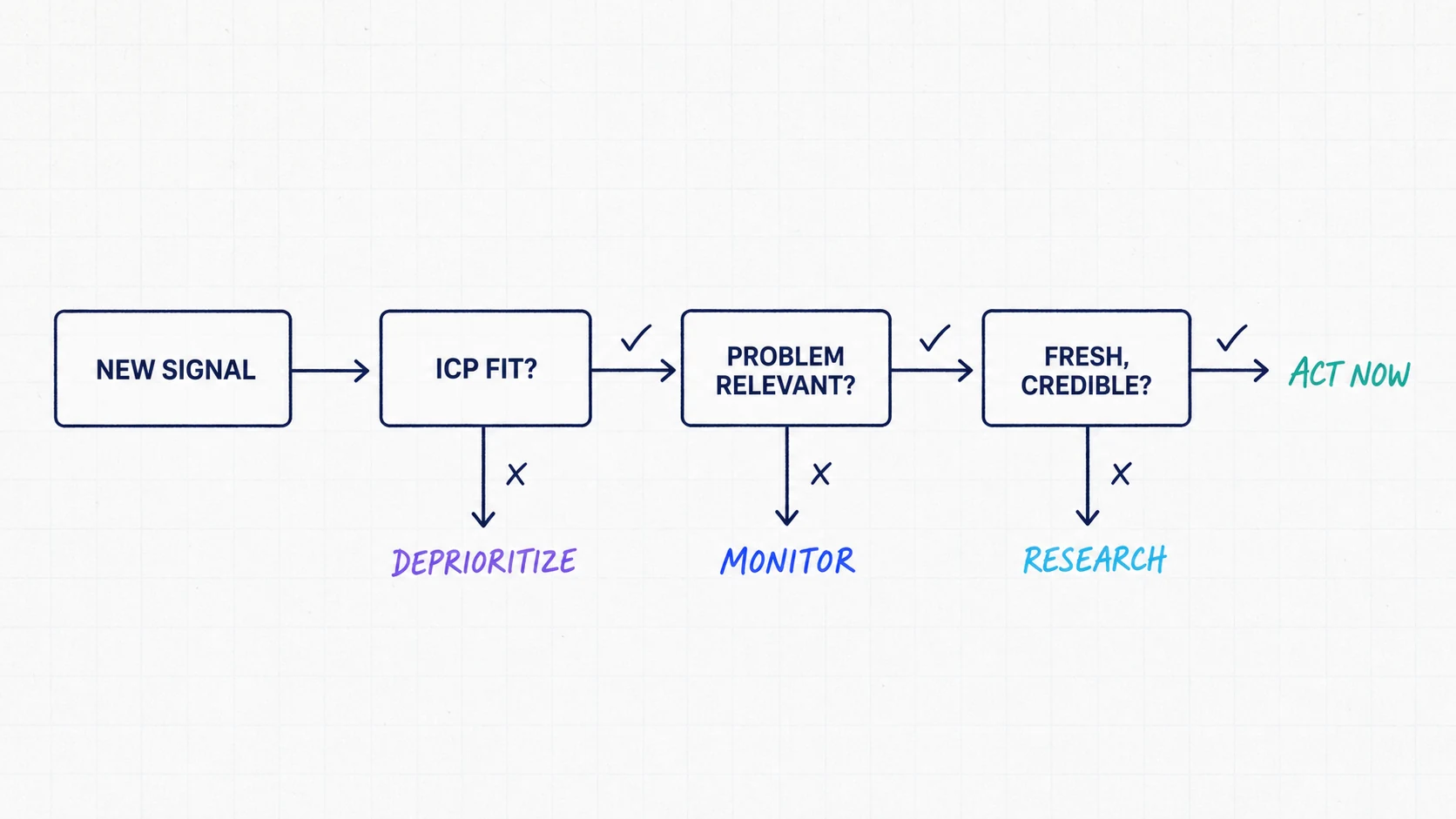
Four SaaS account examples
Consider a hypothetical seller of data-quality workflow software for Series A to C SaaS companies with established outbound teams.
Account A fits the ICP. A RevOps leader recently joined, and the company posted a CRM data role. Those events suggest that ownership and staffing may be changing, but they do not confirm a buying project. The account enters research. If the team confirms that data quality sits within the leader's remit, it can send a role-relevant note.
Account B announced funding but has no outbound team and sits outside the ICP. Funding does not prove budget for this category. The event does not create an active sales task, so the account is deprioritized for this motion.
Account C is high fit and shows repeat first-party engagement from multiple known stakeholders. After checking identity, bots, customer status, open opportunities, and ownership, the account enters act now. The seller uses the known professional context to choose the play without claiming to know private intent.
Account D is high fit, but its only evidence is an old job-change event with no reinforcement. The account stays monitored. Sending a stale "congratulations on the new role" message would expose poor timing rather than useful relevance.
The event alone never determines the action. Fit, problem relevance, confidence, recency, and current account state do.
Measure whether the signals improve decisions
Measure the system by source and cohort. Track detected volume, accepted signals, suppressed records, false positives, time to action, meetings, qualified sales pipeline, and later outcomes. Keep the counts separate so a high-volume source cannot look useful merely because it creates activity.
Define a false positive operationally. It might be a wrong identity, an irrelevant event, an account already in an active motion, or a signal that repeatedly fails verification. Review examples with sellers because a dashboard cannot reveal every interpretation error.
Use a holdout or simple comparison group when feasible. Compare similar accounts worked through the signal queue with accounts handled through the existing process. The goal is to learn whether the model improves account selection and downstream quality, not to manufacture a lift claim from a small or biased sample.
Revise weights, expiry windows, caps, and suppression rules from those outcomes. Do not call a score predictive until your own records support that description.
Common failure modes and compliance
The first failure is treating an event as intent. Funding, hiring, research activity, and page visits all have multiple explanations. The second is arbitrary precision: point values and thresholds that look analytical but have no relationship to outcomes.
Other failures include leaving signals active indefinitely, treating one person's behavior as account momentum, ignoring stale CRM state, and automating outreach without an owner. Invasive copy is another warning sign. Do not expose inferred browsing behavior, imply surveillance, or cite personal details merely because they are accessible.
Signal-led outreach still carries the same commercial-email duties. The Federal Trade Commission's CAN-SPAM guidance says the law covers B2B commercial email. It requires accurate headers, non-deceptive subject lines, a valid postal address, an opt-out mechanism, and timely handling of opt-outs. Hiring another sender does not remove the advertiser's responsibility.
FAQ
What is the difference between signal-based selling and intent data?
Intent data is one input. Signal-based selling is the operating method that combines multiple evidence types with fit, prioritization, routing, and action. It may use intent data alongside first-party engagement, product activity, people changes, company events, and technographic changes.
Which buying signals are strongest?
Signal strength depends on first-party proximity, relevance to the problem you solve, identity confidence, recency, and corroboration. A signal close to the product and supported by known stakeholder activity may justify a stronger action than a broad third-party topic surge.
How should a team score sales signals?
Keep fit and timing visible, then apply confidence, recency, negative criteria, and caps. Start with explicit rules instead of arbitrary precision. Compare each signal source with downstream outcomes, then revise weights, expiry windows, and suppression rules as evidence accumulates.
Can a startup use signal-based selling without expensive tools?
Yes. Start with one ICP, one use case, CRM history, first-party activity, and a small set of public business events. Review a small queue manually. Add automation when recurring monitoring, identity resolution, enrichment, or routing volume becomes the actual constraint.
How do you avoid false positives or invasive outreach?
Verify identity and CRM state, require a clear connection to the problem you solve, and seek corroborating evidence before using an assertive play. Suppress ambiguous records. In the message, reference only professional context that is accurate, relevant, and appropriate to disclose.
Build a sharper account queue
Join the GTMpreneur newsletter for practical notes on account prioritization, outbound systems, and AI-native GTM.