


Buying committee
A buying committee is the group of people who influence, evaluate, approve, use, secure, or block an organizational purchase. The group may never meet as a formal committee, but its members collectively determine whether a B2B deal proceeds.
The committee is specific to one purchase. Its shape depends on the product, price, risk, implementation effort, and company. A software renewal may involve a small group. A new data platform can pull in users, engineering, security, finance, legal, procurement, and an executive sponsor.
Why it matters
B2B sellers often enter an account through one contact. That person may explain the problem and support the product, yet still lack authority over technical approval, budget, security, or procurement.
The deal becomes fragile when the seller treats that contact as the whole market. A late objection from an unseen role can return an opportunity to evaluation or stop it entirely.
A buying-committee map helps an account executive see which concerns have owners, which relationships are missing, and which evidence must move inside the account. It also gives account-based marketing a practical unit for messaging and engagement.
How it works
Committee roles describe influence in a decision, not job titles. One person may hold several roles, and one role may be shared by several people.
The initiator surfaces the problem. Users judge whether the product helps them do the work. A technical evaluator checks integration and feasibility. Security, legal, or compliance teams examine risk. A financial buyer controls budget. Procurement governs commercial terms. An executive sponsor may connect the purchase to a larger company priority.
A champion carries the change internally. The champion can arrange access, explain the decision process, and help other members evaluate the case. Support from a champion is valuable, but it does not prove approval.
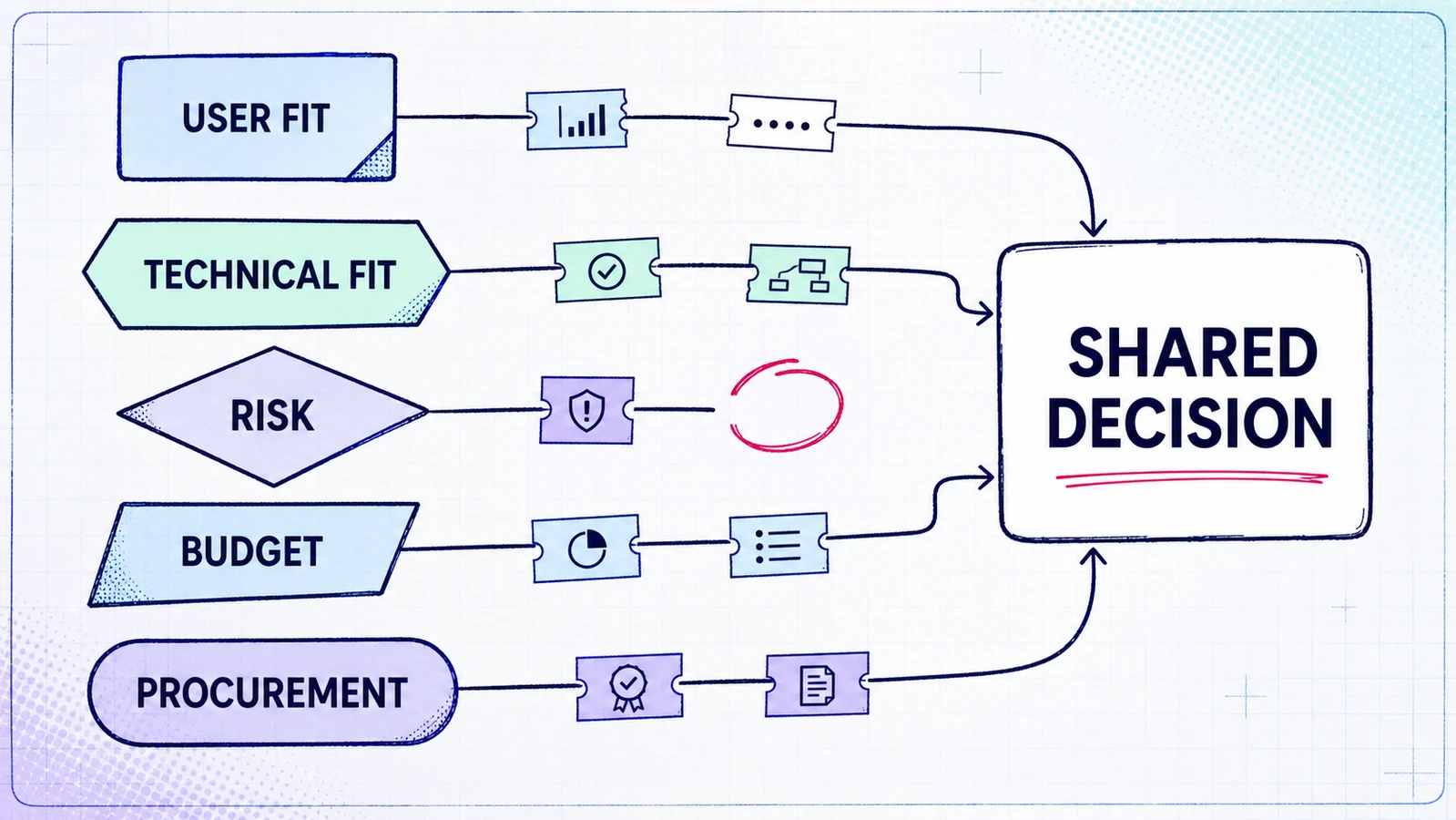
The committee moves through evidence. Users need workflow proof. Technical teams need architecture and integration detail. Finance needs cost and expected value. Security needs controls. Procurement needs acceptable terms. The purchase advances when the group can resolve those concerns together.
Committee maps begin as hypotheses. A buyer persona can suggest likely roles, and intent data can reveal activity. Seller conversations and deal events must verify who has influence, what each person needs, and how the final decision will be made.
SaaS example
An operations leader starts evaluating an analytics platform because reporting takes too long. She becomes the internal champion.
A data engineer tests whether the platform connects to the warehouse. Security reviews access controls. Finance checks the cost against expected time savings. Procurement negotiates the contract. The operations executive approves the change and owns the outcome.
The seller gives each role evidence suited to its concern, then helps the champion carry a coherent case across the group. Progress in the sales pipeline depends on those concerns being resolved, not on the number of contacts added to the CRM.

Common mistakes
The first mistake is treating the champion as the decision-maker. Champions can create momentum, but budget or risk owners can still stop the purchase.
The second is mapping job titles instead of decision roles. A chief technology officer may approve one purchase and barely influence another.
The third is counting contacts as coverage. Five relationships with users do not cover finance, security, or executive approval.
The fourth is freezing the map. New concerns can add legal, implementation, or procurement roles late in the process.
How we see it
A buying committee is a temporary decision system. The seller's job is to understand how evidence travels through that system and where it stalls.
Strong committee coverage means every material concern has a known owner, a credible proof path, and a verified decision role. It does not mean collecting as many names as possible. When the team tracks influence and evidence instead of seniority and contact volume, it can see the actual work required to earn a shared decision.