


SaaS pricing strategy: Models, packaging, and testing
A SaaS pricing strategy defines who pays, which unit connects price to value, how charges accumulate, what each package includes, and how price points change as customers receive more value. It also defines how the company will test, govern, and revise those choices.
Pricing is not one number. A company can choose a sensible price and still create friction if the wrong customer segment sees it, the metric feels unpredictable, or the packages block the natural upgrade path.
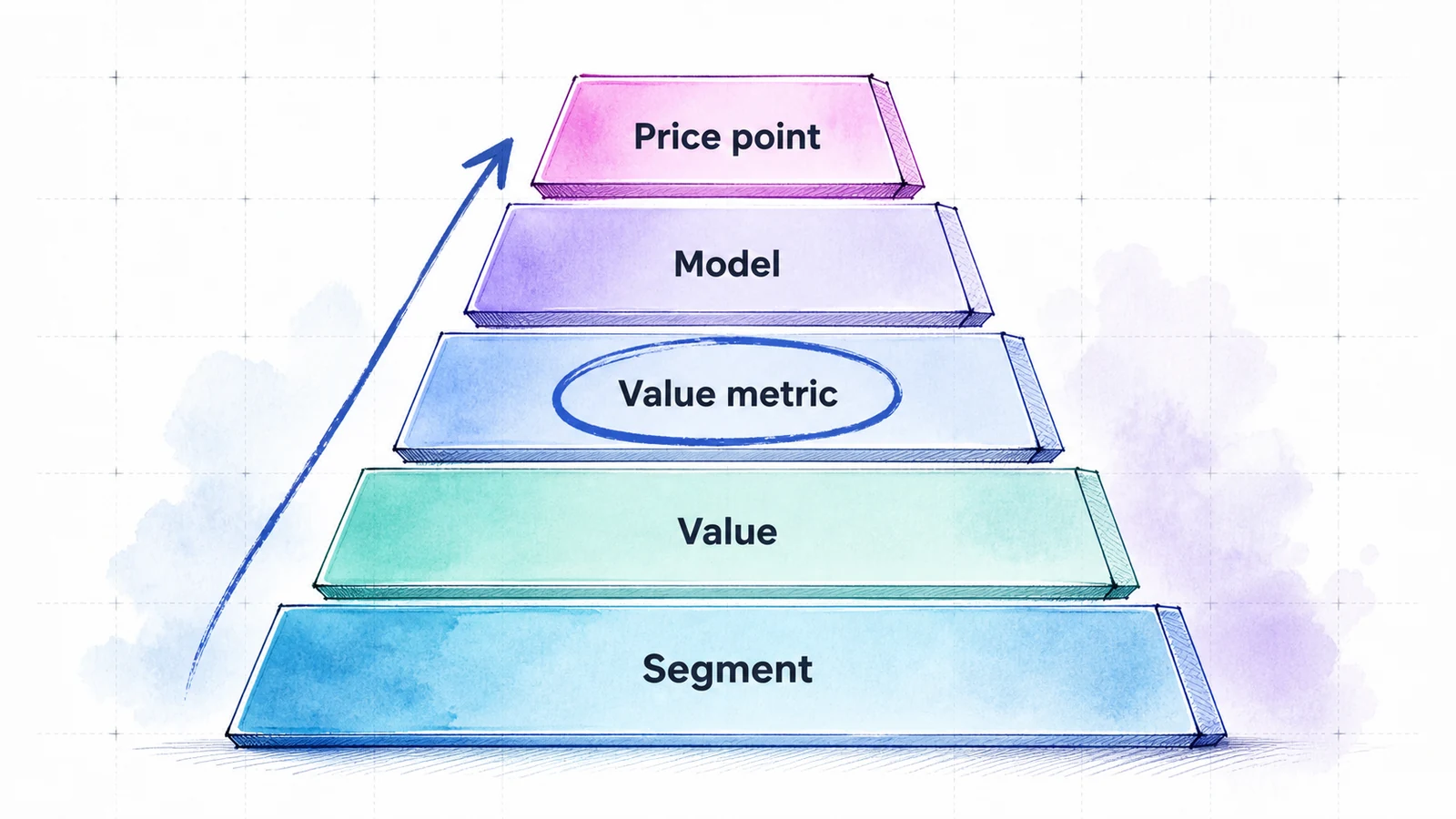
Stripe's pricing and packaging guide connects pricing to customer value, packaging, and measurement. The useful sequence for an operator is: segment, value hypothesis, value metric, charging model, packages, price points, validation, and rollout.
The five decisions inside a SaaS pricing strategy
Teams often discuss models, packages, and prices as if they were interchangeable. They are separate decisions.
- Segment: Which customer and buying situation is the offer designed for?
- Value metric: Which measurable unit tracks the value the customer receives?
- Charging model: How does the bill respond to access, seats, usage, outcomes, or a combination?
- Package: Which capabilities, limits, service levels, and terms belong together?
- Price point: How much does each package or unit cost?
The order matters. A price point chosen before the value metric can look attractive on a page while producing weak expansion or surprising bills. A package built before the segment is clear can combine features that serve unrelated buyers.
Start with the value proposition: the specific outcome, for a specific customer, under a specific set of conditions. Pricing should capture a defensible share of that value while remaining understandable enough to buy and operate.
Choose the segment before the model
Pricing decisions become clearer when the target segment is narrower than “SaaS companies” or “sales teams.” Use market segmentation to separate customers whose value, usage, buying process, and support requirements differ.
For each candidate segment, document:
- the job or problem that triggers the purchase;
- who receives value and who approves spend;
- how value grows after adoption;
- the buying and procurement path;
- acceptable budget predictability;
- implementation and support requirements;
- credible alternatives, including manual processes.
The ICP supplies a boundary for fit. Pricing may need a separate structure when two good-fit segments receive value in materially different ways. An enterprise security team may value governance and deployment control, while a small team values speed and low commitment.
Do not create a new package for every customer request. Create one when a recurring segment has a distinct value pattern and can be served without excessive exceptions.
Select a value metric
A value metric is the unit that connects customer value to price or package expansion. Common examples include seats, contacts, transactions, messages, data processed, locations, revenue managed, or successful outcomes.
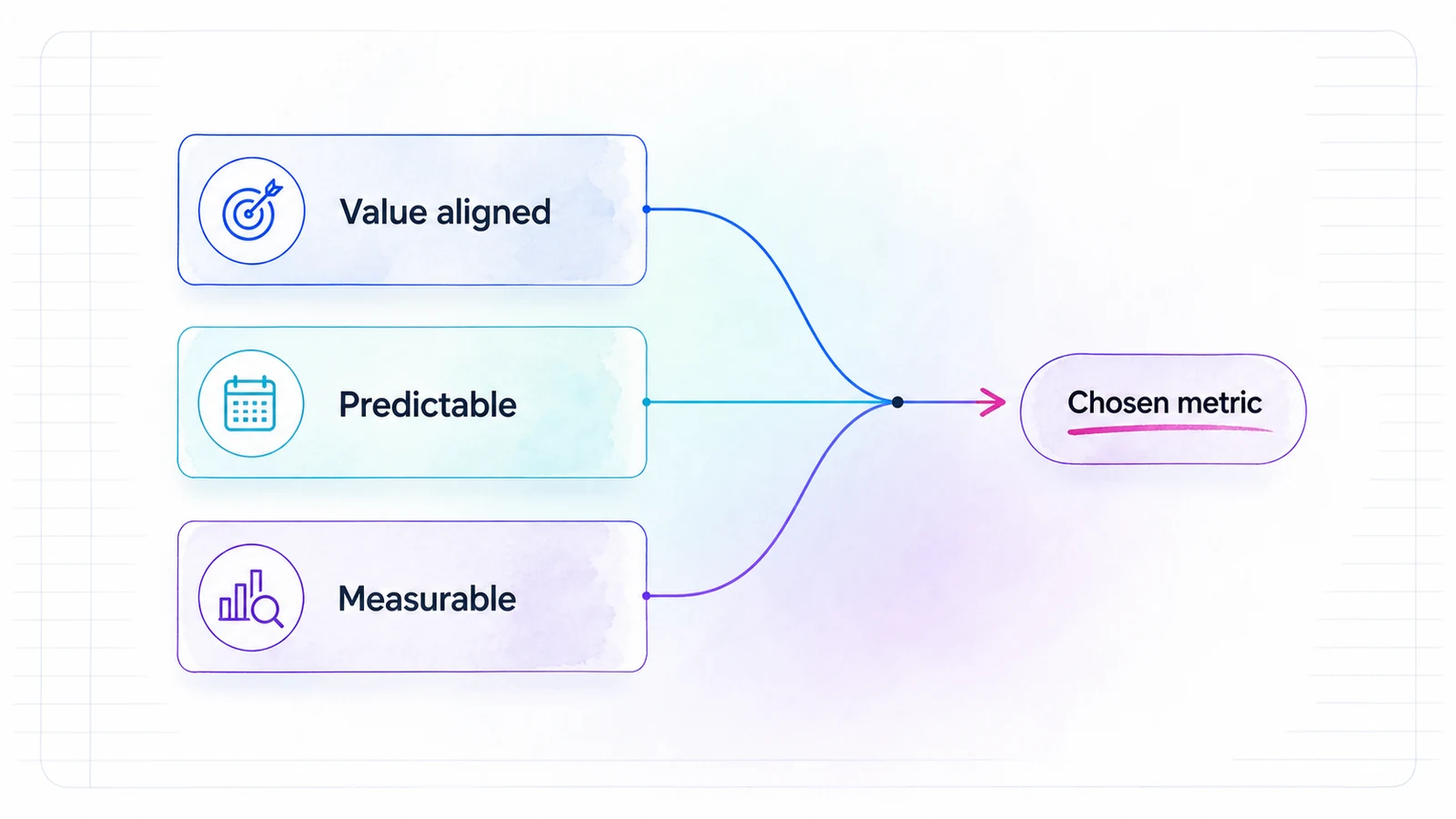
A strong metric passes four tests:
Value alignment: As the metric grows, does customer value usually grow?
Predictability: Can the buyer estimate the bill and explain it internally?
Measurability: Can the product measure the unit consistently, audit it, and resolve disputes?
Expansion path: Can a satisfied customer increase usage or scope without a forced renegotiation every time?
Per-seat pricing fits products where each additional user receives distinct access or productivity value. It becomes restrictive when the product is more valuable with broad participation but the customer is punished for inviting people.
Usage metrics fit products where consumption tracks value and metering is reliable. They become difficult when usage is volatile, the customer cannot control it, or the unit reflects provider cost more closely than customer value.
Outcome metrics can align price closely with value, but attribution, timing, and disputes can make them hard to operate. Use them when the outcome is observable, attributable, and contractually clear.
Compare the main SaaS pricing models
Paddle's model overview covers the familiar structures. The practical choice depends on how value appears.
Flat-rate pricing
One product or package has one recurring price. It is easy to understand and administer. It fits a narrow product with similar customer needs. It limits segmentation and expansion when customer value varies widely.
Per-seat pricing
The customer pays for the number of users. It is predictable and familiar for collaborative software. It can discourage adoption when broad internal participation creates the value.
Usage-based pricing
The customer pays according to metered consumption. It aligns well when usage is a credible proxy for value. Revenue and customer bills can become less predictable, and poor instrumentation creates billing risk.
Tiered pricing
Customers choose among packages with different capabilities, limits, or service. It supports segmentation and a clear upgrade path. Weak tiers use arbitrary feature walls or make the middle package attractive only through visual tricks.
Hybrid pricing
A base subscription provides access or a committed amount, while seats, usage, add-ons, or overages expand the bill. Hybrid structures can balance predictability and value capture. They also add explanation and billing complexity.
Outcome-based pricing
Payment depends on a verified result. It can align incentives when the provider materially affects the outcome. It requires strict definitions, attribution rules, timing, and dispute handling.
Treat usage pricing as an option, not a default
Usage pricing is common enough to evaluate seriously. In Metronome and Greyhound Capital's January 2025 survey of 100 SaaS companies, 85 percent reported adopting usage-based pricing. The remaining 15 percent is a derived complement, not a separately reported finding.
The survey was produced by a usage-billing vendor and an investor. Its public page does not establish a representative US sample, and adoption may include hybrid models. The result shows prevalence within the sample. It does not show that usage pricing caused better growth, retention, or margins.
Use four gates before selecting it:
- The usage unit tracks customer value.
- Customers can understand and influence consumption.
- Metering, reporting, and dispute handling are reliable.
- The revenue variability is acceptable to the company.
A product-led growth motion may benefit from a low-friction entry and usage expansion, but only when the bill remains legible. A sales-led enterprise motion may prefer a committed minimum with measured overage.

Build packages around buying decisions
Packages should help a customer choose the right level of value and service. They should not function as a warehouse for every feature.
For each package, define:
- target segment and use case;
- core outcome;
- included capacity or limits;
- governance and security needs;
- support or implementation level;
- natural reason to upgrade;
- features that must remain universal for product integrity.
There is no universal package count. A simple product may need one public plan plus a negotiated enterprise path. A broader product may need more. Add a package only when it represents a meaningful buying decision.
The sales motion matters. Product-led and sales-led growth place different demands on packaging. Self-serve buyers need transparent boundaries and immediate activation. Enterprise buyers may require security, procurement, implementation, and contract flexibility.
Set initial price points with multiple forms of evidence
An initial price is a hypothesis. Use several evidence sources because each one has limits.
Customer interviews: Explore the consequence of the problem, current spending, approval path, and comparison set. Do not ask only, “What would you pay?”
Competitive context: Record how alternatives package value and where switching costs appear. A competitor's price does not reveal its discounting, margins, customer mix, or strategy.
Willingness-to-pay research: Price-range questions and structured choice exercises can reveal sensitivity and tradeoffs. Results depend on sample quality and how realistic the offer feels.
Behavioral tests: Paid pilots, proposal acceptance, controlled offer tests, and renewal conversations reveal behavior closer to a purchase. Protect buyers from misleading experiments and keep contract terms clear.
Unit economics: Check gross margin, service cost, acquisition cost, support load, and expected expansion. ACV should reflect the commercial structure rather than becoming the only pricing goal.
Use a price range when evidence is thin. Record which assumption would cause the range to change.
Test the pricing architecture, not only the number
A test should isolate a decision. If the model, packages, page, sales script, and price all change together, the outcome is hard to interpret.
Useful tests include:
- comparing two value metrics in buyer interviews;
- testing whether buyers understand the unit without explanation;
- offering controlled package choices to comparable new prospects;
- measuring conversion, activation, usage, expansion, and support effects by cohort;
- reviewing lost deals for price, packaging, procurement, or value objections separately.
Do not optimize only for initial conversion. A lower entry price may increase signups while reducing qualified adoption or adding costly customers. A higher price may improve ARR per customer while slowing pipeline creation.
McKinsey's survey of 184 software decision makers found that 40 percent used seats as their primary pricing metric. It also reported an association between simpler structures and more effective pricing and discount controls. Those findings provide context, not a rule that seats or simplicity will fit every product.

Govern discounts and exceptions
Discounts change the pricing strategy even when the list price stays still. Define who can approve a discount, which reasons are acceptable, what the customer gives in return, and how the exception will be recorded.
A concession can exchange price for a longer commitment, earlier payment, narrower scope, a reference, or reduced service. Avoid discounts that hide a value or packaging problem.
Track exceptions by segment, seller, package, reason, and renewal outcome. Repeated exceptions signal that the public architecture and the buying process disagree.
Roll out a pricing change carefully
For an existing product, choose which customers receive the new structure, when it applies, and how migration happens. Options include new customers only, renewal-based migration, a temporary grandfathering period, or a voluntary path tied to added value.
Before launch:
- Model revenue, margin, conversion, expansion, and churn scenarios.
- Test billing and metering from event to invoice.
- Prepare sales, success, support, finance, and legal teams.
- Explain the customer value and transition rules plainly.
- Define rollback and exception criteria.
Grandfathering protects trust but can create long-term complexity. Forced migration simplifies the catalog but can increase churn or negotiation load. Choose based on customer impact and the company's ability to support parallel structures.
Measure what happens after launch
Monitor a balanced set of outcomes:
- conversion and sales-cycle length;
- activation and retained usage;
- expansion, contraction, and churn;
- average discount and exception rate;
- gross margin and support cost;
- invoice disputes and billing tickets;
- package mix and upgrade paths;
- revenue concentration and predictability.
Connect these signals to the SaaS growth strategy. A pricing change that lifts short-term revenue but weakens adoption or retention may have shifted the constraint rather than improved the business.
Common SaaS pricing mistakes
- Choosing a model before defining the segment
- Copying competitor price points without customer evidence
- Using a metric that tracks provider cost instead of customer value
- Adding packages for isolated feature requests
- Treating stated willingness to pay as purchase behavior
- Changing several pricing decisions in one test
- Letting discounts create an unofficial package
- Measuring revenue without adoption, margin, and retention
Frequently asked questions
What is the best SaaS pricing strategy?
There is no universal best strategy. The strongest choice aligns a defined segment, value metric, charging model, package, and price point, then proves the combination through buyer behavior and business outcomes.
How do you choose a SaaS value metric?
Choose a unit that rises with customer value, is predictable enough for the buyer, can be measured reliably, and creates a fair expansion path. Test whether customers understand and can influence it.
Is usage-based pricing right for every SaaS product?
No. It fits when usage tracks value, customers can understand consumption, metering is reliable, and both sides can tolerate variability. A base commitment or another model may fit better otherwise.
How many pricing tiers should a SaaS company offer?
Use the fewest packages needed to represent meaningful buying decisions. The right count depends on segment differences, product breadth, sales motion, service requirements, and upgrade paths.
How often should SaaS pricing change?
Review pricing when customer value, product scope, costs, segment mix, or buying behavior changes materially. Change it when evidence supports a specific revision and the company can manage the transition.
Write the pricing sentence
Before discussing a price point, write one sentence: “For this segment, we charge by this unit because it tracks this customer value.” If the sentence is unclear, the next task is pricing research, not a number.