


Sales enablement strategy: Build behavior change into the plan
A sales enablement strategy is a coordinated plan for changing specific seller behavior tied to a commercial problem. It combines a clear standard, practice, content, tools, manager coaching, and measurement for a defined seller group and sales stage.
The output is not a larger content library. It is better execution that can be observed in a customer conversation, opportunity, account plan, or CRM record.
Suppose discovery calls produce vague problem statements and weak next steps. The strategy should define the discovery behavior, give sellers a way to practice it, help managers observe it, and measure whether opportunities leave discovery with stronger evidence. Building another folder of case studies would not address that constraint.
What belongs in a sales enablement strategy
Salesforce defines sales enablement as giving sellers the content, training, coaching, and technology required to engage buyers effectively. Its sales enablement strategy guide also emphasizes goals, ownership, actions, and measurement.
That definition is useful when the components are tied to a behavior. A strategy should specify:
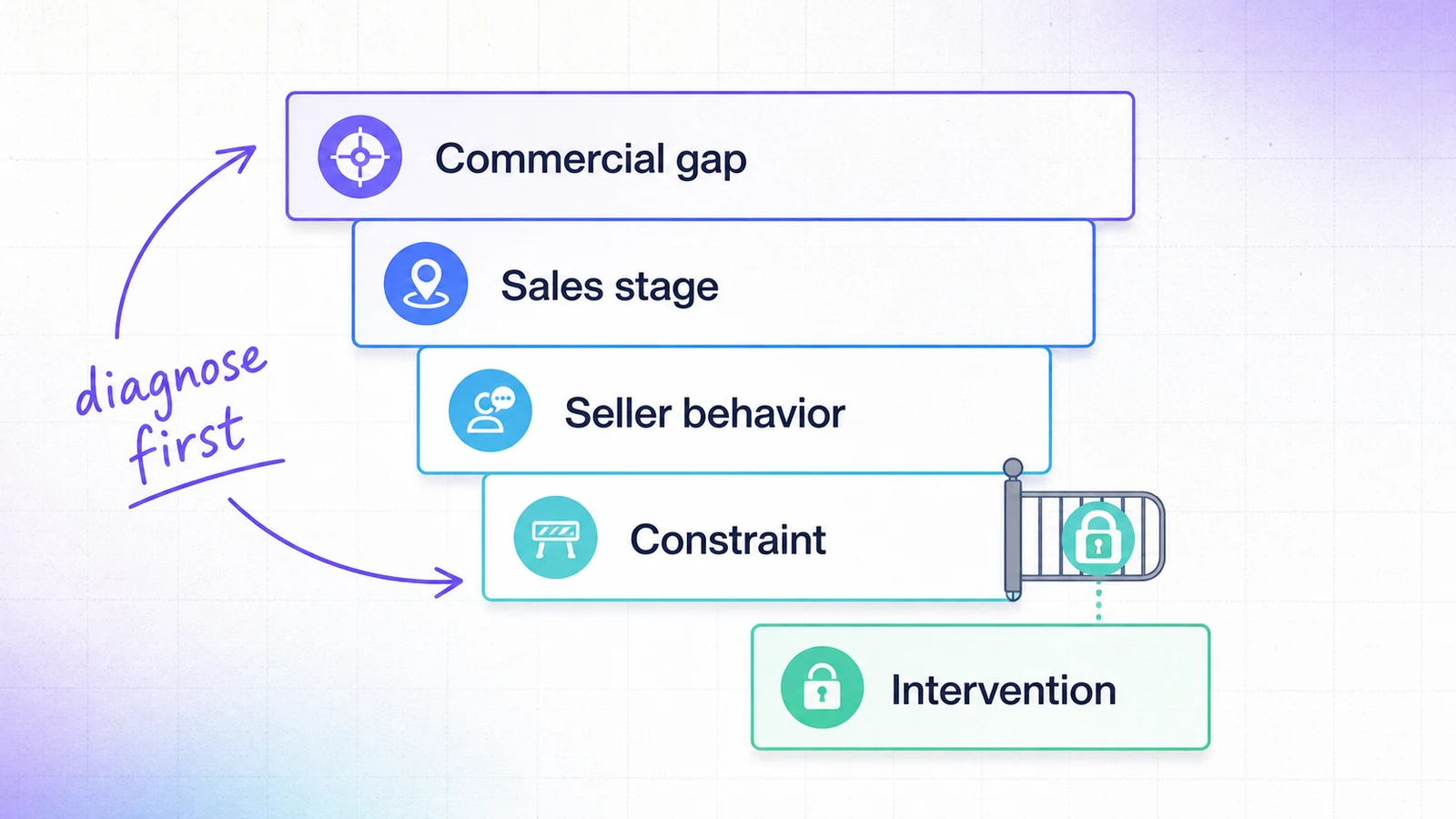
- The commercial problem and affected sales pipeline stage
- The seller group and target behavior
- The standard sellers and managers will use
- The constraint preventing that behavior today
- The intervention, practice, and reinforcement sequence
- The owners across sales, managers, marketing, product, and operations
- The evidence that will show adoption, behavior change, and customer progress
Enablement does not need to own every sales problem. Territory design, compensation, hiring, forecasting, and CRM administration may sit elsewhere. They become part of the enablement plan only when the diagnosis shows that they block the target behavior.
Start with a commercial problem
Broad goals such as "increase productivity" do not tell the team what to change. Begin with a visible problem at a specific stage.
Examples include:
- New account executives take too long to run an independent discovery call.
- SDRs book meetings that do not meet the agreed qualification standard.
- Opportunities reach proposal without a confirmed buying process.
- Reps cannot explain the value proposition for a new segment.
- Managers identify weak multithreading only after a deal stalls.
Use pipeline data, call reviews, opportunity records, win-loss findings, manager observation, and seller interviews to define the problem. A metric points to the location. Evidence from calls and deals explains the behavior inside it.
For example, a drop between discovery and evaluation may come from poor qualification, weak problem depth, missing technical fit, slow follow-up, or a pricing mismatch. Each cause requires a different response.
Diagnose the constraint before choosing an intervention
The same weak result can come from several constraints:
- Knowledge: the seller does not know the product, market, buyer, or process.
- Skill: the seller knows the standard but cannot perform it reliably in a live conversation.
- Process: the required step, owner, or handoff is unclear.
- Data: the seller lacks the account, buyer, or product information needed for the decision.
- Tool: the system makes the desired action slow or difficult.
- Manager capacity: the manager cannot observe or reinforce the behavior often enough.
- Incentive: the seller is rewarded for a different action.
Training helps knowledge and skill gaps. It will not fix a routing rule, missing product signal, impossible CRM flow, or conflicting compensation plan.
The diagnosis should be narrow enough to test. Instead of "reps need better discovery," write: "Mid-market AEs do not confirm business impact and decision process before moving an opportunity from discovery to evaluation." That statement identifies the role, stage, and missing behavior.
Define the behavior standard
A standard describes what good execution looks like without forcing every seller to use identical words.
For discovery, the standard might require the seller to document the current process, business consequence, desired change, affected stakeholders, decision process, and agreed next step. For a signal-based selling motion, the standard might require the rep to explain why the signal matters, verify the account context, and choose the approved action before outreach.
Make the standard observable. A manager should be able to find evidence in a call, email, account plan, or CRM field. The seller should know what evidence counts and what does not.
Keep the first standard small. If a rubric contains twenty behaviors, practice becomes diffuse and manager feedback becomes inconsistent. Choose the few behaviors most likely to improve the affected stage.
Design the intervention around the constraint
An intervention can combine several elements, but each one needs a job.
Instruction creates shared understanding
Explain the customer problem, the standard, examples, and the reason behind the change. Use short material that sellers can revisit near the relevant moment.
Practice creates capability
Reps need to perform the behavior, receive feedback, and try again. Roleplay, call annotation, deal review, written exercises, and live simulations can all help. Choose the format closest to the real task.
Content supports the customer conversation
Content should answer a known buyer or seller need. A discovery guide, objection note, proof point, calculator, mutual plan, or case study should connect to a stage and behavior. Usage alone does not prove quality; examine whether the asset supports customer progress.
Tools reduce friction
Technology should make the target behavior easier to perform or observe. That may mean account context inside the CRM, call review, content access in the sales flow, or automated capture of agreed fields. Do not add a tool without naming the delay or error it should remove.
Managers reinforce the standard
The manager observes the behavior in actual selling, gives specific feedback, and follows up during later calls or deal reviews. Without reinforcement, the new standard competes with established habits and immediate deal pressure.
Gong's sales enablement strategy framework places regular evaluation, coaching, and data-backed revision alongside onboarding and tools. That combination is stronger than treating enablement as a launch event.
Managers turn training into repeated behavior
Front-line managers should be part of design before the seller session occurs. They need the same standard, an observation rubric, examples of acceptable evidence, and a realistic coaching cadence.
A simple reinforcement cycle is:
- State the behavior and why it matters.
- Let sellers practice with a realistic case.
- Observe the behavior in live or recorded selling.
- Give feedback on one or two specific moments.
- Check the same behavior in the next opportunity.
Manager capacity is a design constraint. If each manager has little time, the program can use short call clips, sampled opportunity reviews, peer practice, or a rotating behavior focus. The answer is not to pretend managers will complete a long coaching program every week.

Assign ownership without creating a committee
Cross-functional input does not require shared ownership of every decision.
- Sales leadership chooses the commercial priority and seller group.
- Enablement owns diagnosis, program design, practice, and program measurement.
- Managers own observation and reinforcement.
- Marketing and product contribute customer, message, product, and competitive expertise.
- RevOps owns reliable data, fields, reporting, and system changes.
- Sellers provide feedback about realism, friction, and buyer response.
One program owner should decide scope, standard, timing, and revision. Contributors should have explicit deliverables and dates. This keeps an enablement plan from becoming a series of optional requests across departments.
The plan should also connect to the company's go-to-market strategy. If the business is moving upmarket, launching a product, or changing its sales motion, enablement priorities should reflect that decision rather than maintain last quarter's content calendar.
Access and time can block enablement before content does
The Salesforce State of Sales, Seventh Edition provides useful evidence about current constraints. Salesforce surveyed 4,050 sales professionals across 22 countries from August through September 2025 using an anonymous third-party panel.
Forty percent reported lack of access to data or insights as an obstacle to enabling reps. Thirty-eight percent cited managers' lack of time, 37% cited lack of enablement expertise, and 34% cited reps' lack of time. The responses were global, cross-industry, and not mutually exclusive.
These findings do not describe US SaaS alone, and they do not show that fixing one obstacle causes revenue growth. They do challenge a common response to weak execution: create more material. A team should first determine whether sellers lack information, practice, manager attention, or capacity to apply the standard.
Highspot's 2025 sales enablement research provides another current view based on 350 GTM professionals across 21 countries and 61 industries. Its broad sample also makes it directional context rather than a direct benchmark for one SaaS team.

Run a focused pilot
Start with one seller group, one stage, and one behavior. A 90-day pilot can follow this sequence:
- Establish the baseline from recent calls, deals, and stage data.
- Confirm the target behavior with managers and high-performing sellers.
- Remove obvious process, data, and tool barriers.
- Teach the standard with real examples.
- Run repeated practice and manager feedback.
- Observe the behavior in live opportunities.
- Compare adoption and stage evidence with the baseline.
- Revise the standard or intervention before expanding.
The pilot does not need to wait 90 days if evidence arrives earlier. The fixed window protects the team from declaring success after attendance or abandoning the plan after one difficult week.
Measure a chain of evidence
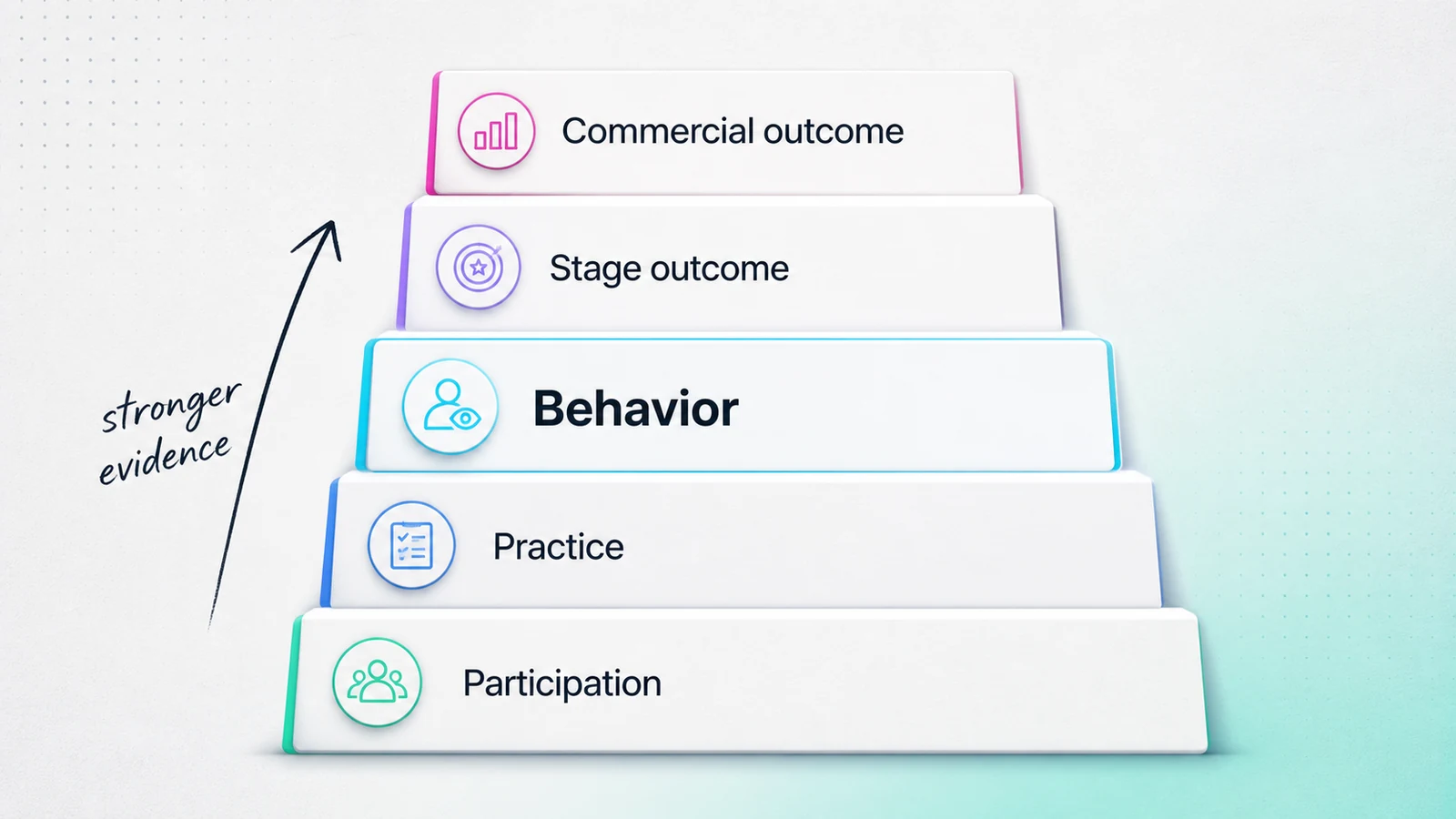
Enablement measurement should move through five levels:
- Participation: Did the intended sellers and managers complete the required activity?
- Practice: Can they perform the behavior in a realistic exercise?
- Observed behavior: Does the behavior appear in calls, deals, account plans, or system records?
- Stage outcome: Does the affected part of the SaaS sales funnel show better progression, evidence quality, or cycle time?
- Commercial outcome: Do win rate, revenue, retention, contract value, or ramp improve for the relevant group?
Do not jump from attendance to revenue. Many factors influence a commercial outcome. Use a baseline, comparison group, staggered rollout, or matched cohort when possible. Record product, pricing, territory, and market changes that might affect the result.
Behavior evidence is the bridge. If the behavior did not change, the program cannot credibly claim the later outcome. If behavior changed but the stage result did not, the standard may be wrong or another constraint may remain.
A practical example
A SaaS company finds that mid-market deals stall after discovery. Call review shows AEs discuss features but rarely confirm business impact, stakeholders, or the decision process.
The enablement owner defines a five-part discovery standard. Reps annotate two call clips, practice a realistic scenario, and use a short planning sheet before live calls. Managers review one call per rep each week and give feedback on one missing behavior. RevOps adds structured fields only for evidence the team needs at the stage gate.
After several weeks, the team checks call behavior and opportunity records before examining conversion. If reps follow the standard but deals still stall, the company can test another constraint, such as technical validation or executive access.
Common mistakes
The first mistake is choosing content before diagnosing the constraint. The second is using a broad goal that no manager can observe. The third is treating managers as attendees instead of reinforcement owners.
Other failures include measuring completion alone, launching too many behaviors at once, using idealized examples, and attributing every revenue change to the program.
Our view: enablement earns its place when a seller can perform a valuable behavior more reliably and a manager can verify it. The asset or session is only a means to that result.
Frequently asked questions
Who owns a sales enablement strategy?
One enablement owner should manage diagnosis, design, rollout, and measurement. Sales leadership sets the priority, managers reinforce behavior, marketing and product supply expertise, and RevOps supports data and systems.
What is the difference between sales enablement and sales operations?
Sales enablement focuses on seller capability and buyer-facing execution. Sales operations manages process, systems, data, territories, forecasting, and administration. The two collaborate when an operational constraint blocks the target behavior.
How do you measure sales enablement?
Measure participation, practice quality, observed behavior, affected stage outcomes, and commercial outcomes in that order. Use baselines or comparison groups before making impact claims.
Can a small sales team use this approach?
Yes. Choose one behavior, use real calls and deals, assign a manager or founder to observation, and keep the measurement simple. A dedicated platform is not required for the first pilot.
What role should sales managers play?
Managers help define the standard, observe actual seller behavior, give specific feedback, and check the behavior again. Their capacity should shape the coaching design from the start.
For practical GTM analysis like this, join the GTMpreneur newsletter.