


BANT
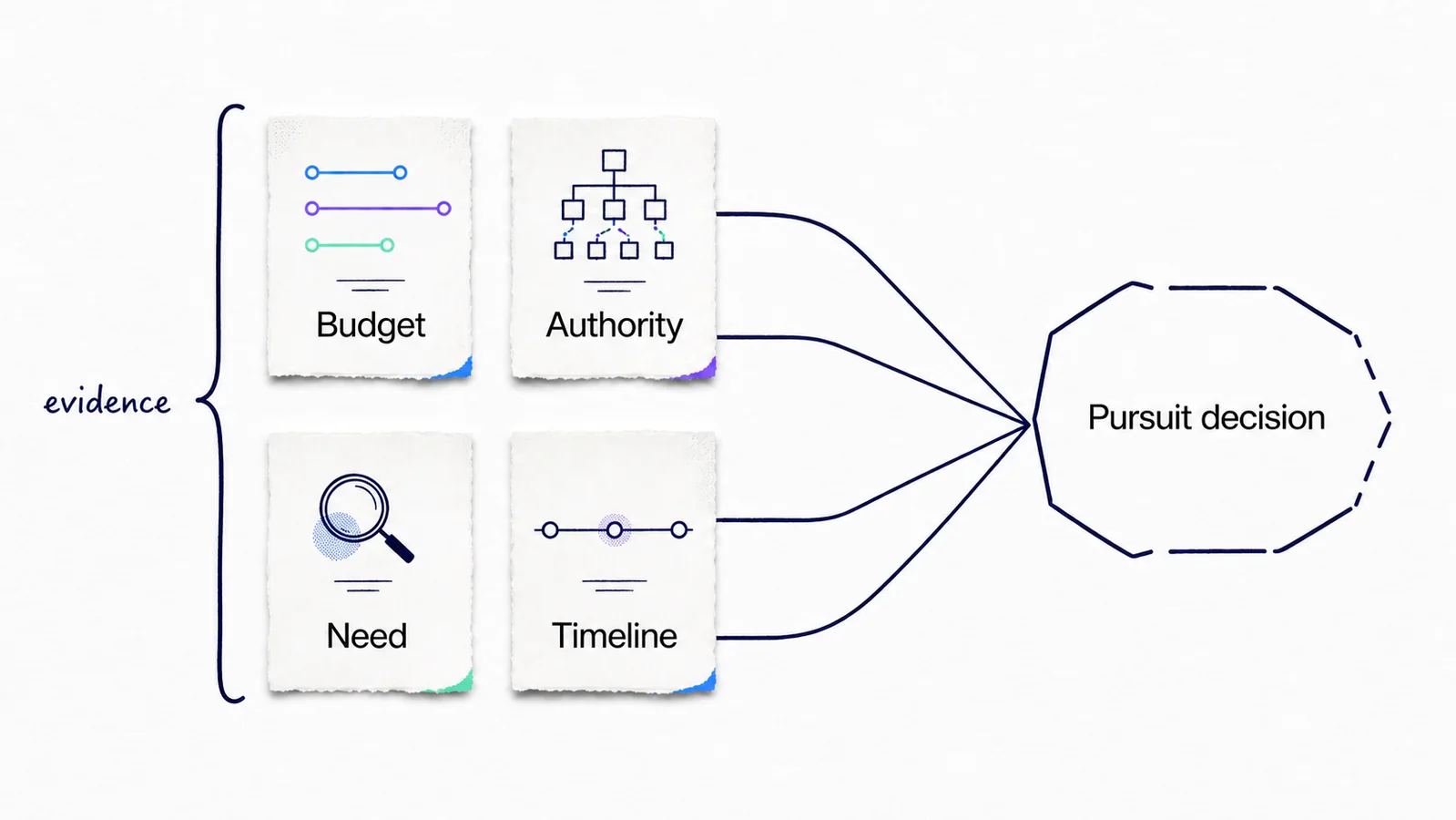
BANT is a sales qualification framework that evaluates Budget, Authority, Need, and Timeline. It helps a seller decide whether and how to pursue a lead or opportunity. It does not prove that a deal is ready to close.
BANT is compact by design. Its value comes from creating a shared evidence boundary, not from forcing four positive answers during the first conversation.
Why BANT matters
A sales team needs a consistent reason to invest time in one account and defer another. BANT covers four questions that affect purchase readiness: Can the buyer fund a change? Who has decision rights? Is there a meaningful problem? What event shapes timing?
Those questions can strengthen sales qualification when the purchase path is fairly direct. They also expose obvious gaps before an account consumes technical, executive, or proposal resources.
BANT becomes less descriptive as the buying system gains stakeholders, formal evaluation criteria, procurement steps, or several competitive alternatives. The sales qualification frameworks guide compares those risk patterns with CHAMP, SPICED, and MEDDICC.
How BANT operates
Each field needs evidence, not a checkbox:
- Budget: The buyer has allocated funds or a credible path to obtain them.
- Authority: The team understands who can approve, influence, block, and administer the decision.
- Need: A real problem has a consequence that the offer can address.
- Timeline: A date or event creates a reason to act within a defined period.
Use open questions during discovery, then apply BANT to the resulting evidence. Discovery gathers and tests context. BANT helps the team make the current pursuit decision.
Budget does not always mean a line item already exists. A strong business problem can create a funding path. Authority rarely means one person acts alone. Map decision rights and confirm the economic buyer when the investment requires final approval.
Need should include consequence. “Reporting is manual” describes a condition. “The finance team cannot complete board reporting before the monthly deadline” provides a reason to change. Timeline should also connect to a real event and consequence, not a hopeful close date.
Record the source and confidence for each field. Unknown is useful when it leads to a bounded next question. An unsupported “yes” only hides risk.

SaaS example
A small SaaS vendor receives a request from an operations manager who needs automated compliance reports before an annual customer audit. The problem and audit date support Need and Timeline.
The manager can recommend software but cannot approve the purchase. Budget has not been assigned. The current decision is not to reject the opportunity or call it fully qualified. The seller validates the funding path and asks how finance approves tools tied to audit readiness.
Once finance confirms available funds and decision rights, the opportunity enters the sales pipeline. If procurement, legal, and a broader buying group become material, the team may need deeper evidence than BANT supplies.
Common mistakes
The first mistake is asking, “Do you have budget?” before establishing a problem worth funding.
The second is treating the first contact's title as proof of Authority.
The third is accepting a desired date without a critical event or consequence.
The fourth is using BANT as a call script. Buyers do not need to experience the acronym in sequence.
The fifth is treating four completed fields as close readiness. A complex deal may still lack decision criteria, a tested champion, competition evidence, or a paper process. MEDDICC makes several of those risks explicit.
Use BANT as a decision, not a verdict
The useful output is a current action: pursue, validate next, nurture, or disqualify. Preserve what the buyer actually confirmed, keep uncertainty visible, and revisit the decision when money, authority, need, or timing changes.