


Product adoption
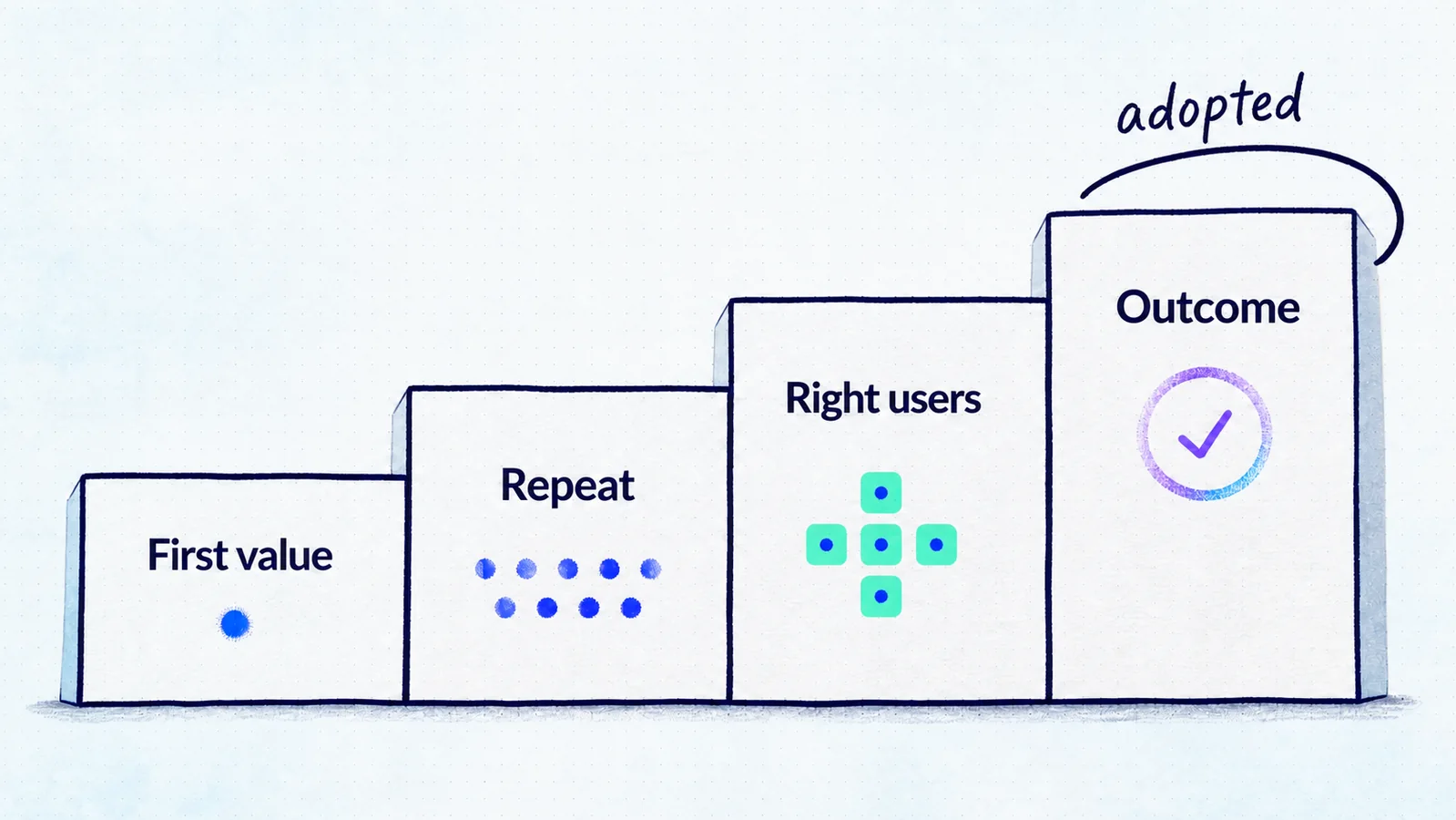
Product adoption is recurring, meaningful use of a product by the right users in a way that supports the customer outcome. It begins after initial access and becomes visible when core behavior repeats at the cadence the product requires.
Adoption is different from acquisition and activation. Acquisition brings a user or account into the product. Activation is an early moment when the user experiences value. Adoption develops afterward, as the behavior becomes dependable in a real workflow.
Logins, time in product, and feature clicks can support the analysis. None proves adoption without context.
Why product adoption matters
A SaaS customer can complete customer onboarding and still fail to build a durable behavior. Setup may be correct, while the product remains outside the decision, process, or collaboration pattern it was purchased to support.
Adoption gives product and customer success teams earlier evidence than a renewal decision. They can see whether customers reached first value, repeated the core action, involved the necessary users, and continued receiving the intended result.
Those signals can inform a customer health score, but adoption is one component. Relationship changes, support severity, customer fit, budget, and product gaps can alter account health even when usage looks stable.
How product adoption works
Define the behavior before tracking events. Start with the customer outcome, then identify the smallest recurring action that contributes to it.
For a reporting product, the key behavior may be publishing and reviewing a weekly report. For a payroll product, a monthly cadence can be healthy. For a messaging product, daily team participation may matter. Frequency only makes sense relative to the product's purpose.
Measure adoption across five dimensions:
- Actor: Which user, role, team, or account must perform the behavior?
- Behavior: Which action represents meaningful use?
- Cadence: How often should it occur naturally?
- Depth: Is the core use case completed or only sampled?
- Breadth: Has use reached the people required for the customer outcome?
Use cohorts so new customers are not compared with mature accounts. Track activation separately from repeated behavior. Preserve the event definition and eligibility rule when reporting an adoption rate.

SaaS example
Imagine a sales-planning product. A revenue operations leader signs in, imports pipeline data, and creates a forecast model. That first completed model is activation.
Adoption appears when the model is refreshed before each forecast meeting, sales leaders review the output, exceptions are investigated, and the decision process continues across several cycles. If only the original administrator logs in while the forecast meeting uses spreadsheets, product activity exists without account-level adoption.
A customer success strategy can define the milestone and response. Product owns usability and instrumentation. Customer success can diagnose blocked behavior. Marketing can educate users. Sales may use qualified adoption signals inside a product-led sales motion.
Common mistakes
One mistake is defining every active user as adopted. The active-user rule may include low-value behavior.
Another is rewarding feature breadth without asking which capabilities matter to the use case. Customers do not need every feature.
A third is measuring one power user and calling the account adopted. Concentrated use can create dependency rather than durability.
Finally, teams often change event definitions without preserving history, which makes cohort comparisons unreliable.
The operator view
Adoption should be defined before instrumentation. Otherwise, the cleanest event becomes the metric even when it has little relationship to value.
The useful definition is narrow enough to test: the right actor, completing the right behavior, at the expected cadence, with enough depth and breadth to support the customer outcome.