


On-target earnings
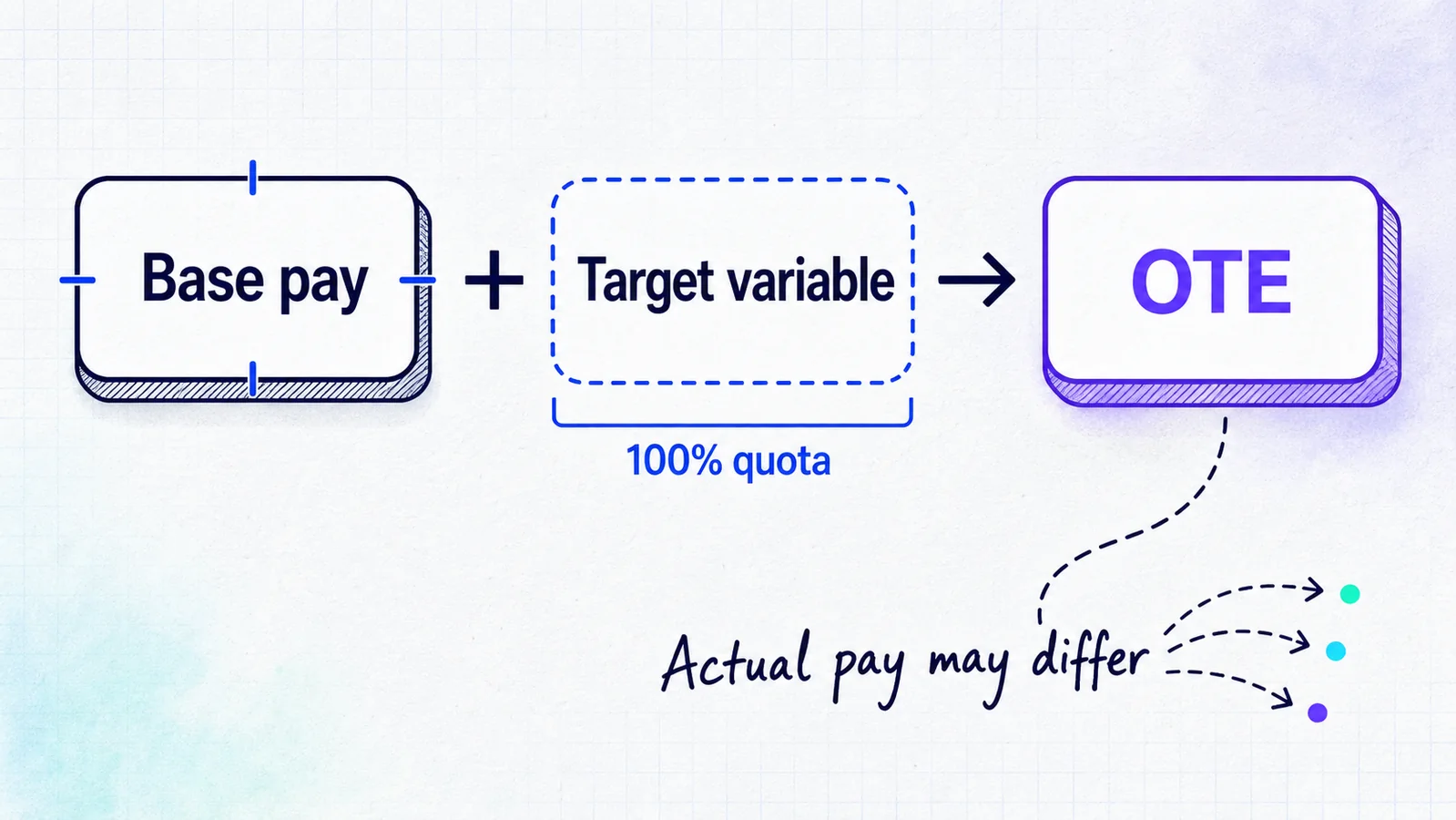
On-target earnings, or OTE, are the total cash compensation attached to 100% target attainment for a role. OTE equals fixed base pay plus the target variable pay available when the seller reaches the stated quota under the stated compensation plan.
OTE = Base pay + Target variable pay at 100% attainment
OTE is not guaranteed annual pay. The base is fixed, while the variable portion depends on credited performance and the payout rules. OTE is also not added on top of base pay. Base pay is already one component of the OTE total.
Why OTE matters
OTE connects hiring, quota design, seller economics, and company cost. Candidates use it to compare earning potential. Finance uses it to model compensation expense. Sales leaders use it to check whether the assigned quota and target payout form a credible offer.
The number is useful only when its components are visible. A $180,000 OTE could mean $90,000 base plus $90,000 target variable, or $120,000 base plus $60,000 target variable. Those roles carry different income risk even though the headline is identical.
OTE also needs the same time boundary as the quota. An annual OTE should connect to annual target variable pay and an annualized quota. A quarterly plan may prorate both. The sales quota defines the assigned performance expectation, while OTE defines cash pay at 100% attainment.
How OTE works
Start with base pay. This is the fixed salary for performing the role. Then define target variable pay, which is the commission or bonus amount available at 100% quota attainment.
The compensation formula must produce that target variable amount at exactly 100%. A simple linear revenue plan might calculate the target rate as:
Target rate = Target variable pay / Quota
Actual pay can differ from OTE. Below-quota performance may produce lower variable pay. Above-quota performance may produce higher pay through accelerators. Thresholds, tiered rates, caps, bonuses, split credit, cancellations, and payout timing can make the relationship non-linear. The SaaS sales compensation plan guide explains how those rules fit together.
Keep the forecast outside the equation. A forecast estimates what the team is likely to close. It may help Finance anticipate commission expense, but it does not define OTE or earned pay. Sales forecasting methods address estimates; the compensation plan controls the payout.

SaaS example
A SaaS AE has $90,000 in annual base pay and $60,000 in target variable pay. The role's OTE is $150,000.
The AE carries a $600,000 annual new-ARR quota. Under a simple linear plan with no threshold, the target rate is 10%. At 75% attainment, the AE receives $45,000 in variable pay and $135,000 in total cash pay. At 100%, variable pay reaches $60,000 and total cash pay reaches the $150,000 OTE.
If the plan adds an accelerator above quota, total pay can exceed OTE. If it adds a threshold below which no commission is earned, pay below quota will not remain linear. The written formula, not the OTE headline, determines the result.
Common mistakes
The first mistake is saying base plus OTE, which double-counts base pay.
The second is treating OTE as guaranteed compensation. Only the base component is fixed under a standard base-plus-variable plan.
The third is publishing an OTE without the pay mix, quota, crediting event, and payout curve. A candidate cannot assess earning potential from the headline alone.
The fourth is setting quota and OTE independently. At 100% attainment, the formula must return the stated target variable amount.
The fifth is using forecast attainment to calculate pay before the credited result occurs. Forecasts support planning; actual eligible events support commission.
Operator point of view
OTE should be treated as a testable promise at a defined performance point. Ask whether a representative seller, in a viable territory and after ramp, can reach the quota under the documented rules. Then check whether the formula returns the advertised target variable pay. Go-to-market metrics can provide the capacity and conversion evidence, but the plan still needs clear crediting and payout terms. Without those pieces, OTE is a recruiting claim rather than a complete compensation contract.