


SaaS quick ratio
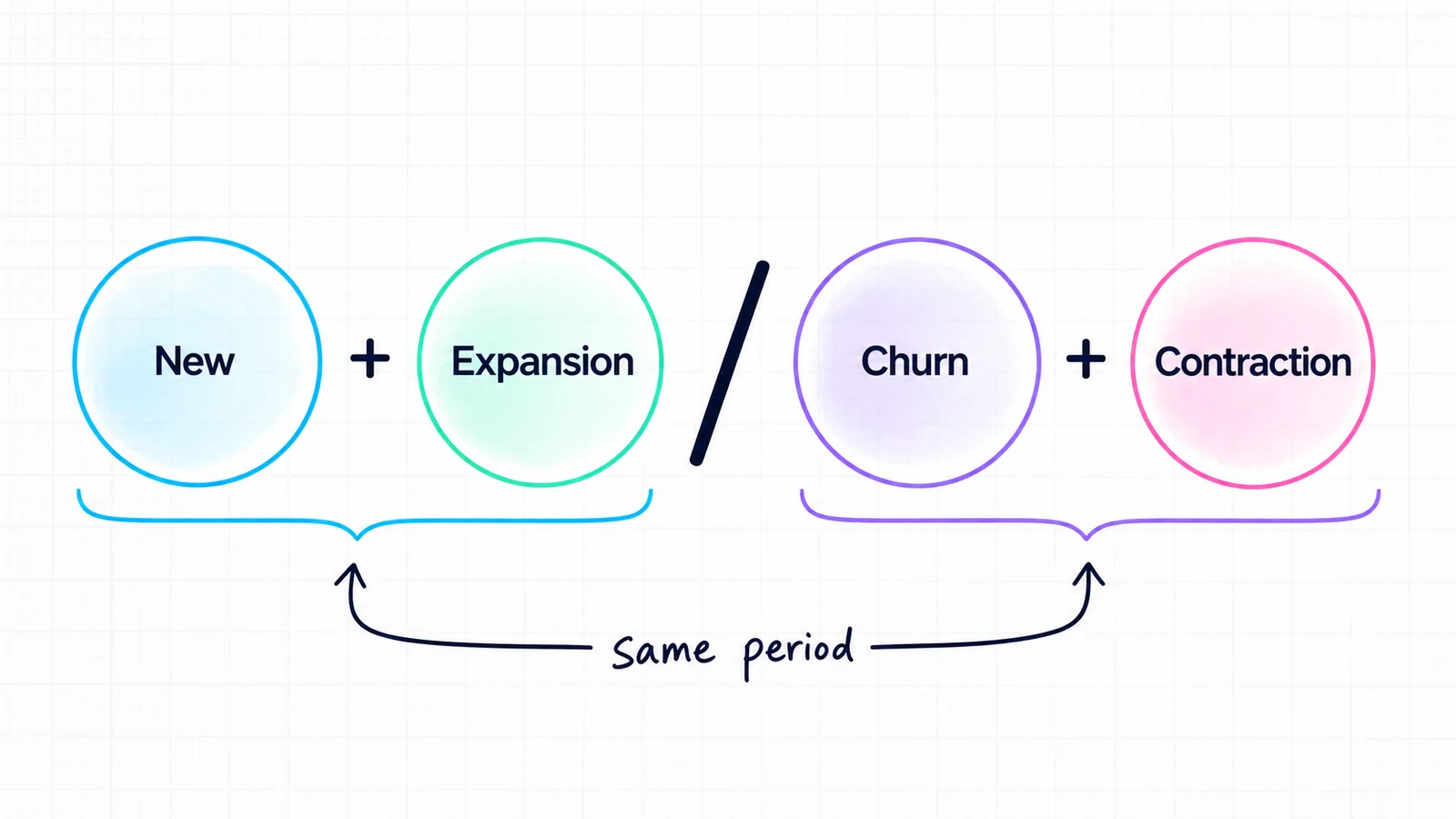
The SaaS quick ratio compares recurring-revenue gains with recurring-revenue losses during the same period. It divides new and expansion monthly recurring revenue by churned and contraction monthly recurring revenue.
The formula is:
SaaS quick ratio = (New MRR + Expansion MRR) / (Churned MRR + Contraction MRR)
This is not the accounting quick ratio, which measures short-term liquidity. The SaaS version is a recurring-revenue movement metric.
Why the SaaS quick ratio matters
Top-line growth can hide how much selling effort is replacing lost customers. The quick ratio puts additions and losses in one view.
New MRR shows recurring revenue added from new customers. Expansion MRR shows increases from existing customers. Churned MRR records revenue lost when customers leave, while contraction MRR records downgrades or reduced usage.
A ratio above 1.0 means additions exceeded losses during the period. A ratio of 1.0 means they were equal. Below 1.0, recurring revenue losses exceeded gains.
The number does not explain why any movement occurred. It also says nothing about acquisition cost, cash burn, or gross margin.
How the SaaS quick ratio is calculated
Choose one period and one revenue basis. Monthly MRR movements are common, but the calculation can use consistent annual movements. Do not put monthly losses under annual gains.
Classify every movement using documented rules. A customer upgrade belongs in expansion. A downgrade belongs in contraction. A full cancellation belongs in churn rate analysis as churned revenue. Reactivations need a consistent policy so teams do not move them between new and expansion whenever a dashboard needs a better result.
Add the positive movements, add the negative movements, then divide gains by losses. If the denominator is zero, the ratio is undefined rather than infinitely healthy. Report that no recurring revenue was lost and show the underlying values.
Read the ratio beside NRR and gross revenue retention. Retention metrics isolate the existing customer base, while the SaaS quick ratio includes both new acquisition and expansion revenue.

SaaS example
A SaaS company adds $20,000 in new MRR and $5,000 in expansion MRR during a month. It loses $4,000 to cancellations and $1,000 to downgrades.
The positive side is $25,000. The negative side is $5,000. The SaaS quick ratio is 5.0.
That result means the company added five dollars of recurring revenue for each dollar it lost during that month. It does not prove efficient acquisition. The team still needs to inspect customer acquisition cost, payback, margin, and whether the losses are concentrated in a valuable segment.
Common mistakes
One mistake is mixing bookings, invoices, cash, or one-time services into MRR movements.
Another is treating a common benchmark as a universal grade. Company stage, customer segment, contract timing, and a small denominator can make one period unusually high or low.
A third is reporting only the ratio. Two companies can have the same result with very different acquisition and retention patterns.
Use the SaaS quick ratio as a compact signal, then open the formula. The four movements tell operators where growth is coming from and how much of it is being consumed by revenue loss.