


Rule of 40
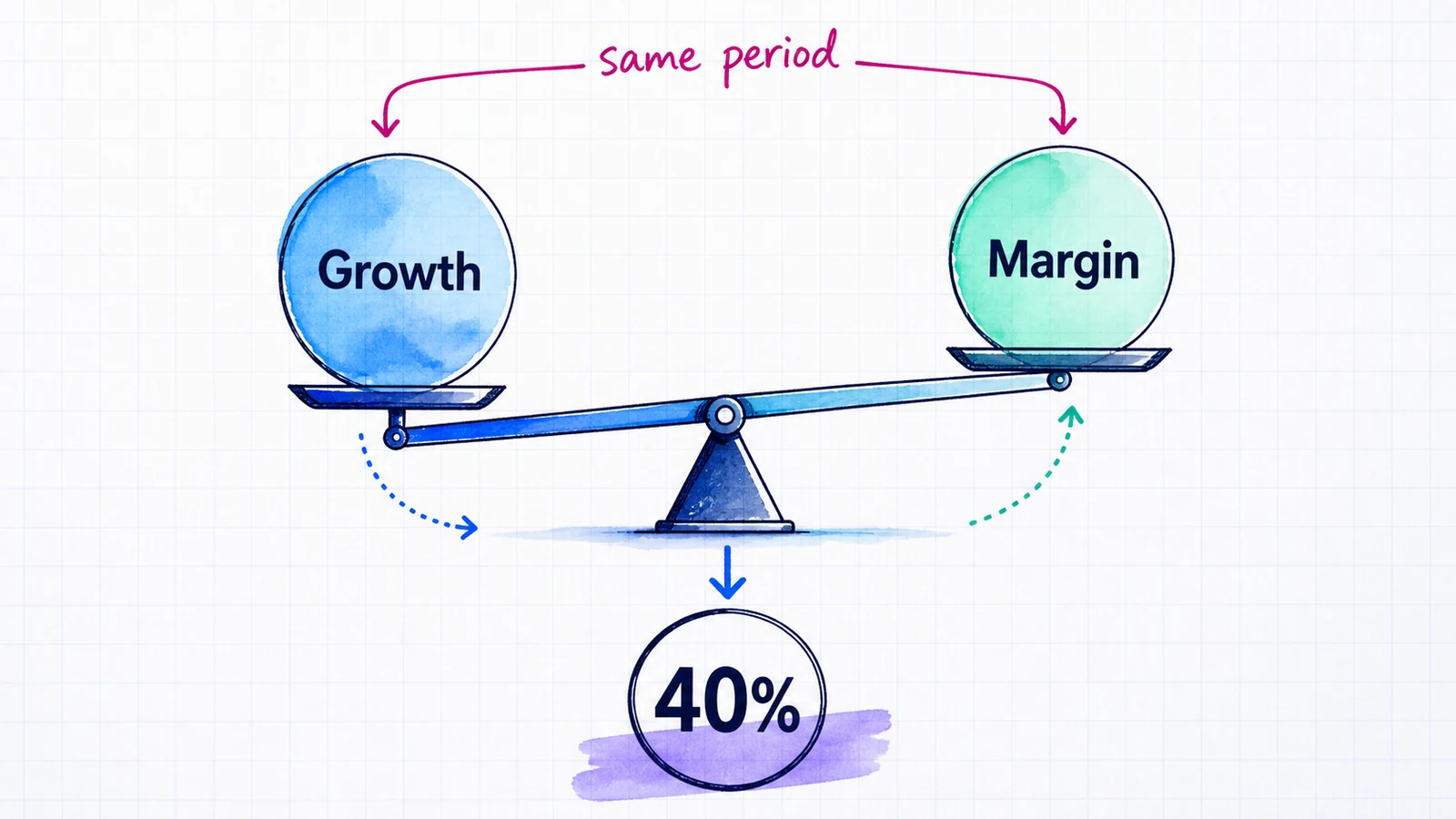
The Rule of 40 is a software-company performance heuristic that adds a defined annual growth rate to a consistently defined profit or cash-flow margin. A combined result of 40% or more satisfies the rule.
The formula is:
Rule of 40 score = Growth rate (%) + Margin (%)
A company growing 28% with a 12% free-cash-flow margin reaches 40%. A company growing 55% with a negative 15% margin also reaches 40%. The same score can represent very different operating profiles.
Why the Rule of 40 matters
Software companies often trade current margin for growth. Hiring, product development, and customer acquisition can reduce near-term profitability while increasing future recurring revenue. Mature companies may accept slower growth while generating stronger cash flow.
The Rule of 40 places both choices in one frame. It helps boards, investors, and operators discuss whether growth and margin together support the company's current strategy.
It does not show whether the growth came from new customers, pricing, or expansion revenue. It also does not reveal retention quality, capital consumption, or gross margin.
How the Rule of 40 is calculated
Declare the growth basis first. A SaaS company might use year-over-year revenue growth or ARR growth. Pick one definition and keep it consistent across periods and comparisons.
Then declare the margin. Free-cash-flow margin and adjusted EBITDA margin are common choices, but they are not interchangeable. A company should state the selected policy instead of presenting a Rule of 40 score without its ingredients.
Use matching periods. Add the annual growth percentage to the margin percentage for the same window. Negative margins subtract from the score.
Read the result beside NRR and gross revenue retention to inspect growth quality from existing customers. Use burn multiple to examine cash consumed per dollar of net new ARR when the company is burning cash.

SaaS example
A SaaS company grows ARR from $10 million to $12.8 million over one year. Its annual ARR growth rate is 28%. During the same period, it produces free cash flow equal to 12% of revenue.
Using ARR growth and free-cash-flow margin, the Rule of 40 score is 40%.
The calculation satisfies the heuristic, but the operating review should continue. The team still needs to inspect whether growth is concentrated in a few accounts, whether churn is rising, and whether cash generation depends on unusual collections or delayed spending.
Common mistakes
One mistake is switching margin definitions between periods. A score built with adjusted EBITDA cannot be compared cleanly with one built using free cash flow unless the difference is disclosed.
Another is using mismatched time windows or annualizing a short period with unusual seasonality.
A third is applying the heuristic to every startup. A pre-revenue company or a very early product still searching for repeatable demand may not have stable inputs for a useful comparison.
The Rule of 40 is a compact trade-off view. Keep the growth basis, margin basis, and period visible, then inspect the operating drivers beneath the total.