


Burn multiple
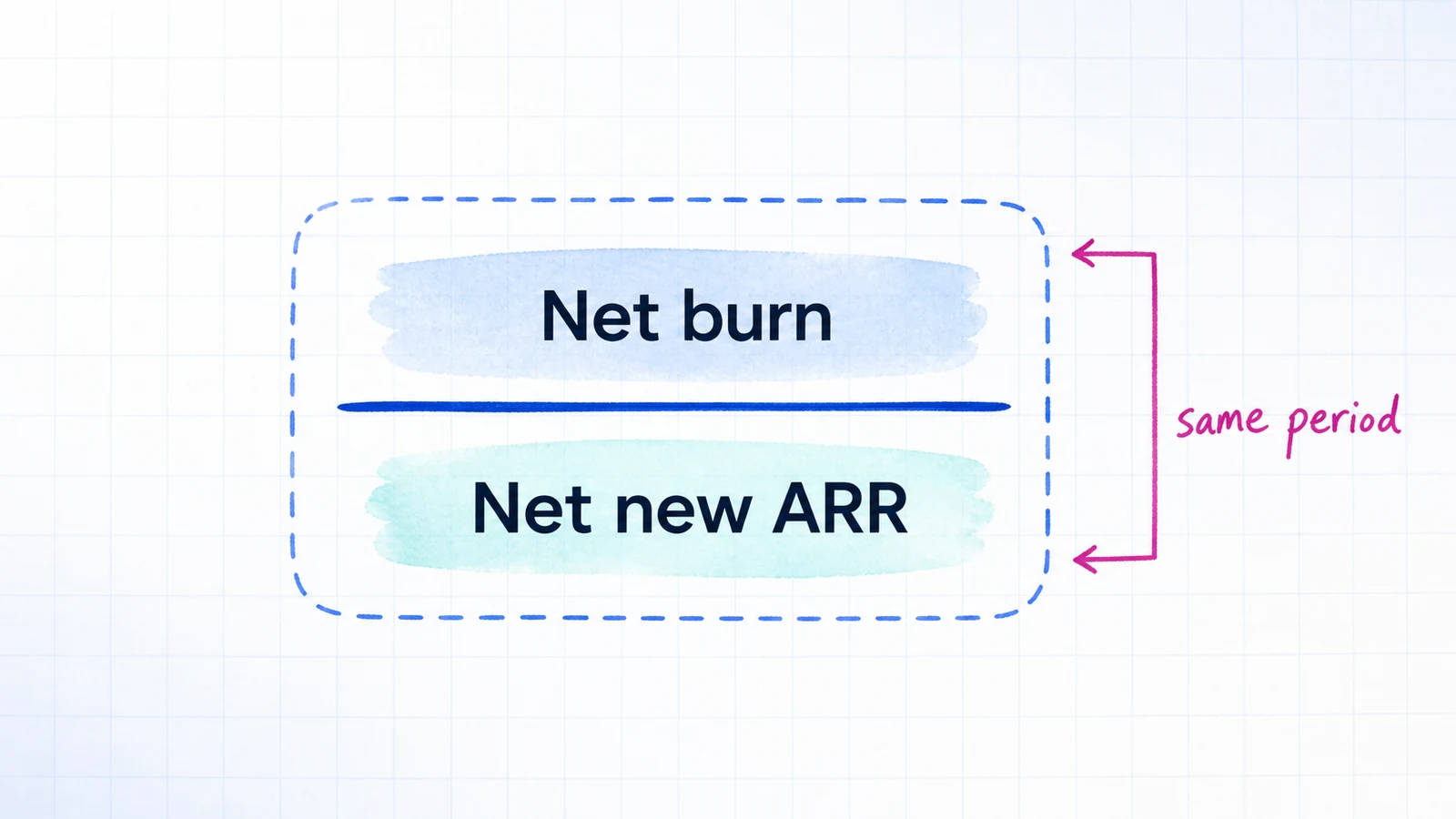
Burn multiple is a SaaS capital-efficiency metric that divides net burn by net new annual recurring revenue for the same period. It shows how much cash a company consumed to add one dollar of recurring revenue.
The formula is:
Burn multiple = Net burn / Net new ARR
A 1.5 burn multiple means the company consumed $1.50 in cash for each $1.00 of net new ARR during the measured period. Lower positive values indicate less cash consumed per dollar added, but the result needs context.
Why burn multiple matters
Revenue growth alone does not show how much capital produced it. A company can add significant ARR while consuming cash at a rate that shortens runway and limits future choices.
Burn multiple combines the cash consequence and the recurring-revenue result. It is broader than the CAC payback period, which focuses on recovering customer acquisition cost, and broader than the LTV:CAC ratio, which compares modeled customer value with acquisition cost.
The metric cannot tell operators which expense caused the result. Product investment, hiring timing, gross margin, collections, and customer retention can all affect the ratio.
How burn multiple is calculated
Choose a period, commonly a quarter or year. Calculate net cash burn for that period using a documented finance policy. Then calculate net new ARR as ending ARR minus starting ARR, adjusted consistently for new, expansion, contraction, and churn movements.
Both inputs must cover the same window. Dividing one quarter of cash burn by a full year of ARR growth creates a ratio with no coherent interpretation.
If net new ARR is zero, the ratio is undefined. If net new ARR is negative, a negative burn multiple should not be celebrated as better than zero. It signals that recurring revenue contracted while the company consumed or generated cash. Show the two inputs separately and investigate the decline.
Read burn multiple beside revenue-quality metrics. The SaaS quick ratio shows whether recurring-revenue additions are outrunning losses, while expansion revenue helps explain how existing customers contribute to net new ARR.

SaaS example
A SaaS company starts a quarter at $4 million ARR and ends at $4.4 million ARR. Its net new ARR is $400,000. During the same quarter, operating cash outflows exceed operating cash inflows by $600,000 under the company's net-burn policy.
The burn multiple is 1.5.
The result says the company consumed $1.50 for every $1.00 of net new ARR added during the quarter. It does not say whether that ratio is acceptable for the company's stage, financing plan, product investment, or gross margin.
Common mistakes
The first mistake is using burn rate instead of net burn for the period. Monthly burn is a pace; burn multiple needs the total cash consumed across the matching window.
The second is annualizing one side but not the other. Matching periods matter more than making the number look comparable.
The third is treating a benchmark band as a verdict. Stage, growth rate, margin profile, and investment timing change the decision around a given ratio.
Burn multiple is most useful as a review prompt: what cash was consumed, what recurring revenue was added, and which operating choices explain the relationship?