


CAC payback period
CAC payback period is the number of months required for gross profit from a new customer to recover the cost of acquiring that customer.
The standard formula is:
CAC payback period = CAC / monthly gross profit per customer
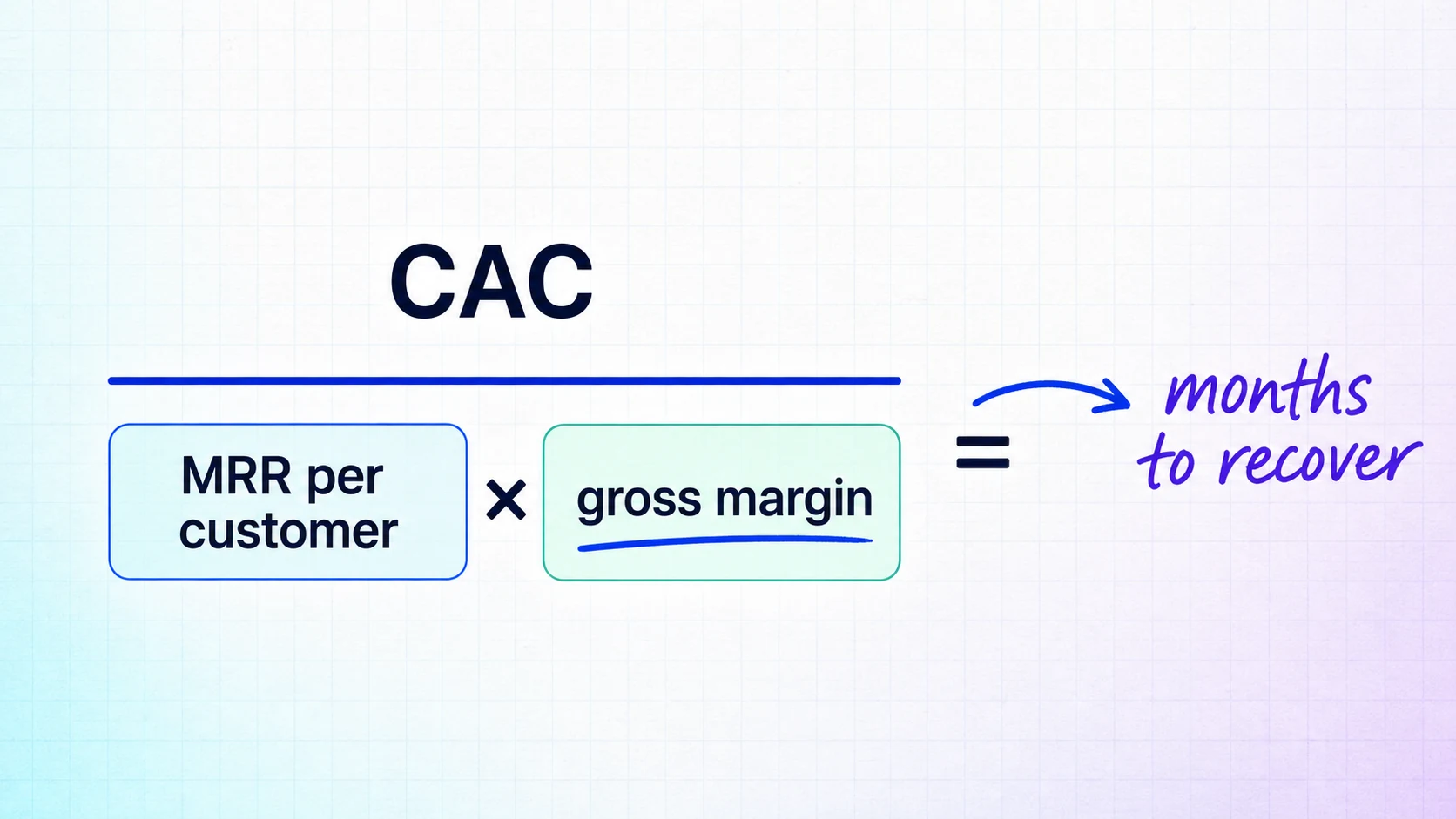
For a subscription business, monthly gross profit per customer is usually monthly recurring revenue multiplied by gross margin. The result is expressed in months.
Why it matters
CAC is paid before most SaaS customers generate enough profit to cover it. The payback period shows how long that acquisition cash remains tied up.
A shorter payback period lets a company recover acquisition spend sooner. A longer period creates a larger funding requirement because the company must keep paying for sales and marketing while earlier customers are still repaying their acquisition cost.
The metric is especially useful when comparing customer segments or GTM motions. A self-serve customer may have lower CAC and lower MRR. An enterprise customer may require a longer sales process but produce a higher ACV. Payback puts both motions on a time basis.
It does not measure total customer value. LTV estimates value across the customer relationship, while CAC payback focuses on the recovery window.
How it works
Start by defining CAC for a specific customer group. Include the sales and marketing costs required to acquire that group, then match those costs to the customers they produced.
Next, calculate monthly gross profit per customer:
Monthly gross profit = MRR per customer x gross margin
Divide CAC by that monthly gross profit. If a company calculates payback for a cohort instead of one average customer, it can divide matched acquisition spend by the new MRR from that cohort multiplied by gross margin.
Timing needs attention. Sales and marketing spend in January may produce customers in March. Comparing January spend with January customers can distort the result when the sales cycle crosses reporting periods.
Annual prepayment also requires a distinction. It improves cash collection timing, but it does not automatically shorten the gross-profit payback period. RevOps and finance should document whether the metric tracks accounting gross profit, cash, or another recovery definition.

SaaS example
Suppose a SaaS company spends $6,000 to acquire one customer. The customer produces $750 MRR, and the product has an 80% gross margin.
Monthly gross profit is $600:
$750 x 80% = $600
The CAC payback period is 10 months:
$6,000 / $600 = 10 months
If the customer prepays for a year, the company receives cash sooner. Under this simplified gross-profit calculation, the payback period remains 10 months.
Common mistakes
The first mistake is dividing CAC by revenue instead of gross profit.
The second is matching acquisition spend with customers from the wrong period.
The third is blending enterprise, self-serve, partner, and outbound acquisition into one average that no team can act on.
The fourth is treating a common benchmark as a rule. Contract structure, gross margin, retention risk, sales cycle, and access to capital all change what a workable payback period looks like.
How we see it
CAC payback is strongest as a cohort measure. Track when each acquisition cohort actually repays its cost, then compare segments using the same cost scope, lag, and gross-margin rules.
A fast payback number can still mislead if discounts reduce later revenue, onboarding costs sit outside the formula, or early customers leave soon after recovery. The useful question is not whether payback crossed a generic target. It is whether the company can fund the recovery window and repeat the motion without hiding costs.