


Product-led growth vs sales-led growth: How to choose your SaaS motion
Product-led growth makes product use the primary path to value and conversion. Sales-led growth makes human diagnosis, guidance, and buying coordination the primary path. Choose by testing whether users can reach meaningful value on their own, whether the organization can approve and adopt the product without coordinated help, and whether the economics support the required human work.
Treat the decision as a routing choice for a defined segment. Locate the work required to prove value, configure the product, approve the purchase, and expand the account. Assign that work to the product or to people based on what reliably moves the customer forward.
One company may reach different answers by segment. The useful output is a default path with explicit exceptions.
What each motion makes responsible for growth
Product-led growth uses the product experience as the main mechanism for acquisition, evaluation, conversion, or expansion. A user can enter a usable product path, experience a meaningful outcome, and build enough confidence to continue without a seller directing each step.
That does not make PLG a synonym for freemium or a free trial. Access alone proves little. The product has to carry the user from entry to a valuable outcome, while onboarding, documentation, support, packaging, and billing make that path workable. Salesforce's current explanation of PLG also separates meaningful usage from surface activity and leaves a role for sales after product value is visible.
Sales-led growth gives people primary responsibility for structuring evaluation and purchase. Sellers and specialists diagnose the problem, adapt the explanation to the account, coordinate stakeholders, reduce perceived risk, and guide commercial steps. The product may still appear through a demo, trial, pilot, or proof of concept. What makes the motion sales-led is that people carry the buyer through the decisive work.
These choices sit inside the wider go-to-market strategy. They change team design, instrumentation, pricing, onboarding, and the way a company interprets demand. ProductLed's specialist comparison distinguishes the motions across first engagement, value delivery, guidance, measures, and team structure. Those dimensions are useful, but no single dimension settles the choice.
Product-led sales is a related but distinct route. The product creates the initial proof, then sales enters when account context or buying work makes human assistance useful. Traditional SLG can use product signals, too, but product-led sales begins from demonstrated product value rather than treating every suitable account as an opportunity from the outset.
Product-led vs sales-led comparison

The practical difference becomes clearer when the same buyer jobs are compared side by side.
| Dimension | Product-led growth | Sales-led growth | Decision question |
|---|---|---|---|
| First proof of value | Product use is the primary proof. | Human diagnosis, demo, pilot, or business case is the primary proof. | Can the user experience the core outcome without a person translating it? |
| Evaluation | The user explores a usable product path. | Sellers and specialists structure evaluation. | How much context, configuration, or risk assessment is required? |
| Purchase coordination | Often supports a direct or lightweight purchase path. | Coordinates multiple stakeholders and commercial steps. | Who must approve security, legal, budget, and change? |
| Onboarding and implementation | Product and documentation carry most setup. | Services, solutions, or customer teams guide setup. | Can the account reach value without custom implementation? |
| Primary signals | Activation, meaningful usage, adoption breadth, and expansion behavior. | Qualified opportunity, stakeholder progress, evaluation milestones, and commercial commitment. | Which signals show value and buying readiness for this segment? |
| Expansion | Product prompts and usage may expose expansion. | Sales or customer teams coordinate broader adoption and terms. | Does expansion require organization-level agreement? |
| Cost structure | More acquisition and service work is built into product and systems. | More acquisition and coordination work is carried by people. | Does segment contribution support the required route? |
| Failure mode | Signups without value, weak activation, or noisy usage signals. | Expensive attention on poor-fit accounts or a process that hides product weakness. | Where is the current motion failing to move value forward? |
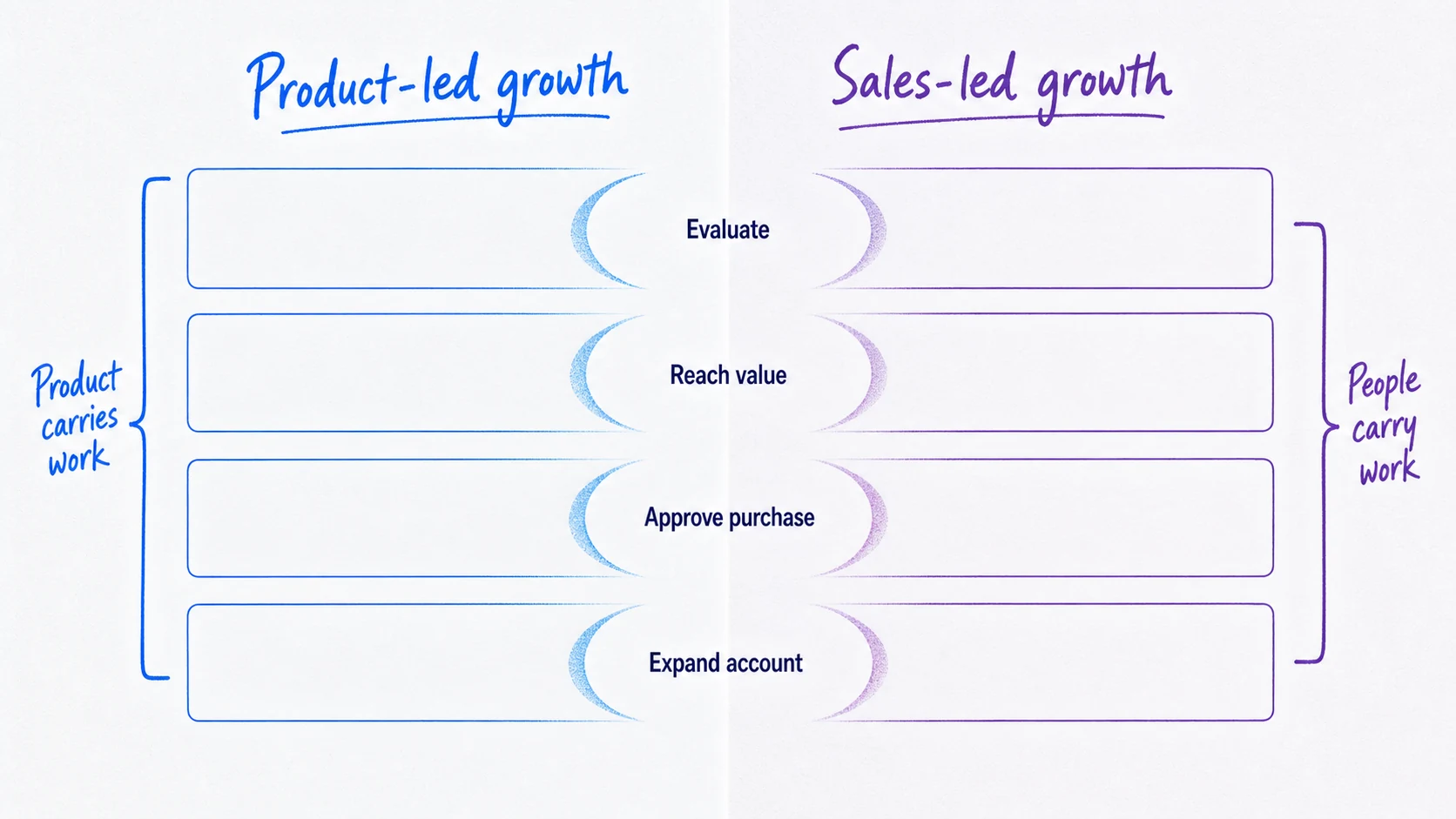
The table is not a maturity ladder. Both motions must prove value, support evaluation, complete a purchase, and create an expansion path. They allocate responsibility differently. Their signals also require different interpretation: usage can show value without showing purchase intent, while movement in a sales pipeline can show commercial activity without proving product value.
How to choose your primary SaaS motion


Choose for one segment at a time. A motion that fits an individual practitioner may not fit a regulated company buying the same product for several departments.
Signup volume does not settle the route. In OpenView's 2022 Product Benchmarks, a 1,000-visitor scenario produced 60 free signups and three paid customers for freemium, compared with 40 signups and seven paid customers for a free trial. The benchmark is directional and does not provide a complete sales-led comparison, but it shows why access volume and paid conversion need to be read together.
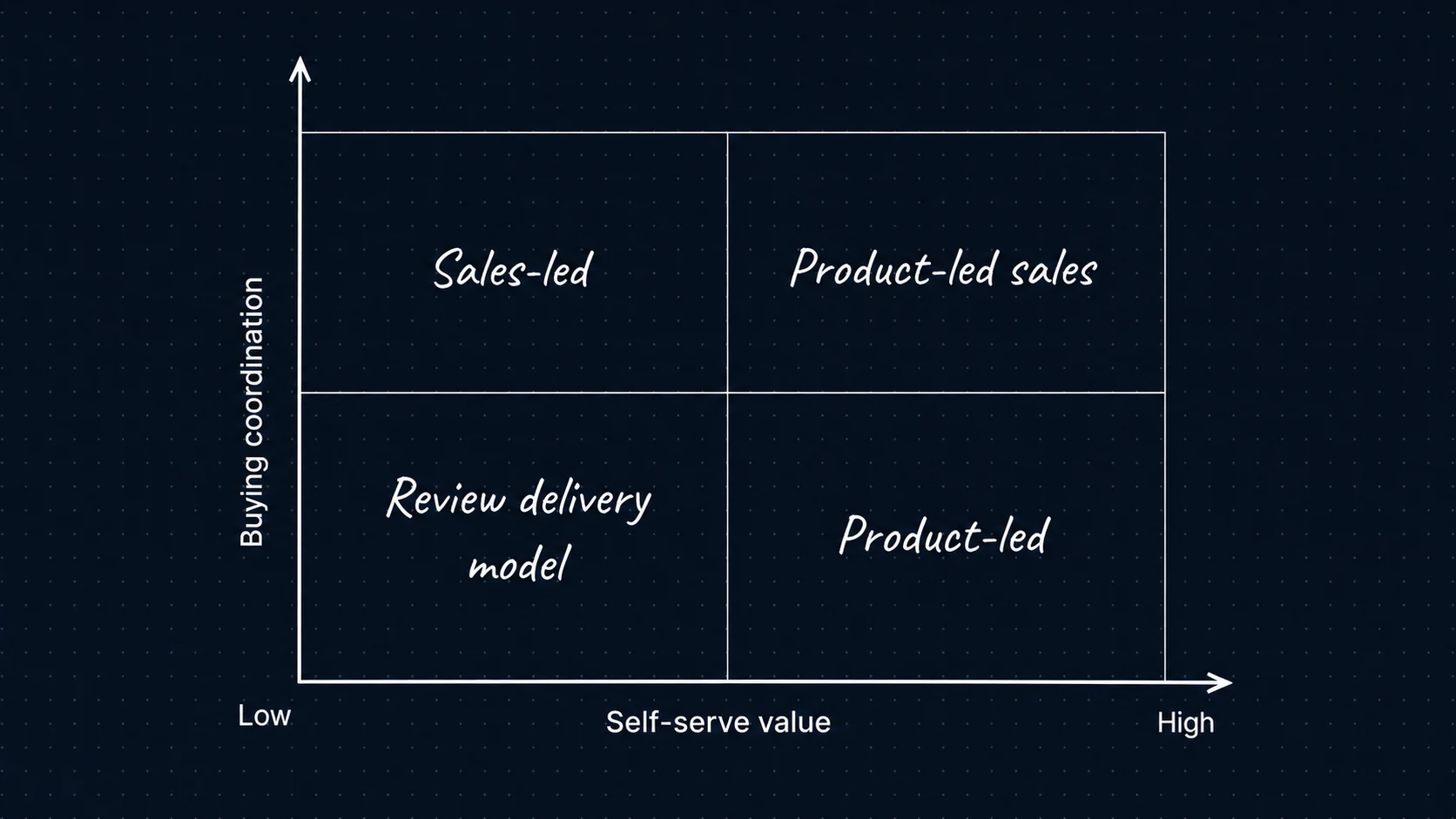
- Test self-serve value. Identify the smallest meaningful outcome the user seeks. Can a suitable user reach it with the product, onboarding, and documentation available? Count completed value events, not account creation or feature clicks. If a person must translate the problem before the user can see relevance, the route is not self-serve yet.
- Measure setup burden. List the data access, configuration, migration, integration, and process changes needed before value appears. A complex interface does not automatically require sales, and a simple interface does not guarantee self-service. The operative question is whether the account can complete setup reliably without custom diagnosis or implementation.
- Map the distance between user and buyer. The person using the product may be able to reach value alone while someone else controls budget, security, legal approval, or organizational change. A wide user-buyer gap raises the amount of coordination required even when product adoption is strong.
- Inspect purchase risk and coordination. Ask how many groups must agree and what evidence each needs. Security review, procurement, legal terms, change management, and executive sponsorship can create legitimate work for sales or specialists. This is about the purchase, not a broad assumption that every large company needs the same route.
- Test segment economics. Compare the revenue and contribution available from the segment with the full cost to acquire, onboard, support, implement, and expand it. Deal size is an input because it constrains how much human work the model can support. It does not reveal whether a person changes the customer's outcome, so annual contract value should never act as a standalone cutoff.
- Design the expansion path. A user may add seats through the product, while a broader rollout requires common administration, negotiated terms, or a coordinated deployment. Decide whether expansion is another self-serve action or a separate assisted job. The answer may justify a second route without changing the primary entry motion.
Review the evidence by segment. Activation data, support requests, implementation effort, stakeholder progress, service cost, and expansion behavior describe different parts of the path. Averages across all customers can hide a route that works well for one segment and fails another.
Once these tests are explicit, choose the route that handles the defined segment most of the time. Write the assumptions into a small go-to-market plan: segment, value event, required assistance, expected costs, observable signals, and review date. Test that path before reorganizing the whole company around a new label.
When a hybrid motion is real
A hybrid motion needs a default route and an exception rule. “We use both” does not tell product, growth, sales, or customer success what to do when an account appears.
Pocus, a product-led sales vendor, defines product-led sales around existing users driving conversion and expansion, with product signals and clear rules of engagement. The useful operational idea is that product evidence changes where human attention is applied.
Write each assisted route in this form:
segment or signal -> owner -> action -> exit condition
A product-qualified lead can help trigger the route, but it should not be a score assembled from arbitrary clicks. Define the value event, confirm account fit, identify the buying work, and state what sales is expected to change. An active user at a poor-fit account is not automatically a sales opportunity. A suitable account may also need no contact if the product continues to move it forward.
Consider a fictional reporting SaaS. Individual analysts remain self-serve after publishing their first dashboard. An account routes to sales when adoption spreads across teams and security or shared administration becomes part of the purchase. A possible rule is: cross-team adoption plus security review -> account executive -> coordinate approval -> return to self-serve or open a qualified opportunity.
The exit condition matters. Without it, assisted accounts can remain in limbo or receive overlapping outreach. RevOps should make ownership, data, and handoffs visible across the routes. Product, sales, and customer teams can then distinguish assistance that advances value from attention that merely adds activity.
Rules also need a review loop. If sales repeatedly returns accounts to self-service, the trigger may be too broad. If suitable accounts reach value and then stall on the same approval step, the route may be entering too late. Change the rule based on observed work, not team preference.
Two current SaaS examples
Figma's pricing page currently exposes a free Starter plan, direct plan selection, and sales contact on larger plans. That public structure shows that one product can offer more than one purchase path. It does not reveal Figma's internal routing rules or prove which path caused company growth.
Jira's pricing page similarly presents Free, Standard, and Premium routes with direct actions, while Enterprise uses a sales contact path and includes organization-scale administration and security controls. The page supports a narrow observation: assistance can correspond to coordination needs around a shared product. It does not establish a universal enterprise motion.
Visible routes do not reveal activation, service cost, conversion behavior, or ownership. Test who reaches value independently, what buying work appears later, and whether assistance can carry that work economically.
Common motion-selection mistakes
- Copying an ACV threshold. A generic cutoff ignores value delivery, implementation burden, buyer structure, margin, and the work a seller must perform.
- Calling product access PLG. A trial or free plan is an entry mechanism. PLG requires the product to carry users to meaningful value and support progression.
- Using sales to hide weak activation. Human guidance can win individual deals while leaving the product's value path unclear. Separate intentional assistance from repeated rescue work.
- Treating usage as intent. Product activity needs context: account fit, user role, timing, breadth of adoption, and the specific value event completed.
- Calling route collision hybrid. If product messages, sellers, and customer teams approach the same account without ownership rules, the company has overlapping motions rather than a designed one.
- Choosing once for the whole company. A motion can fit one segment and fail another. Define the segment before assigning the route, then revisit the choice when the product, buyer group, or required implementation changes.
FAQ
What is the main difference between product-led growth and sales-led growth?
Product-led growth makes product experience the main mechanism for proving value and advancing conversion. Sales-led growth makes human diagnosis, guidance, and buying coordination the main mechanism. The distinction is primary responsibility, not whether a salesperson or product trial ever appears.
Does product-led growth mean you do not need a sales team?
No. Sales can enter after users have experienced value, especially when an account needs configuration, security review, procurement support, or coordinated expansion. The product remains the primary entry and proof mechanism while people handle work the product cannot complete reliably.
Is product-led growth cheaper than sales-led growth?
There is no universal cost advantage. PLG moves work into product development, onboarding, support, instrumentation, and experimentation. SLG carries more work through sellers and specialists. Compare each segment's contribution with its full acquisition, implementation, service, and expansion costs.
Can enterprise SaaS use product-led growth?
Yes. Users can discover and prove value through the product even when the wider organization needs an assisted purchase route. Security, legal review, procurement, implementation, and account-wide expansion may still require people without changing the product-led entry path.
When should a PLG company add sales?
Add sales when identifiable, suitable accounts have reached meaningful product value but stall on configuration, coordination, approval, or expansion, and when the segment economics support human assistance. Define the qualifying signal and the job sales must perform before assigning an owner.
Can one SaaS company use both product-led and sales-led growth?
Yes, when the routes serve distinct segments or respond to explicit signals. Each route needs an owner, action, and exit condition. Two teams approaching the same account without rules is route collision, not a working hybrid motion.
Get practical GTM decision models and operator notes in the GTMpreneur newsletter.