


Market segmentation
Market segmentation is the process of dividing a broad market into smaller groups that share meaningful characteristics, needs, behavior, buying conditions, or value potential. Each segment should be distinct enough to support different product, message, channel, or sales choices.
In B2B SaaS, segments may be based on company size, industry, region, growth stage, technology, use case, pain, maturity, buying process, or product behavior.
Segmentation gives a GTM team a more useful view than "the whole market." It shows where the company can focus and where the same motion is unlikely to work.
Why it matters
Broad markets hide important differences. A startup and an enterprise may want the same outcome but evaluate risk, pricing, integrations, security, and onboarding differently. A sales-led buyer may need proof and procurement support, while a self-serve buyer may need fast activation.

Market segmentation helps the team adapt the go-to-market strategy to those differences. It can change the offer, channel, content, sales process, packaging, and product roadmap.
Segmentation also improves learning. If conversion falls, the team can see whether the problem affects every buyer or one specific group.
How it works
A useful segmentation process starts with a business question. The team may need to decide which market to enter, where to run outbound, how to package plans, or which customers deserve sales support.
Then it tests segmentation variables.
Firmographic variables include size, industry, region, funding, revenue, and team structure.
Needs-based variables group accounts by pain, desired outcome, or use case.
Behavioral variables include product usage, buying signals, content engagement, and adoption patterns.
Buying variables include budget, stakeholders, procurement, security, and sales-cycle complexity.
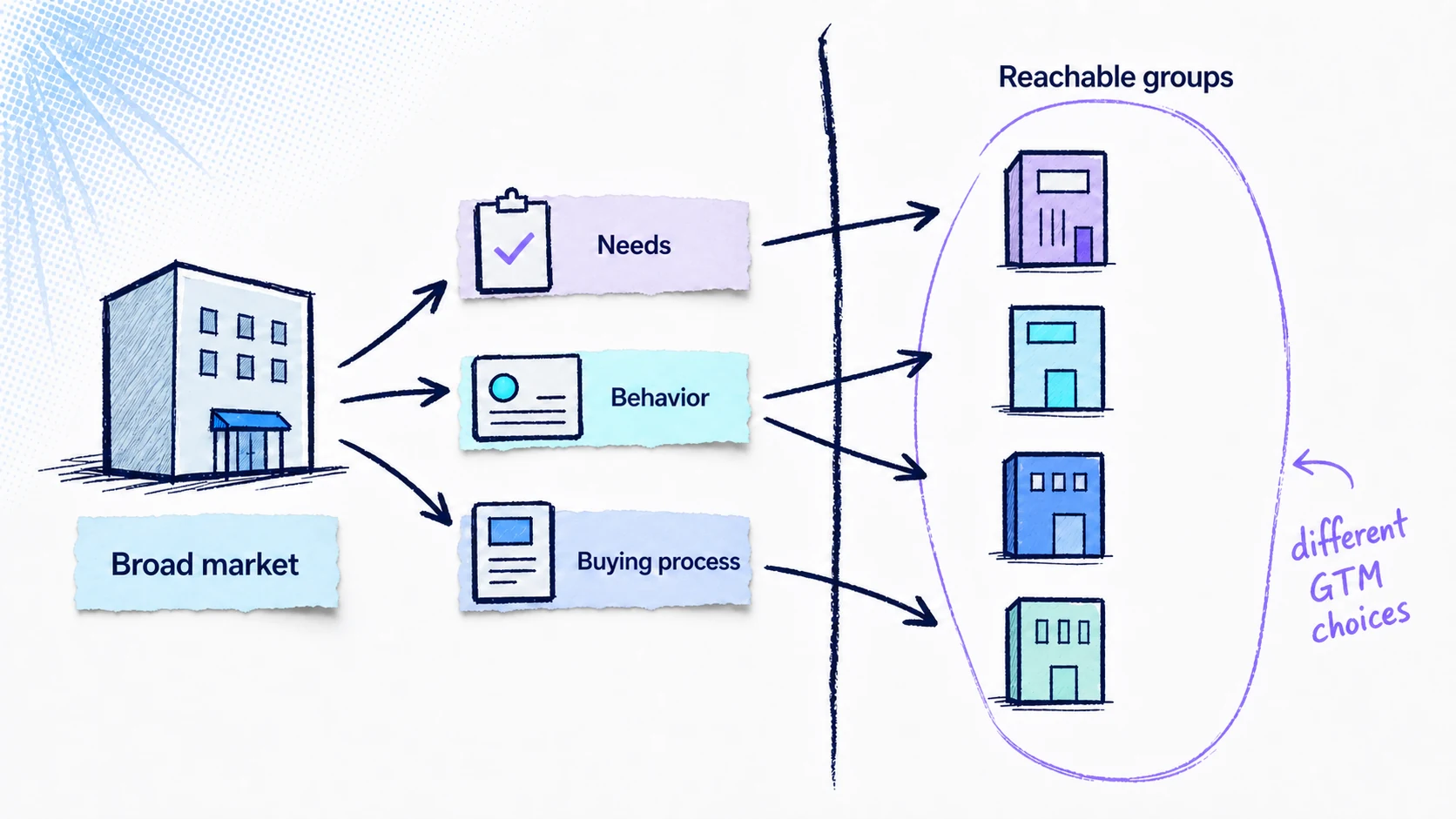
The final segments should be measurable, reachable, and actionable. If two groups receive the same product, message, channel, and motion, separating them may add reporting work without improving a decision.
SaaS example
Imagine a CRM cleanup product. One segment may be early-stage SaaS teams with no RevOps hire. Another may be mid-market teams with a dedicated operations function. A third may be agencies managing several client CRMs.
The first group may need simple onboarding. The second may care about governance and integrations. The third may need multi-account workflows. Each segment can produce a different ICP, buyer persona, and positioning choice.
Common mistakes
The first mistake is using only company size. Size can correlate with complexity, but it does not explain the pain or buying trigger.
The second mistake is creating too many segments before the company has enough data to support them.
The third mistake is describing segments that the team cannot identify or reach.
How we see it
Segmentation earns its place when it changes a decision. The goal is not a perfect taxonomy of the market. The goal is to find groups that deserve a different bet.