


PQL
PQL means product qualified lead. It is a user or account whose product behavior shows meaningful value, relevant fit, and a credible reason for conversion or sales action.
PQLs are common in product-led growth motions where buyers can use a free plan, trial, sandbox, or limited product before speaking with sales.
A signup is not automatically a PQL. The user should complete an action that indicates real product value or expansion potential.
Why it matters
Traditional lead qualification often relies on form data and marketing engagement. A PQL adds evidence from what the buyer actually did inside the product.
The commercial case depends on whether product-qualified users form a stronger cohort than signups overall. OpenView's activation and PQL analysis reported that product-qualified leads in recent portfolio projects converted at five times the overall rate. OpenView did not publish the project count, absolute rates, or qualifying product events, so the multiplier is a reason to validate a PQL definition against your own outcomes rather than copy a universal threshold. Its 2022 product benchmark surveyed more than 450 practitioners and likewise treated activation as product-specific.
That can make sales outreach more relevant. The team knows which feature was used, whether teammates joined, which limits appeared, and what outcome the account may be trying to create.
PQLs also connect product, marketing, sales, and inbound sales around a shared activation definition.
How it works

The company first identifies product behaviors that correlate with conversion, retention, or expansion.
Examples include importing real data, completing a workflow, publishing an asset, inviting teammates, integrating another system, using a core feature repeatedly, or reaching a meaningful usage threshold.
Those behaviors are combined with account fit, role, plan, team size, usage depth, and timing. Lead scoring may rank PQLs, but the criteria should remain understandable.
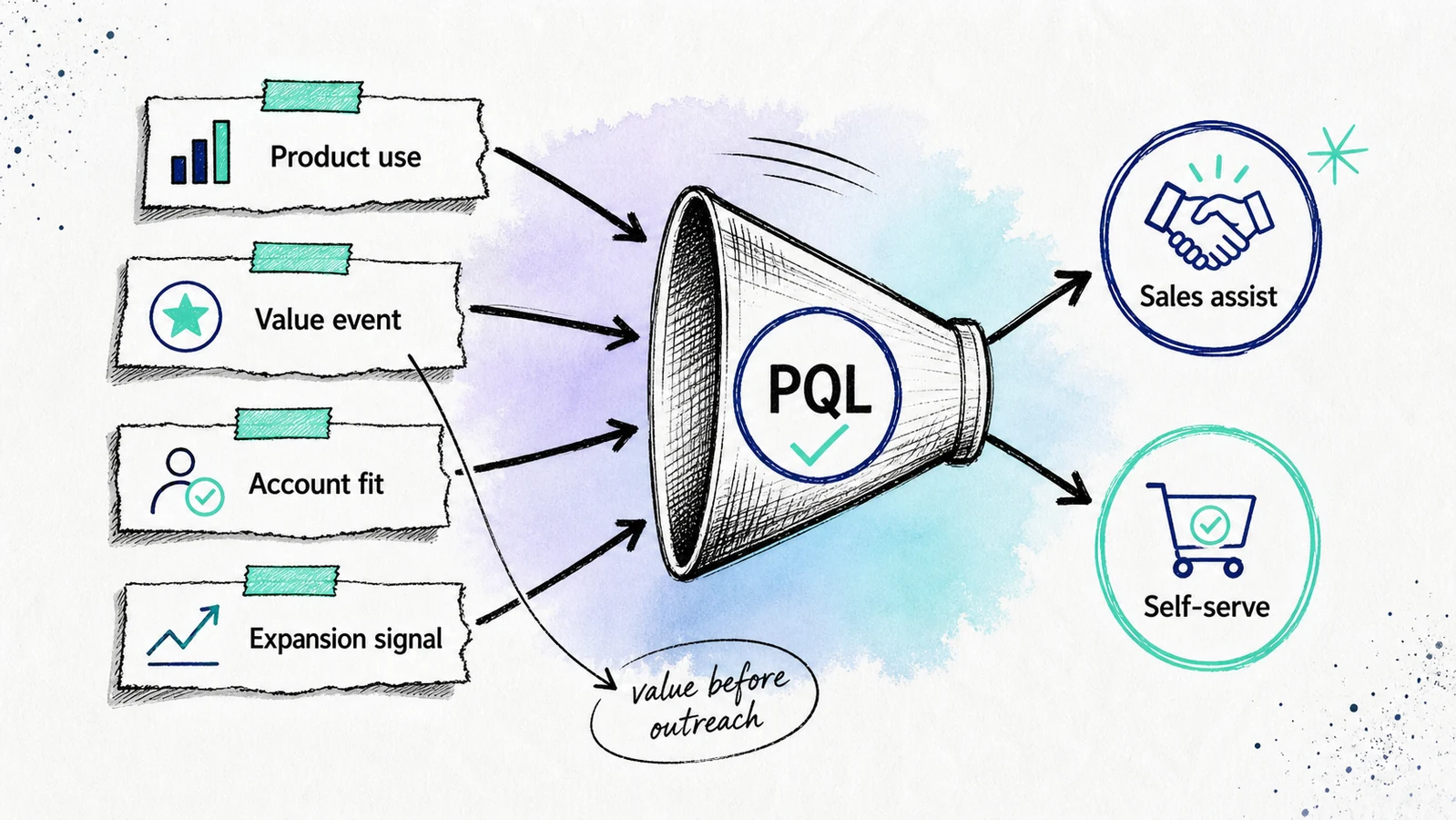
The PQL then enters a route. Some users receive a self-serve upgrade prompt. Larger or more complex accounts may receive sales assistance. Poor-fit users may continue in product nurture without sales contact.
The definition should be compared with conversion, retention, deal size, and sales acceptance. It should change as the product and pricing change.
SaaS example
Imagine a collaborative reporting tool. A user who signs up and leaves is not a PQL. A user who connects company data, publishes a dashboard, invites five colleagues, and reaches a workspace limit has experienced value and created an account-level signal.
If the company fits the target segment, the account may become a PQL and receive an assisted team-plan conversation.
Unlike an MQL, the primary evidence comes from product behavior. Unlike an SQL, sales may not have confirmed the opportunity yet.
Common mistakes
The first mistake is using login frequency as proof of value.
The second mistake is setting the PQL threshold around a paywall rather than a meaningful outcome.
The third mistake is ignoring account fit.
The fourth mistake is contacting users without acknowledging the product context that triggered outreach.
How we see it
A PQL should tell the company that value has happened and a sensible next action exists. Product activity becomes useful qualification only when it connects to customer outcomes.
Criteria should differ when product use cases differ. Collaboration software may value invited teammates, while infrastructure software may value a successful deployment. The qualifying event must represent value in the product's actual buying process.