


Lead scoring
Lead scoring is a method for ranking prospects or accounts based on how closely they match the target market and how strongly their behavior suggests relevant interest. The score helps marketing and sales decide who should receive attention, which route they should enter, and how quickly the team should respond.
In B2B SaaS, a score may combine company fit, role, content engagement, website activity, product usage, buying signals, and negative criteria. The number itself has no universal meaning. Its value comes from the rules and outcomes behind it.
Why it matters
Revenue teams rarely have equal time for every lead. Lead scoring gives them a consistent way to prioritize without treating every form fill, page visit, or contact as sales-ready.
A strong model connects the ICP, buyer persona, behavior, and timing. It can help sales respond faster to high-fit demand while keeping early or low-fit interest in a more appropriate nurture path.
Scoring also creates a shared qualification language. Marketing can explain why a lead became an MQL, while sales can show which scored leads became qualified opportunities and which criteria produced noise.
Account-level behavior can be more useful than an isolated click. In HockeyStack's analysis of more than 1.5 million contacts, activity from multiple stakeholders arriving through G2 was associated with 10 fewer touchpoints from MQL to pipeline creation and 15 fewer from pipeline to closed-won under the source's stated conditions. That makes the signal worth testing in a scoring model. It does not make it a universal score or prove that the activity caused faster progression.
How it works

Most lead scoring models use four inputs.
First, fit scoring measures whether the company and role match the target market. This can include industry, size, region, technology, job function, and seniority.
Second, behavior scoring measures meaningful actions such as pricing-page visits, demo requests, repeated category research, event attendance, or product activation.
Third, timing uses intent data, account changes, product signals, or recent activity to identify why the lead may deserve attention now.
Fourth, negative scoring reduces priority for poor-fit regions, students, competitors, inactive records, irrelevant roles, unsubscribes, or activity that does not indicate buying interest.
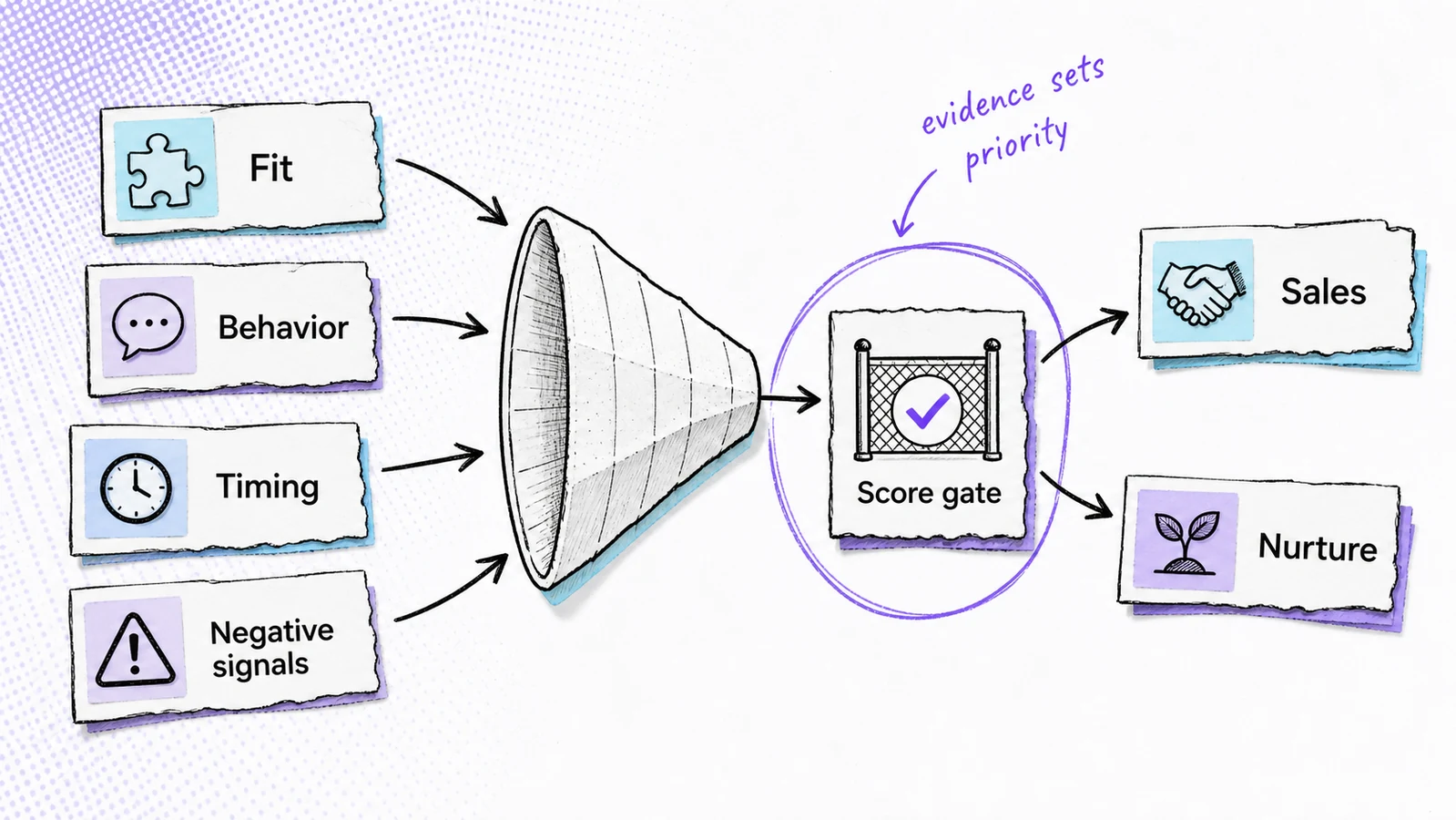
The score then triggers a route: sales follow-up, further qualification, nurture, suppression, or disqualification. Thresholds should be tested against real conversion and sales pipeline quality.
SaaS example
Imagine a RevOps software company. A director at a 200-person SaaS company may receive fit points. Visiting integration and pricing pages adds behavior points. A recent sales-operations hiring signal adds timing. A personal email domain may reduce the score.
If the combined evidence crosses the agreed threshold, sales reviews the lead. The threshold should not replace a human check when account context is incomplete.
Common mistakes
The first mistake is giving points to every click. Email opens and casual content views are weak signals on their own.
The second mistake is ignoring negative criteria.
The third mistake is setting thresholds once and never comparing them with revenue outcomes.
The fourth mistake is hiding the scoring logic from sales.
How we see it
Lead scoring is a prioritization model, not proof of purchase intent. It should make the next action clearer and improve as the team learns which leads become real customers.