


Ideal customer profile vs buyer persona: What each decides in B2B GTM
An ideal customer profile defines which companies are a strong fit for your product. A buyer persona explains how people inside those companies experience and influence the purchase. In B2B GTM, the ICP guides account selection and qualification. Personas guide stakeholder messaging, proof, and sales conversations.
Use both when a decision spans account fit and the people involved in the purchase. Together, they make targeting, messaging, and qualification more specific within a wider go-to-market strategy.
Ideal customer profile vs buyer persona at a glance
The useful boundary is the object of the decision. An ICP describes a company or account. A persona describes a person or buying role inside an account. Salesforce's ICP guide treats firmographic, behavioral, technographic, and environmental traits as useful account evidence, so a credible ICP goes well beyond industry and headcount.
| Dimension | ICP | Buyer persona |
|---|---|---|
| Level | Company or account | Person or buying role inside an account |
| Core question | Which accounts deserve attention? | How does this person experience and influence the purchase? |
| Useful inputs | Industry, size, operating pain, trigger, stack, buying ability, retention fit, and expansion fit | Role, goals, pressure, trigger, barriers, decision criteria, language, and influence |
| Decisions | Segmentation, account selection, scoring, qualification, territory, and learning cohort | Message, content, discovery, proof, objections, and stakeholder plan |
| Evidence | CRM records, wins and losses, usage, retention, expansion, support, and market signals | Buyer interviews, sales calls, win-loss notes, objections, and evaluation evidence |
| Output | Account-fit rules | Role-specific buying insight |
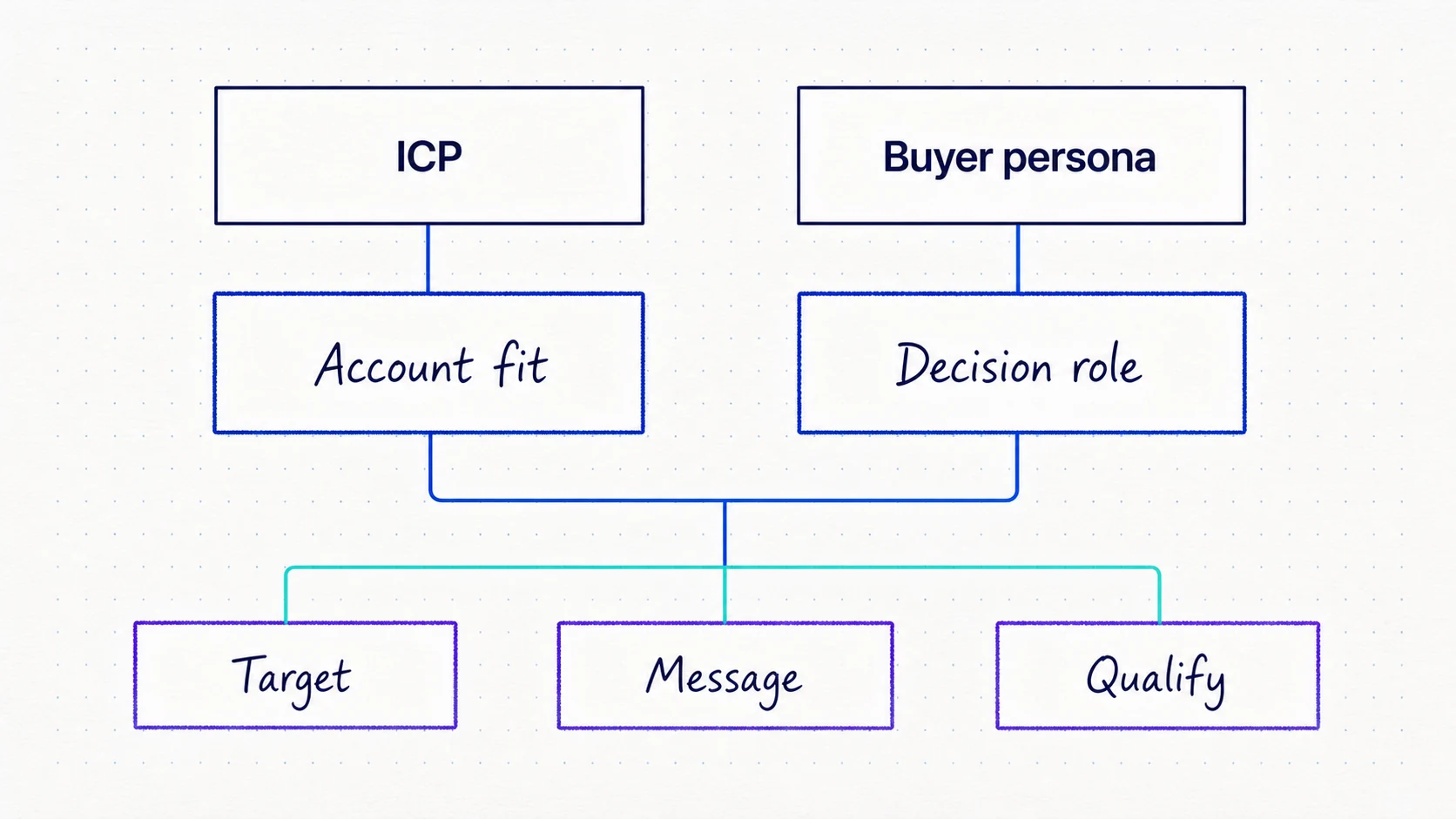
A target market is broader than either artifact. Miro's comparison separates the broad market, best-fit accounts, and roles inside those accounts. Market segmentation divides a market into useful groups. The ICP then defines which accounts within a segment fit the current product and motion.
What an ICP decides
An ICP sets the account-level rules for attention. It should help a team decide whether an account is eligible, how it should be prioritized, what qualifies or disqualifies it, and which segment deserves focused learning.
Firmographics may help identify the account, but they rarely explain fit on their own. Two companies with the same industry and headcount can have different operating pains, technology constraints, buying ability, and urgency. A stronger ICP combines observable attributes with conditions that make the problem relevant now.
Useful ICP criteria include:
- Fit: The product serves the account's operating model, use case, and constraints.
- Pain: The account has a problem the product can credibly address.
- Trigger: A current event or change makes the problem timely.
- Ability: The account can buy, adopt, and support the solution.
- Value potential: The relationship has a plausible retention or expansion case.
Those criteria guide list building, territory design, qualification, and account priority. They also define the cohort from which the team learns. Feedback from a poor-fit account should not carry the same weight as repeated evidence from accounts the product is designed to serve.
What a buyer persona decides
A buyer persona records the buying insight needed to engage a meaningful role. Salesforce defines a buyer persona around an individual, informed by research, customer data, and interviews, while an ICP describes the fit of an organization.
The useful fields are role in the purchase, goals, pressure, trigger, barriers, decision criteria, language, and influence. These inputs shape positioning, discovery questions, content, proof, objection handling, and the stakeholder plan. They also help a team express its value proposition in terms that matter to the person evaluating it.
A title is not enough. Two RevOps leaders may enter the same purchase with different responsibilities or levels of influence. A fictional name, age, hobby, or invented quote adds detail without improving a GTM decision.
The Buyer Persona Institute's method focuses on purchase triggers, expected outcomes, perceived barriers, decision criteria, and the evaluation process. That evidence is more useful than a character sheet because it explains how a person participates in a specific buying decision.
How ICPs and buyer personas work together in B2B GTM


The ICP and personas connect around the same buying motion. The ICP establishes why an account deserves attention. Personas explain which people matter inside it, what each person needs to understand, and how each one can support or block the decision.
The persona layer cannot stop at the visible user or champion. The 2025 Edelman-LinkedIn B2B Thought Leadership Impact Report surveyed 1,934 U.S. management-level professionals. It found that 64% of target decision-makers and 63% of hidden decision-makers spent more than an hour a week with thought leadership. Vendor-vetting use was also nearly identical at 56% and 55%. This supports researching hidden roles, but it does not measure account fit or prove that content caused a purchase.
This is not a rigid handoff from account research to persona research. A team may start with an account hypothesis, interview buyers, and discover that the strongest trigger or constraint belongs in the ICP. It may also find that a role assumed to be the champion has little influence in a particular segment. Account and buyer evidence should refine each other.
Buying groups make this connection practical. In a 2024 survey of 632 B2B buyers, Gartner reported groups spanning multiple people and functions. That study has a specific sample and should not be treated as a universal stakeholder count. It does support a useful operating point: B2B teams need shared account relevance and role-specific proof.
An account executive might use the ICP to understand the account's trigger and constraints, then use personas to plan questions for the user, champion, economic buyer, or reviewer. The common account story stays coherent while the proof changes by role.
Example: One SaaS ICP, three buyer roles
Consider a hypothetical B2B SaaS company selling account-research and enrichment workflows.
Its ICP is Series A to C B2B SaaS companies with 50 to 300 employees, an active outbound team, a visible CRM data-quality problem, a RevOps or growth owner, and a current trigger such as SDR hiring or a CRM migration. Those criteria change the account list. A company outside the size range might still qualify if the operating pain and adoption conditions fit, but headcount alone does not decide the case.
Inside a selected account, three roles may matter:
- SDR user: Needs faster account research and clear next actions. Outreach and discovery should examine where research time goes and what information is missing before contact.
- RevOps champion: Owns data quality, process consistency, and governance. The demo should show workflow control, field logic, and how the system fits the current CRM process.
- Sales leader as economic buyer: Evaluates pipeline quality, adoption risk, and budget. Proof should address how the workflow supports the sales motion and how the team would roll it out.
The ICP changes list filters and qualification. The personas change the outreach lead, discovery questions, demo proof, and stakeholder sequence. The same account-level trigger can be relevant to all three roles, but each role evaluates a different part of the purchase.
This example is deliberately hypothetical. It shows the decisions that change without inventing a budget, preferred channel, customer result, or performance claim.
Which one should guide each GTM decision?

Choose the artifact according to the level of the decision. Use the ICP for account choices, personas for stakeholder choices, and both when the action must connect account context with role relevance.
| GTM decision | Use | Reason |
|---|---|---|
| Choose a market segment | ICP, with market segmentation | The decision concerns groups of accounts |
| Build an account list | ICP | The decision is whether an account fits |
| Prioritize or disqualify an account | ICP | Fit, timing, and buying ability are account-level |
| Choose the first stakeholder | Both | Account context and role influence both matter |
| Write outbound messaging | Both | The ICP supplies account relevance; the persona supplies role relevance |
| Plan discovery questions | Persona, informed by ICP | Questions should reflect the person's role within the account context |
| Choose demo proof | Both | Proof should fit account conditions and stakeholder criteria |
| Handle objections | Persona, informed by ICP | Barriers differ by role and buying environment |
| Interpret product or sales feedback | Both | The team needs to know which account and role produced the evidence |
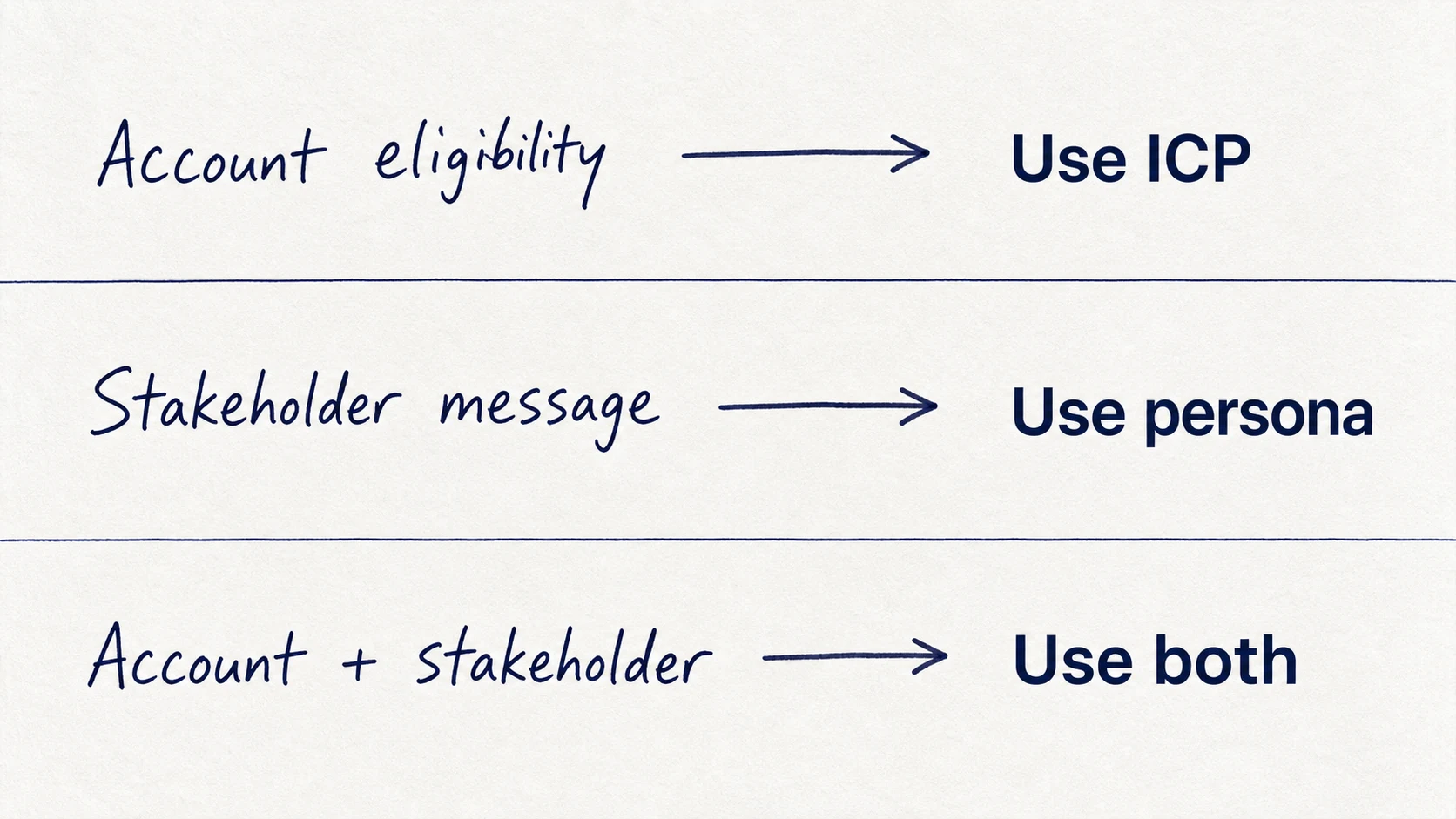
The test is simple: name the object of the decision. If the object is the account, start with the ICP. If it is a participant in the purchase, start with a persona. If the action crosses both levels, inspect both.
Build both from evidence
Build the ICP from account records: CRM data, closed-won and closed-lost analysis, product usage, retention, expansion, support patterns, and observable market triggers. Look for repeated combinations, including the conditions present when an account was a poor fit.
Build personas from recent-buyer and lost-buyer interviews, sales calls, objections, evaluation behavior, and win-loss notes. Ask buyers to reconstruct what triggered the purchase, which alternatives they considered, who became involved, what blocked progress, and what criteria shaped the choice. Do not fill missing evidence with personality details.
Then reconcile the layers. A recurring stakeholder barrier may reveal an account-level adoption constraint. A new market trigger may change which role enters first. A product change may open a new account cohort and introduce different buying roles.
Update the artifacts when patterns change, not because a generic calendar says they are stale. Document the current rules and evidence in the working go-to-market plan, then revise them when wins, losses, usage, interviews, or market conditions produce a repeatable contradiction.
Common mistakes
- Using firmographics as the entire ICP: Industry, geography, and headcount identify accounts, but they do not establish pain, timing, buying ability, or product fit.
- Using job titles as personas: A title does not explain goals, barriers, criteria, or influence in a particular purchase.
- Inventing a biography: Names, ages, hobbies, quotes, and channel preferences should not appear without evidence or a decision they change.
- Creating one persona for every title: Roles with the same goals, barriers, criteria, and influence may belong in one buying-role model.
- Treating ICP and persona as alternatives: Account selection and stakeholder engagement operate at different levels. Many B2B actions need both.
- Leaving both static: New products, segments, buying conditions, and evidence can invalidate old assumptions.
Each artifact earns its place only when it changes a choice. If a field does not affect targeting, qualification, messaging, proof, discovery, or learning, remove it.
FAQ
Can an ICP include buyer personas?
Yes. Personas can sit inside an ICP as the roles involved in a purchase, but keep the two layers distinct. The ICP still defines account fit, while each persona records the goals, barriers, criteria, and influence of a meaningful buying role.
Which should you create first, an ICP or buyer persona?
In B2B, start with an account hypothesis so you know which buyers to research. Then study the people involved and let their evidence refine the ICP. Creation order is a starting point, not a rigid sequence.
How many buyer personas should one ICP have?
Create only as many personas as the purchase requires. A separate persona earns its place when a role has meaningfully different goals, barriers, decision criteria, or influence. Do not create one for every title in the account.
Is an ICP the same as a target market?
No. A target market is the broad space a company can serve. Segments divide that market into useful groups. An ICP identifies the accounts within a segment that best fit the product and the current GTM motion.
When should you update an ICP or buyer persona?
Update either artifact when wins, losses, usage, retention, product direction, buyer interviews, or market conditions reveal a repeatable change. Use evidence triggers rather than a universal monthly, quarterly, or annual refresh rule.
Join the GTMpreneur newsletter for practical guides on account selection, buyer research, positioning, and modern GTM systems.