


What is a go-to-market strategy?
A go-to-market (GTM) strategy is the integrated system of choices a company makes to find and win the right customers for a specific product or service. It defines the target market, ideal customer, product positioning, and the commercial motion required to generate repeatable revenue. This strategy acts as a company’s blueprint for customer acquisition, aligning product, marketing, and sales teams around a shared set of priorities.
Unlike a marketing plan or a product launch checklist, which focus on execution, a GTM strategy is the underlying logic that guides those activities. It answers foundational questions: Who are we selling to? What problem are we solving for them? How will we position our solution against alternatives? How will we reach, engage, and convert them profitably?
The 8 core choices of a GTM strategy
A working GTM strategy is a system of eight connected components. Each choice influences the others, creating a coherent and defensible market approach. The system begins with the market and expands outward to define how a company will operate within it.


- Market: Which specific market segment will you compete in? This is the foundational choice. It requires clear boundaries around industry, company size, geography, and technological maturity. A narrow focus, such as "Series B and C fintech companies in North America," is more strategic than a broad one like "all financial services companies." Good market segmentation creates a playing field where you can win.
- Buyer: Who is the ideal customer profile (ICP) and what are the key buyer personas within it? The ICP defines the perfect-fit account, while personas detail the individuals involved in the purchase decision. This includes their roles, motivations, pain points, and the triggers that initiate a search for a new solution.
- Problem: What specific, high-value problem does your product solve for this buyer? A strong strategy anchors on a problem that is urgent, pervasive, and one that customers are willing to pay to solve. This clarity separates critical solutions from nice-to-have features.
- Position: How do you want the buyer to think about your product relative to competitors and substitutes? Your position is your unique space in the customer's mind. It's defined by a clear value proposition that articulates your primary differentiator.
- Motion: How will you sell? The GTM motion dictates the primary method of customer acquisition. Common motions include product-led growth (PLG), where the product drives acquisition; sales-led, which relies on direct outreach from a sales team; marketing-led, which uses content and campaigns to generate inbound leads; or a hybrid approach.
- Channels: Where will you find and engage your buyers? Channels are the specific pathways to your market, determined by your motion. A PLG motion might prioritize product marketplaces and viral loops. A sales-led motion would focus on outbound channels like cold email and LinkedIn, while a marketing-led motion would use content, paid ads, and events.
- Economics: What is the financial model for acquiring a customer? This involves understanding the customer acquisition cost (CAC) and lifetime value (LTV). A viable GTM strategy requires the cost to acquire a customer to stay below the value that customer generates over time.
- Feedback: How will you measure performance and adapt the strategy? A GTM strategy is not static. It requires a continuous feedback loop where data from sales, marketing, and product usage informs adjustments to the other seven components.
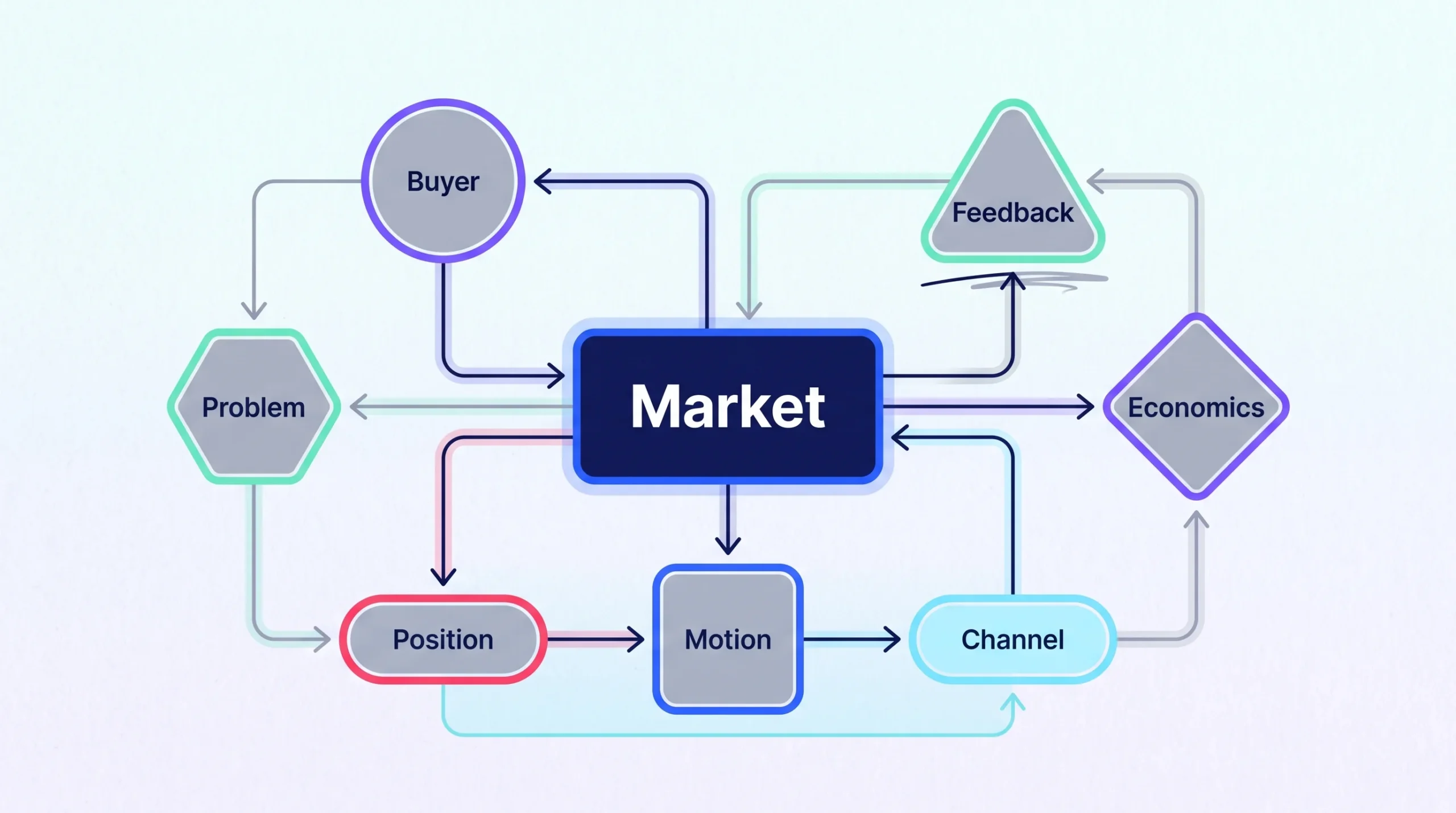
These eight choices are interdependent. A decision to target enterprise buyers (Buyer) will influence your sales motion (sales-led), channels (direct outreach), and economics (high ACV, longer sales cycles). A change in one area necessitates a review of the entire system.
Strategy is not a plan
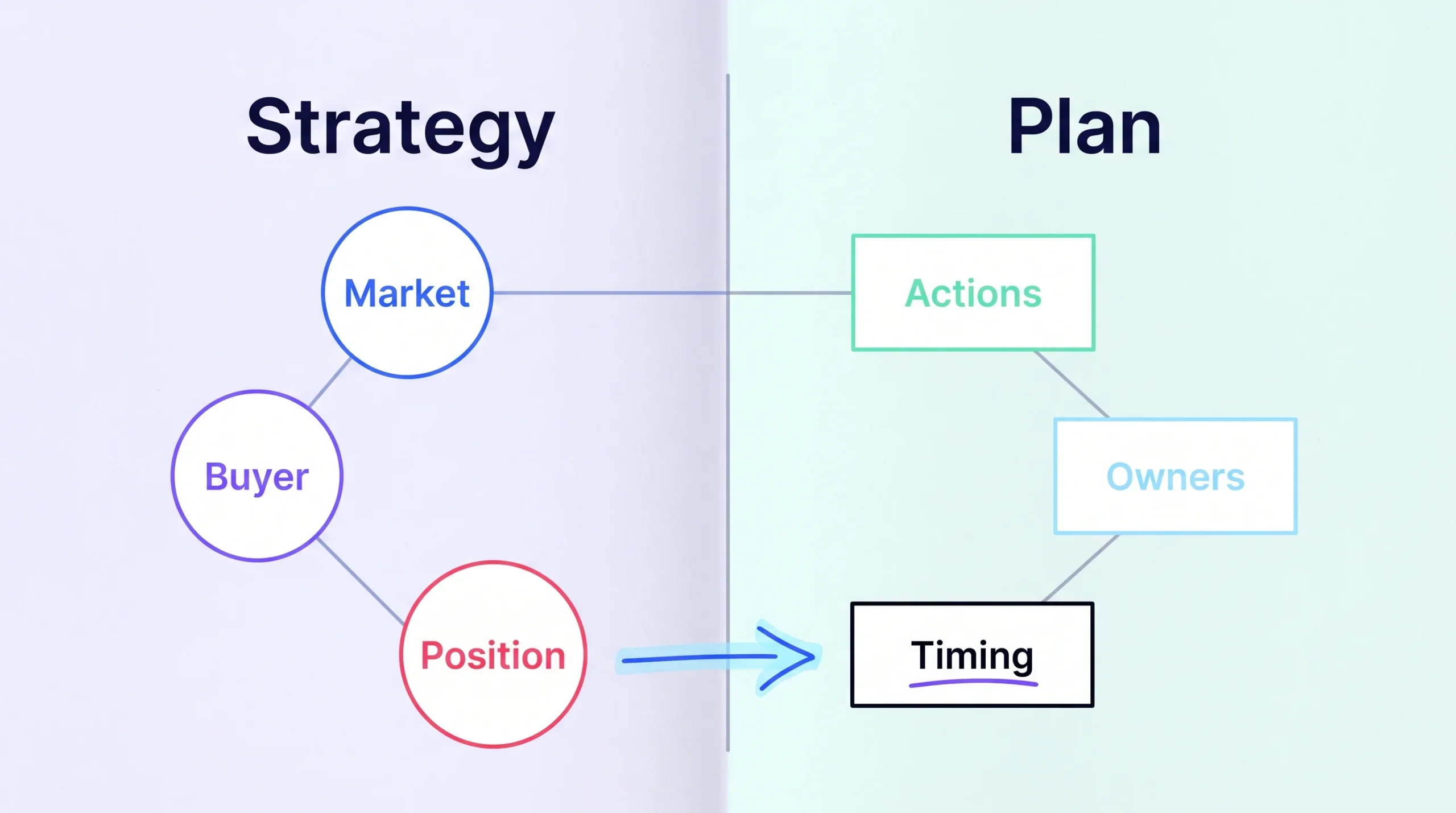
Operators often confuse GTM strategy with a GTM plan. The distinction is critical for effective execution. A strategy is the set of guiding principles and choices, while a plan is the detailed sequence of actions to implement that strategy.

- GTM Strategy: The durable logic for how you will win a market. It is a system of decisions about where to play and how to win. It changes infrequently, typically in response to significant market shifts or performance data.
- GTM Plan: The time-bound project for executing the strategy. It includes specific campaigns, tasks, timelines, budgets, and responsible parties. A plan is tactical and might cover a product launch or a quarterly marketing initiative. It changes often.
According to a framework from Harvard Business School, the strategy focuses on the "big picture" of market opportunity and competitive advantage. The plan translates that picture into concrete actions. For example:
| Aspect | GTM Strategy (The 'Why') | GTM Plan (The 'How') |
|---|---|---|
| Focus | Market selection, buyer definition, positioning | Campaign execution, content creation, sales plays |
| Timeline | 12-24 months | 30-90 days |
| Artifact | A strategy document outlining the 8 core choices | A project plan, marketing calendar, or Trello board |
| Success Metric | Market share, revenue growth, LTV:CAC ratio | MQLs, pipeline generated, launch day signups |
A company might have one core GTM strategy for a product line but execute dozens of GTM plans over its lifetime. Without a clear strategy, these plans become a series of disconnected tactics that fail to build momentum.
A B2B SaaS example: QueryFlow
To see the framework in action, consider an illustrative B2B SaaS company, "QueryFlow." QueryFlow is an AI-native data analytics platform for non-technical revenue teams.
Here is how QueryFlow could define its GTM strategy using the eight-part framework:
- Market: Mid-market B2B SaaS companies ($20M-$100M ARR) in North America that have a mature CRM but lack dedicated data science resources.
- Buyer: The primary buyer persona is the Head of Revenue Operations. Secondary personas include the Head of Sales and the Head of Marketing. They are measured on pipeline efficiency and revenue predictability.
- Problem: Revenue teams cannot access or use product usage data to identify expansion opportunities without relying on engineering tickets, which are slow and costly. This friction leads to missed revenue and high churn risk.
- Position: QueryFlow is positioned as the self-serve analytics layer for GTM teams. Its key differentiator is a natural language interface that allows any operator to query complex databases without writing SQL.
- Motion: A product-led growth (PLG) motion with a sales-assist layer. Users can sign up for a free trial to connect their data sources. A sales team engages with accounts that show high product usage or fit the enterprise ICP to convert them to paid plans.
- Channels: The primary channel for the PLG motion is the HubSpot and Salesforce app marketplaces. Marketing efforts focus on creating content for RevOps communities and running targeted ads on LinkedIn. The sales-assist team uses product-qualified leads (PQLs) as their primary signal for outreach.
- Economics: The model is built around a low CAC from the PLG motion and a high LTV from multi-year enterprise contracts secured by the sales team. The goal is an LTV:CAC ratio greater than 4:1.
- Feedback: The core feedback mechanism is tracking the free-to-paid conversion rate and the time-to-value for new users. The GTM engineer is responsible for instrumenting the product to capture these signals and routing them to the sales and marketing teams. This data informs weekly GTM meetings where the team can adjust messaging, targeting, or in-product onboarding.
This complete system provides clarity for every team at QueryFlow. Marketing knows who to target and what message to use. Sales knows which leads to prioritize. Product knows which features support the core value proposition.
Common GTM strategy mistakes
Even with a framework, companies make predictable errors when designing and executing their GTM strategy.
- Confusing a launch with a strategy: Many teams build a detailed launch plan, including press releases, social media announcements, and a new landing page, and call it a GTM strategy. A launch is a moment in time; a strategy is the engine that drives growth before, during, and after the launch.
- Ignoring the economics: A strategy that cannot acquire customers profitably is a failure. Teams often focus on top-of-funnel metrics like traffic and leads without connecting them to CAC and LTV. As Stripe notes for startups, a GTM strategy must be economically viable to sustain the business.
- Defining the market too broadly: Fear of missing out can lead companies to define their target market too widely. An effective strategy starts with a specific, winnable niche and expands from there. A clear ICP prevents wasted resources on poor-fit customers.
- Building a static document: A GTM strategy is a living system, not a document that gathers dust. The most effective strategies have built-in feedback loops. Market conditions change, new competitors emerge, and customer needs change. The strategy must adapt.
A successful go-to-market strategy is a source of organizational alignment and competitive advantage. By treating it as a dynamic system of choices, operators can build a repeatable engine for growth that connects a valuable product to the right market.
FAQ
Who owns the go-to-market strategy?
In an early-stage startup, the founder or CEO typically owns the GTM strategy. As the company scales, ownership may shift to a Chief Revenue Officer (CRO), Chief Marketing Officer (CMO), or a dedicated head of GTM. However, the strategy is cross-functional, requiring input and buy-in from product, sales, marketing, and finance leaders.
How is a GTM strategy different from a business strategy?
A business strategy defines the company's overall vision, mission, and long-term goals, including financial objectives and operational structure. A GTM strategy is a subset of the business strategy that focuses specifically on how the company will bring a product to market and generate revenue. As defined by industry analysts, the GTM strategy outlines the plan to engage target customers and achieve a competitive advantage.
How often should a GTM strategy be reviewed?
A GTM strategy should be reviewed at least annually or whenever there is a significant change in the market, product, or competitive environment. The tactical plans that execute the strategy should be reviewed more frequently, such as quarterly or monthly, to ensure they are on track and to make necessary adjustments.
Can a company have more than one GTM strategy?
Yes. A company can have multiple GTM strategies for different products, market segments, or geographies. For example, a software company might have a PLG strategy for its self-serve product aimed at small businesses and a separate, sales-led strategy for its enterprise platform targeting Fortune 500 companies. Each requires its own set of choices.