


How to build a go-to-market strategy for a startup
Building a go-to-market (GTM) strategy for a startup is the process of finding a repeatable motion for acquiring customers. It is a system of learning that moves from validating a problem to founder-led selling and then to the first scalable channel. For an early-stage company, GTM is not a launch plan; it is the entire mechanism used to de-risk market assumptions and find a path to revenue before the runway ends.
A go-to-market strategy for a large, established company often focuses on coordinating a known set of resources to launch a new product into a understood market. For a startup, the market, message, and channels are all unproven variables. The job of the GTM strategy is to test and validate these variables with as little capital as possible. It prioritizes learning and evidence over immediate, large-scale growth.
A learning system, not a launch plan
The primary function of a startup's GTM is to answer a sequence of critical questions with evidence:
- Problem: Does a specific group of people have a painful, urgent problem?
- Solution: Does our product solve that problem in a way they are willing to pay for?
- Audience: Can we identify and reach more of these specific people?
- Channel: Can we reach them through a channel that is predictable and scalable?
A static GTM document created before talking to customers will not survive contact with the market. Instead, the strategy should be a framework for controlled experiments. Each stage has a specific goal, a set of activities to achieve it, and evidence gates that must be passed before committing more resources.
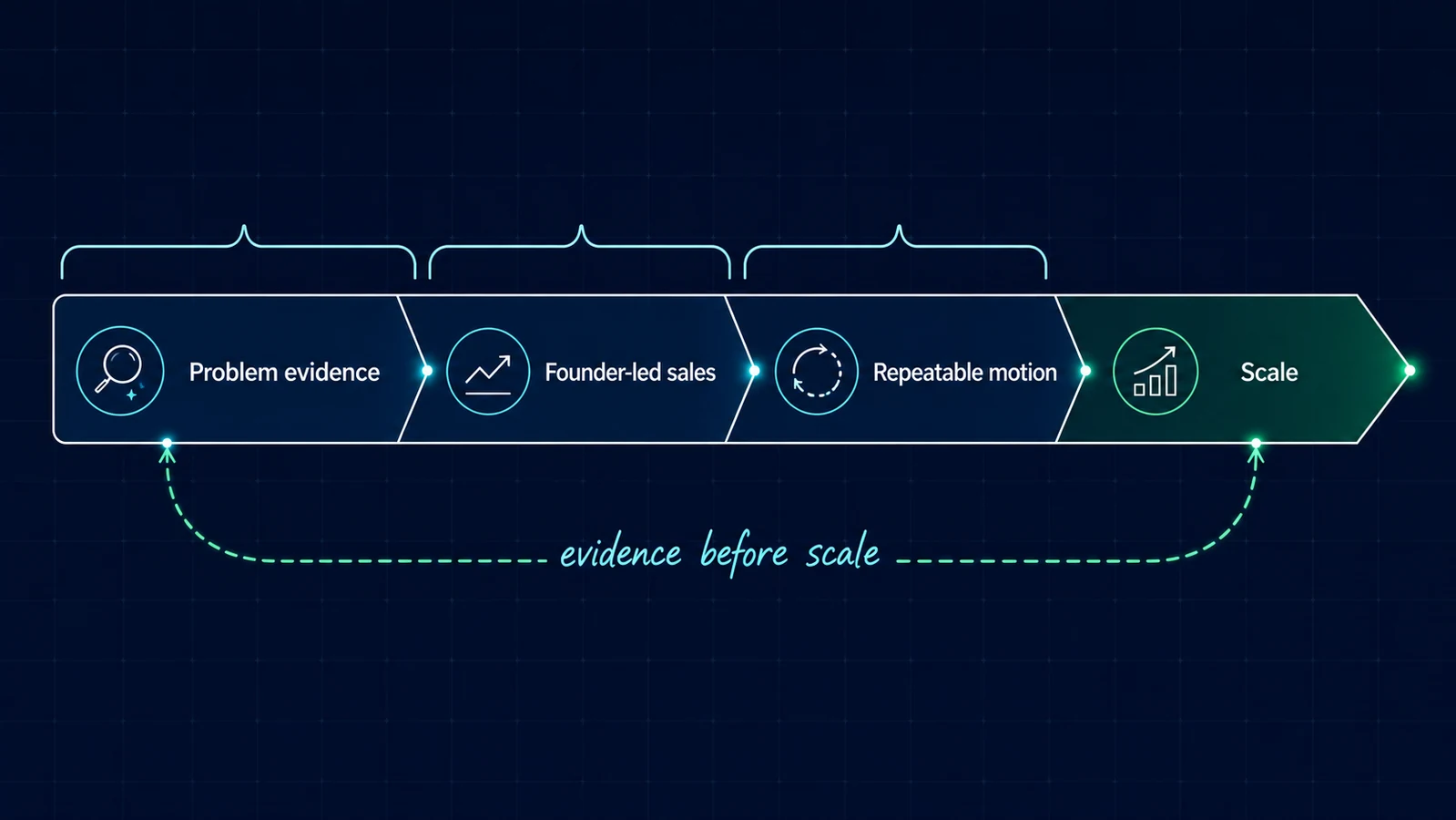
The three stages of a startup GTM
A startup GTM evolves through three distinct stages. Founders cannot skip a stage; attempting to scale before validating the previous stage's assumptions is a primary cause of failure.

Stage 1: Problem evidence
The first stage is not about selling a product. It is about confirming that a well-defined market segment has a problem worth solving.
- Focus: Problem validation and market discovery.
- Activities: Founder-led customer discovery interviews, market research, and analysis of existing solutions. This is not a sales pitch; it is a structured conversation to understand the potential customer’s pain, current workflow, and budget for solving the problem.
- Goal: Gather qualitative evidence that a specific Ideal Customer Profile (ICP) experiences a frequent, high-cost problem. The output of this stage is a clear hypothesis about the market, the problem, and the potential value of a solution. You should be able to articulate the customer's pain in their own words.
Stage 2: Founder-led sales
Once there is strong evidence of a problem, the founder’s job is to prove they can manually sell the solution to the target ICP. This stage is about finding the initial message and offer that works, not about building a sales team.

- Focus: Proving the solution's value and finding message-market fit.
- Activities: The founders sell the product directly. This could be through their personal networks, manual outreach, or attending small industry events. Every sales conversation provides critical feedback on the product, pricing, and value proposition.
- Goal: Acquire the first 5-10 paying customers who all fit the same tight ICP. These initial customers are design partners. Their feedback confirms the product delivers on its promise and helps refine the messaging for the next stage. A founder who cannot personally sell the product cannot write a playbook for someone else to do it.
Stage 3: Repeatable motion
With a handful of happy, paying customers and a clear message, the focus shifts to repeatability. The goal is to find at least one acquisition channel that can predictably generate new customers.
- Focus: Systematizing the acquisition process and finding a scalable channel.
- Activities: Analyze how the first 10 customers were acquired. If it was through cold outreach, build a systematic outbound sales process. If it was through content, build a content engine around the topics that resonated. The work here is to turn the founder’s ad-hoc success into a defined process that a new hire could run.
- Goal: Build one GTM motion that is measurable and predictable. Success means you can model the inputs (e.g., number of emails sent, articles published) and have a reasonable forecast of the outputs (e.g., demos booked, new customers). This is the foundation required before seeking true product-market fit and scaling the GTM team.
How to define your initial GTM constraints
Early-stage startups die from too many options, not too few. The GTM strategy's power comes from focus. Before you can scale, you must constrain your efforts to a small, manageable surface area. This preserves runway and accelerates learning. As one guide from Harvard Business School notes, a focused strategy helps startups avoid "wasting precious time and money."
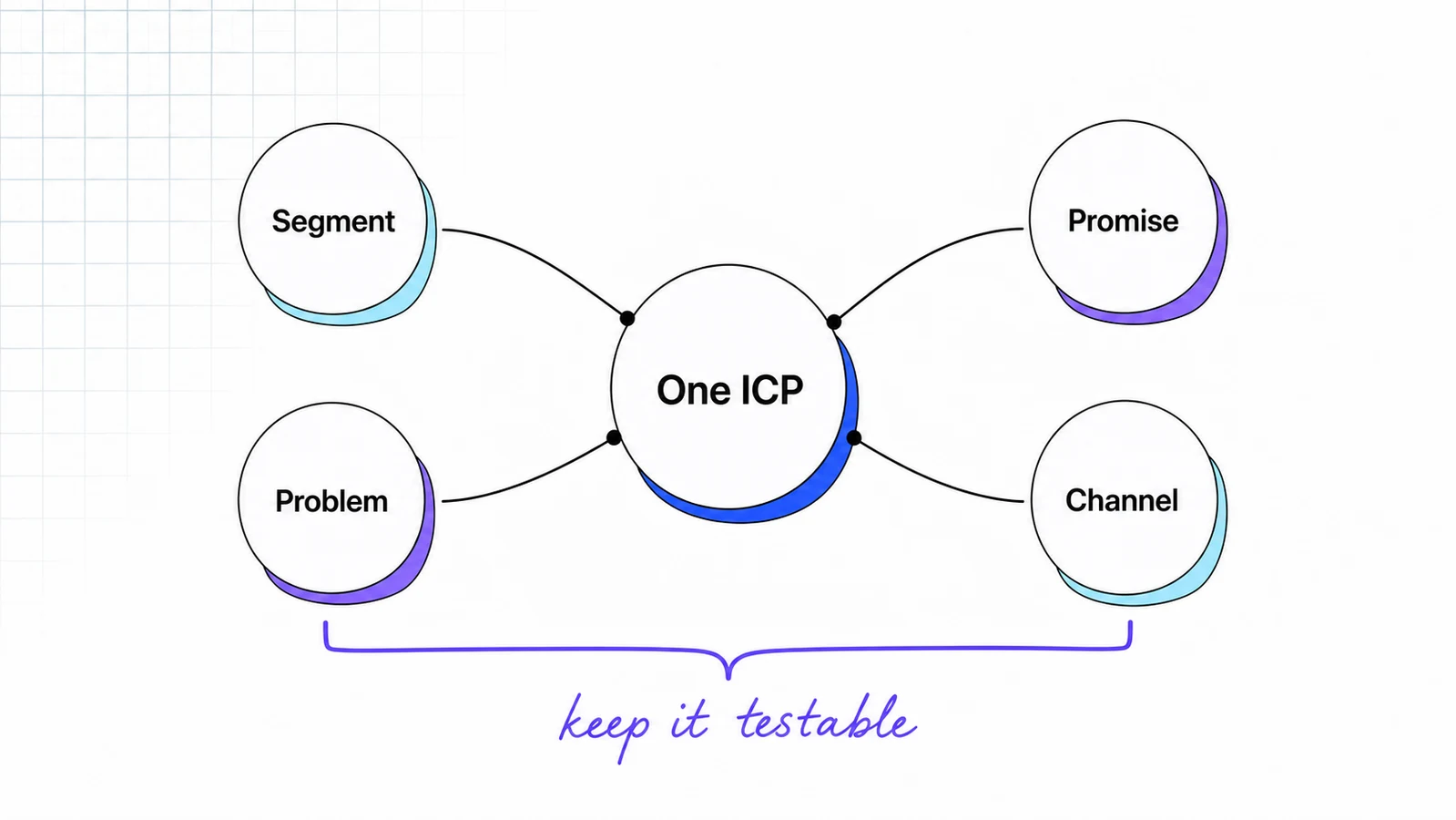
Force your team to make hard choices on four variables.
- One ideal customer profile: Who is the perfect customer for your product right now? Be ruthlessly specific. It is not "all small businesses." It is "B2B SaaS companies with 50-200 employees, a dedicated customer support team of at least five, and no existing integration between their support and engineering software." This clarity defines who you will target and, just as important, who you will ignore. A precise ICP makes it easier to find and qualify potential customers.
- One core problem: What is the single most painful problem you solve for that ICP? Early products that try to solve too many problems often solve none of them well. Focus your product and messaging on one high-value use case. All of your marketing and sales language should speak directly to this pain point.
- One clear promise: What is the specific outcome or result a customer gets from using your product? This is your value proposition. It should be simple, credible, and focused on the problem you solve. A good promise is "We cut down the time your engineers spend on support tickets by 50%," not "We are an innovative platform for workflow automation."
- One primary channel: Where does your specific ICP look for solutions to their core problem? Do not try to be active on every social media platform, run ads, and do cold outreach all at once. Pick one channel where you have the highest chance of reaching your buyer persona and dedicate all your resources to making it work. You must earn the right to expand into more channels later.
A SaaS GTM example: From problem to repeatability
Consider a fictional startup, "SyncUp," a B2B SaaS tool designed to connect engineering tickets in Jira with customer support tickets in Zendesk.
- Stage 1: Problem Evidence: The founder, a former engineering manager, was frustrated by the communication gap between her team and customer support. She hypothesized other EMs felt the same. She conducted 30 discovery interviews with engineering managers at mid-sized tech companies. She learned the problem was real and that teams were using clunky, manual spreadsheets to bridge the gap.
- Stage 2: Founder-Led Sales: She and a co-founder built a minimum viable product. They used their personal networks to get the first 10 meetings. During these sales conversations, they sold the vision and secured their first five paying customers. They learned that the real value was less about syncing tickets and more about automatically prioritizing engineering work based on the customer ARR tied to a support ticket. This insight sharpened their value proposition.
- Stage 3: Repeatable Motion: The founders analyzed their first five customers. Three of them were companies that had recently posted job descriptions for a "Technical Support Engineer." They hypothesized that companies hiring for this role were feeling the pain most acutely. They built a simple outbound sales motion: find companies with this job posting, identify the VP of Engineering, and send a personalized email about how SyncUp helps scale support without adding engineering headcount. After testing and refining the process, it predictably generated two qualified demos for every 100 emails sent. This became their first repeatable GTM motion, a system ready to be handed to their first sales hire.
Common GTM mistakes for early-stage startups
The staged approach helps avoid common pitfalls that burn capital and time. Founders often make these mistakes by trying to act like a scaled company too early.
- Scaling a channel before finding the message: Many startups hire a team of SDRs or pour money into Google Ads before the founders have proven they can consistently close deals themselves. If the core messaging and value proposition are not validated, scaling a channel only scales failure. As Stripe’s guide on GTM points out, the initial phase uses selling to collect evidence.
- Confusing activity with evidence: Generating 1,000 website visits from an ad campaign is an activity. If none of those visitors convert into qualified leads or customers, it is not positive evidence. The goal is to find a signal of market traction, not merely noise. Focus on metrics that signal real buying intent, such as demo-to-close conversion rates.
- Targeting too broad a market: The fear of missing out can lead founders to define their market too broadly. But as explained by startup advisor Andrew Verbitsky, a narrow focus is a startup’s advantage. A vague ICP makes marketing and sales efforts generic and ineffective. It is better to dominate a small, specific niche and expand from there.
- Building a static GTM plan: A 50-page GTM plan is a work of fiction. The market will invalidate most of your assumptions on day one. A startup needs a flexible framework for testing hypotheses, not a rigid plan for execution.
Metrics that matter at each GTM stage
The metrics you track should reflect the goal of your current GTM stage.

- Stage 1 (Problem Evidence): The metrics are qualitative. Success is measured by the number of insightful customer interviews and the clarity of the problem statement you develop from them.
- Stage 2 (Founder-Led Sales): Track early revenue indicators. Key metrics include the number of first paying customers, initial contract value, and the length of the sales cycle.
- Stage 3 (Repeatable Motion): Now, efficiency and predictability become important. Track channel-specific metrics like Customer Acquisition Cost (CAC), pipeline velocity, and lead-to-customer conversion rates.
By aligning your strategy, activities, and metrics by stage, you can systematically build a GTM engine that learns, adapts, and eventually scales.
FAQ
What is the difference between a go-to-market strategy and a marketing plan?
A go-to-market strategy is a comprehensive plan that defines how a company will reach its target customers and achieve a competitive advantage. It covers product, pricing, channels, and marketing. A marketing plan is a subset of the GTM strategy, focusing specifically on the tactics used to generate awareness and leads.
Who owns the GTM strategy at a startup?
At an early-stage startup, the founder or founding team owns the GTM strategy. The founders must be deeply involved in the initial customer discovery and sales process to gain the insights needed to build a repeatable motion. As the company grows, ownership may shift to a Head of Growth, CRO, or Head of Marketing.
When should a startup hire its first GTM role?
A startup should hire its first dedicated GTM role (like a salesperson or marketer) only after the founders have successfully and repeatedly sold the product themselves. The first hire's job is to scale a process that is already proven to work, not to figure one out from scratch.
How do you know when you have a repeatable GTM motion?
You have a repeatable GTM motion when you can predictably and profitably acquire new customers through a specific channel. This means you understand the inputs (e.g., ad spend, number of sales calls), the conversion rates at each step, and the outputs (new revenue). The process is documented and can be run by someone other than a founder.
Can a startup have a product-led GTM strategy?
Yes. A product-led growth (PLG) strategy, where the product itself is the primary driver of customer acquisition and conversion, is a type of GTM strategy. It is well-suited for products that are easy to adopt and demonstrate value quickly. However, it still requires a deliberate strategy for attracting users, converting them to paid plans, and expanding accounts.