


Channel sales strategy: How to build a SaaS partner motion
A channel sales strategy defines how selected partners help a company reach, sell to, transact with, implement for, or support customers. It names the customer segment, the partner's contribution, the commercial rules, and the evidence required before the company expands the program.
The starting question is not how many partners you can recruit. It is which customer constraint a partner can solve repeatedly. A local consultant may carry trust in a market the vendor cannot reach. A managed service provider may make a technical product usable for a customer that lacks internal capacity. A reseller may combine procurement access with implementation.
If the partner adds no clear customer value, the program becomes a second prospecting team with weaker control and more complicated economics.
What a channel sales strategy covers
Direct sales uses the vendor's employees to create and progress opportunities. Channel sales assigns part of that path to another company or individual under a commercial agreement. The partner may refer the opportunity, resell the product, deliver services, manage the product for the customer, or co-sell with the vendor.
Salesforce's channel sales overview describes the model as selling through third parties and emphasizes the need to manage partner relationships, training, and performance. HubSpot's channel sales analysis also makes the central tradeoff clear: indirect reach can expand distribution, but it reduces direct control and adds coordination costs.
A strategy decides where that tradeoff is worthwhile. It should answer:
- Which market segment is being served?
- What customer need does the partner satisfy?
- Which activities belong to the partner and which stay with the vendor?
- How will both sides make money?
- Who owns the account, opportunity, renewal, and customer outcome?
- What evidence would justify expanding the channel?
Those choices should fit the company's broader go-to-market strategy. A partner program is a route to market, not a substitute for choosing a market.
Check whether the company is ready
An early startup often sees partnerships as a way to avoid building direct sales. That usually transfers an unfinished sales problem to a partner. A partner cannot reliably repeat a message, qualification rule, and sales process the vendor has not learned yet.
Before launching a channel, check six conditions.
The direct sale is understandable
The company knows who buys, why they buy, which objection matters, and what a credible next step looks like. Founder-led sales can provide this learning before a partner is asked to carry it.
The value proposition is repeatable
A partner needs a short, accurate value proposition that survives outside the founder's explanation. If every deal requires a new story, enablement will turn into custom support.
The product supports partner delivery
Consider demo access, provisioning, permissions, billing, implementation, support, and customer-data boundaries. Partner friction in these areas can erase the benefit of added reach.
Account economics can support another participant
Commission, discount, services margin, support cost, and channel operations must fit the expected annual contract value. A low-value product can still use referrals or affiliates, but a high-touch reseller motion may be uneconomic.
Customers already use or trust the partner type
Channel fit comes from buyer behavior. If the target customer already relies on an MSP, consultant, marketplace, or system integrator for the problem, that route deserves investigation.
One person owns the motion
The owner needs authority across recruitment, enablement, rules, attribution, and direct-sales conflict. A program split among several teams without one decision owner will move slowly when the first exception appears.
Choose one partner motion
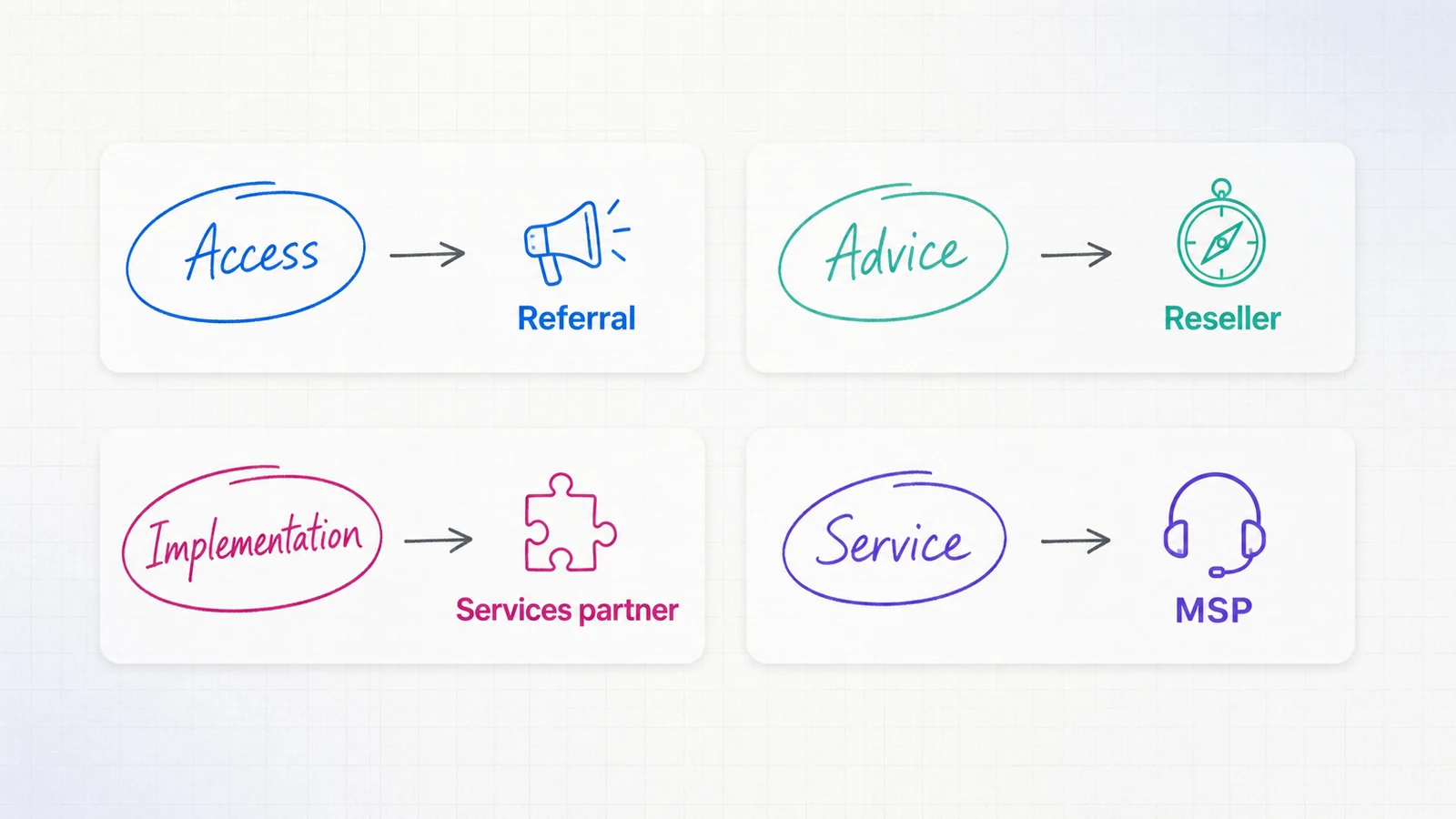
Partner categories are useful only when they connect to a customer need.
- Referral partner: introduces a qualified buyer and leaves the sale to the vendor. Use it when access and trust are the main contribution.
- Reseller: sells the product and may manage the commercial relationship. Use it when customers prefer to purchase through an existing vendor or local provider.
- Services partner: implements, configures, integrates, or advises. Use it when adoption depends on expertise the vendor cannot supply at scale.
- Managed service provider: operates the product or related process for the customer. Use it when the customer wants an outcome without building internal capacity.
- Technology partner: connects complementary products and may support co-marketing or co-selling. Use it when the combined solution creates a clearer customer result.
Do not launch all five. Choose one segment, one contribution, and one commercial path. The first program should be narrow enough that the company can explain why each partner belongs.
Create an ideal partner profile
An ideal partner profile is the partner equivalent of an ICP. It should describe evidence, not prestige.
Evaluate a candidate across five dimensions:
- Customer overlap: Does the partner serve the same segment and buyer?
- Relevant capability: Can it diagnose, position, implement, or operate the product's use case?
- Commercial motivation: Will the product create meaningful revenue, retention, or differentiation for the partner?
- Operating capacity: Does it have people, process, and leadership attention for the motion?
- Conflict risk: Does it sell a competing product or face incentives that oppose the intended customer result?
A large company with weak motivation can be a worse partner than a specialist with trusted customer access and a clear services model. Require evidence such as customer examples, qualified introductions, technical capability, or a joint account hypothesis.
Forrester frames channel strategy as a multiyear hypothesis about how partners help reach business objectives. That is a useful discipline: the partnership should express a strategic belief that can be tested, not a list of logos collected at an event.
Set economics and rules before the first deal
Partner economics should reward the contribution the partner controls. A referral fee pays for a qualified introduction. A reseller discount pays for selling, transacting, and often supporting the customer. Services revenue belongs to the party delivering the service. Co-sell arrangements may require shared account planning without a resale margin.
Model the full cost, including internal channel staff, enablement, incentives, support, marketplace fees, and discounts. Compare partner-sourced customer acquisition cost with direct acquisition, but keep the comparison honest. A new channel can look cheap if internal labor and partner ramp are excluded.
Write the operating rules before opportunities appear:
- Which accounts can a partner register?
- How long does registration protection last?
- What evidence makes an opportunity valid?
- Who sets price and approves discounts?
- How are existing customers and renewals handled?
- What happens when direct sales and a partner claim the same account?
- Which activity counts as sourced, influenced, or delivered?
- Who owns support and escalation?
Rules protect partner trust and direct-sales behavior. If exceptions are negotiated deal by deal, both sides learn to compete for credit rather than serve the buyer.
Run a focused pilot
The first pilot should use a small cohort of partners that match the profile. Give them a specific segment, offer, use case, and action plan. Agree on the customer problem, qualification standard, first accounts, enablement milestones, and review cadence.
A practical sequence is:
- Select a narrow segment and partner contribution.
- Recruit candidates against the written profile.
- Confirm joint economics and named owners.
- Teach one use case and qualification path.
- Build a short target-account or referral plan.
- Observe the first opportunity handoffs closely.
- Revise rules and materials before recruiting another cohort.
The pilot should reveal whether the partner can find and progress suitable customers without constant intervention from the vendor.
Partner enablement must create capability
Uploading a deck does not create an active channel. A partner needs enough capability to identify fit, explain the customer problem, qualify the situation, position the offer, handle common objections, and bring the vendor into the conversation at the agreed point.
Use observable checks. Ask the partner to qualify a sample account, deliver the problem narrative, map the technical handoff, or create a joint account plan. Certification is useful only when it measures behavior that will occur with a customer.
Enablement should also be role-specific. A seller needs discovery and positioning. A solutions consultant needs architecture and integration. A service lead needs delivery standards and escalation. A partner executive needs the economic case and capacity plan.
Alignment fails before technology does
The PartnerStack and Wynter State of Partnerships in GTM 2026 offers a useful view of perceived blockers. Wynter surveyed 100 senior revenue, marketing, and partnership leaders at B2B SaaS companies with more than $50 million in revenue.
Thirty-seven percent selected alignment between teams as the biggest blocker to partner-driven revenue. Twenty percent selected the absence of a clear partner program, 14% selected limited visibility into partner impact, 13% selected other issues, 9% selected lack of executive support, and 7% selected lacking the right technology.
The sample is small, self-reported, and limited to larger B2B SaaS companies. Geography and fieldwork dates were not disclosed on the accessible pages. The finding does not prove that alignment causes partner revenue. It does support a sensible priority: settle ownership, rules, and program design before assuming software is the main constraint.

Measure partner activation before revenue
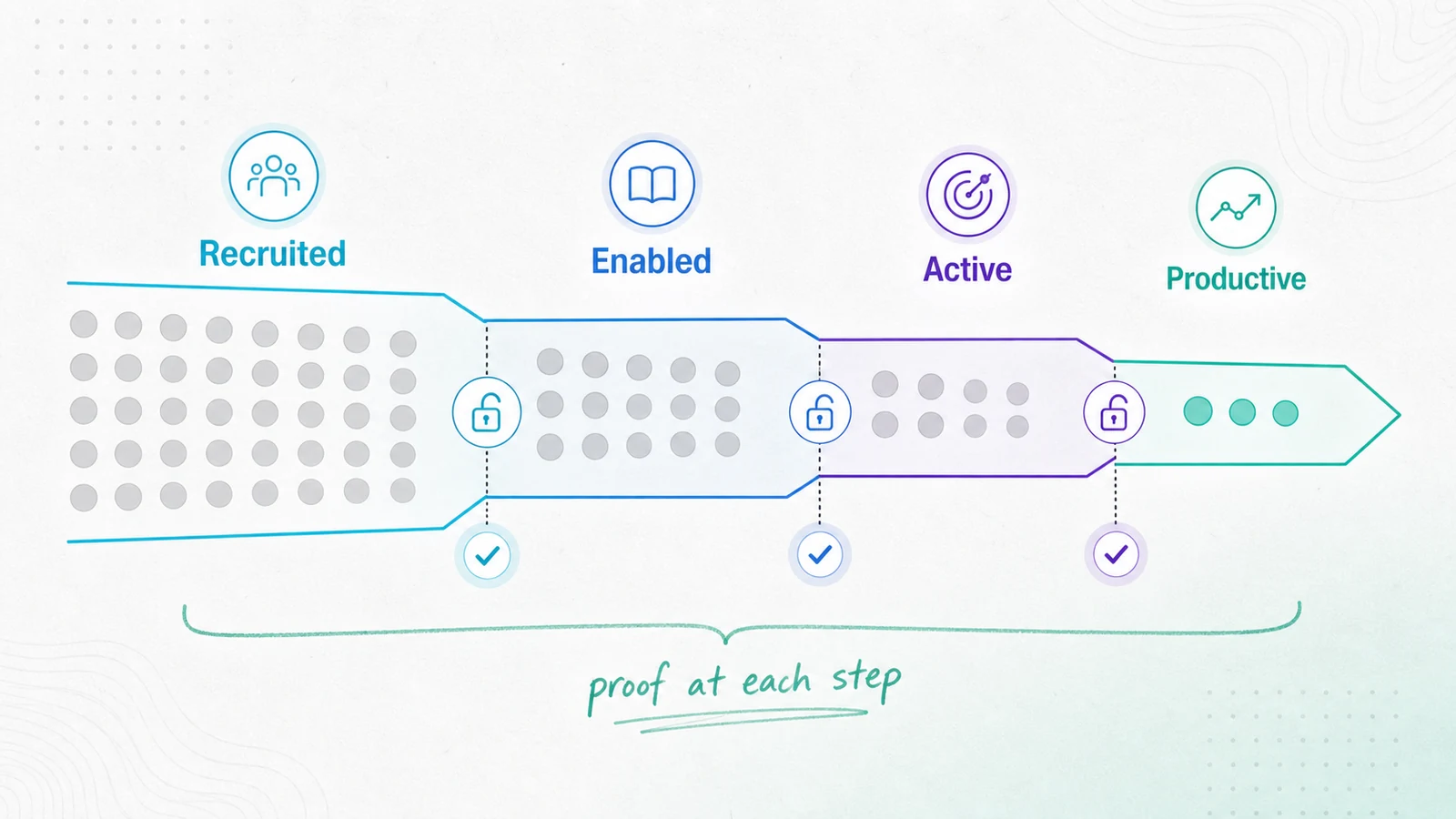
Revenue is the final output, but it arrives too late to diagnose an early program. Track partner progression in four states:
- Recruited: the agreement is signed and the partner profile is confirmed.
- Enabled: the required capability checks are complete.
- Active: the partner has performed a qualified commercial action within a defined period.
- Productive: the partner contributes accepted sales pipeline or customer outcomes repeatedly.
Then measure registration acceptance, opportunity progression, win rate, sales cycle, average contract value, margin after partner cost, implementation quality, retention, and expansion by partner and segment.
RevOps should define attribution and CRM rules with the channel owner before reporting begins. Sourced and influenced revenue need separate definitions. Otherwise one successful deal can be claimed by marketing, direct sales, and the partner without showing what each party contributed.

Common mistakes
The first mistake is recruiting before the direct sale is understood. The second is choosing partners for brand recognition instead of customer overlap and motivation. The third is offering economics that reward registration but not customer progress.
Programs also fail when enablement measures content completion, account rules remain vague, and inactive partners stay in the denominator only when the company wants a large network number.
Our view: a small group of capable partners with clear customer value is a channel. A large directory of signed agreements is an audience for partner emails.
Frequently asked questions
What is the difference between channel sales and direct sales?
Direct sales uses the vendor's employees for the commercial path. Channel sales assigns defined activities to a partner, such as referral, resale, implementation, managed service, or co-selling.
When is a SaaS company ready for channel sales?
The company should understand its direct sale, have repeatable positioning, know which customer need a partner can solve, support partner delivery, and have account economics that can fund the partner contribution.
Which partner type should a SaaS company start with?
Start with the type already trusted by the target customer for the relevant problem. Choose referral for access, reseller for transaction and selling, services for implementation, or MSP for ongoing operation.
How should channel partners be compensated?
Pay for the contribution the partner controls. Referral fees, reseller discounts, services revenue, and co-sell incentives represent different activities. Model margin and internal channel costs before finalizing rates.
How do you prevent channel conflict?
Define deal registration, account ownership, protection periods, pricing authority, renewal rules, and dispute handling before the first shared deal. Apply the rules consistently and record exceptions.
For practical GTM analysis like this, join the GTMpreneur newsletter.