


Founder-led sales: How to build a repeatable motion before hiring
Founder-led sales is the phase in which a founder directly runs enough of the sales motion to learn who buys, which problem creates urgency, what promise earns a next step, and how a deal advances. The goal is a motion that can eventually be taught, inspected, and improved by someone else.
The hiring question is therefore not “Have we reached a standard revenue milestone?” It is “Can we define a useful role without asking the new hire to discover the market from scratch?” Until the answer is yes, the founder still owns the learning. When one stage becomes clear, that stage can move first.
What founder-led sales includes
Founder-led sales covers the work required to find and develop the initial sales motion: selecting accounts, starting conversations, running discovery, qualifying opportunities, presenting the product, following up, handling commercial steps, closing, and reviewing wins and losses.
It is broader than founder-led content or founder-led outbound. Content may create demand, and outbound may start conversations, but neither covers the full path from a buyer signal to a commercial decision. The defining feature is that the founder stays close enough to the buyer to change the motion based on direct evidence.
That evidence should sharpen the ideal customer profile, problem, trigger, promise, qualification logic, offer boundaries, and deal path. Founder-led sales sits inside the wider company motion, but it has a specific job: discover which parts of selling are stable enough to repeat.
Why the founder owns the early motion

Early selling contains questions that touch product, market, pricing, and company direction at the same time. A founder can explain an unfinished product, trace a technical concern to a roadmap choice, and decide whether a requested change reveals a broader need or a one-off exception. That range makes direct founder access useful while the sales hypothesis is still changing.
Deal economics change how much direct conversation, qualification, and proof an early sale requires. Stripe Atlas's guide to the first 10 customers describes software below $500 a month as capable of supporting low-touch sales and software above about $5,000 a year, roughly $417 a month, as requiring high-touch sales. The overlap is useful because these are broad operating guides, not a precise boundary or a rule for when to hire.
Pete Kazanjy's Founding Sales frames the work as finding, refining, and then scaling an initial sales motion, with founder responsibility extending into the first hiring and onboarding steps. The founder is learning what a professional seller will later need to know.
Manual acquisition also creates unusually direct feedback. In “Do Things that Don't Scale,” Paul Graham argues that founders often need to recruit early users manually and pay close attention to them. For B2B sales, the useful output is not activity alone. It is a clearer account of who has the problem, why it is urgent, and what moves the buyer forward.
Run sales as an evidence loop

Start with a narrow sales hypothesis. Name the account type, buyer role, triggering event, current problem, expected outcome, and reason the buyer might act now. Treat it as a testable starting point, not a permanent market statement.
Then run a simple loop:
- Select a target account. Write down why the account may have the problem now. A trigger is more useful than a generic fit label because it gives the conversation a reason to exist.
- Start a direct conversation. Use warm introductions, communities, events, inbound interest, referrals, or targeted outreach. The channel can vary. The learning objective should remain explicit.
- Diagnose the current state. Ask how the buyer handles the work now, what changed, who owns the consequence, and what happens if nothing changes. Do not rush from a surface complaint into a demo.
- Ask for a real next step. A useful next step has an owner, a purpose, and a date. It might be a technical review, stakeholder call, scoped trial, or commercial discussion. Polite interest without commitment is weak evidence.
- Record what happened. Capture the buyer's words, current workaround, consequence, objections, stakeholders, next action, and any exception the founder introduced.
- Update the next test. Keep recurring patterns, narrow broad claims, and remove assumptions that calls fail to support.
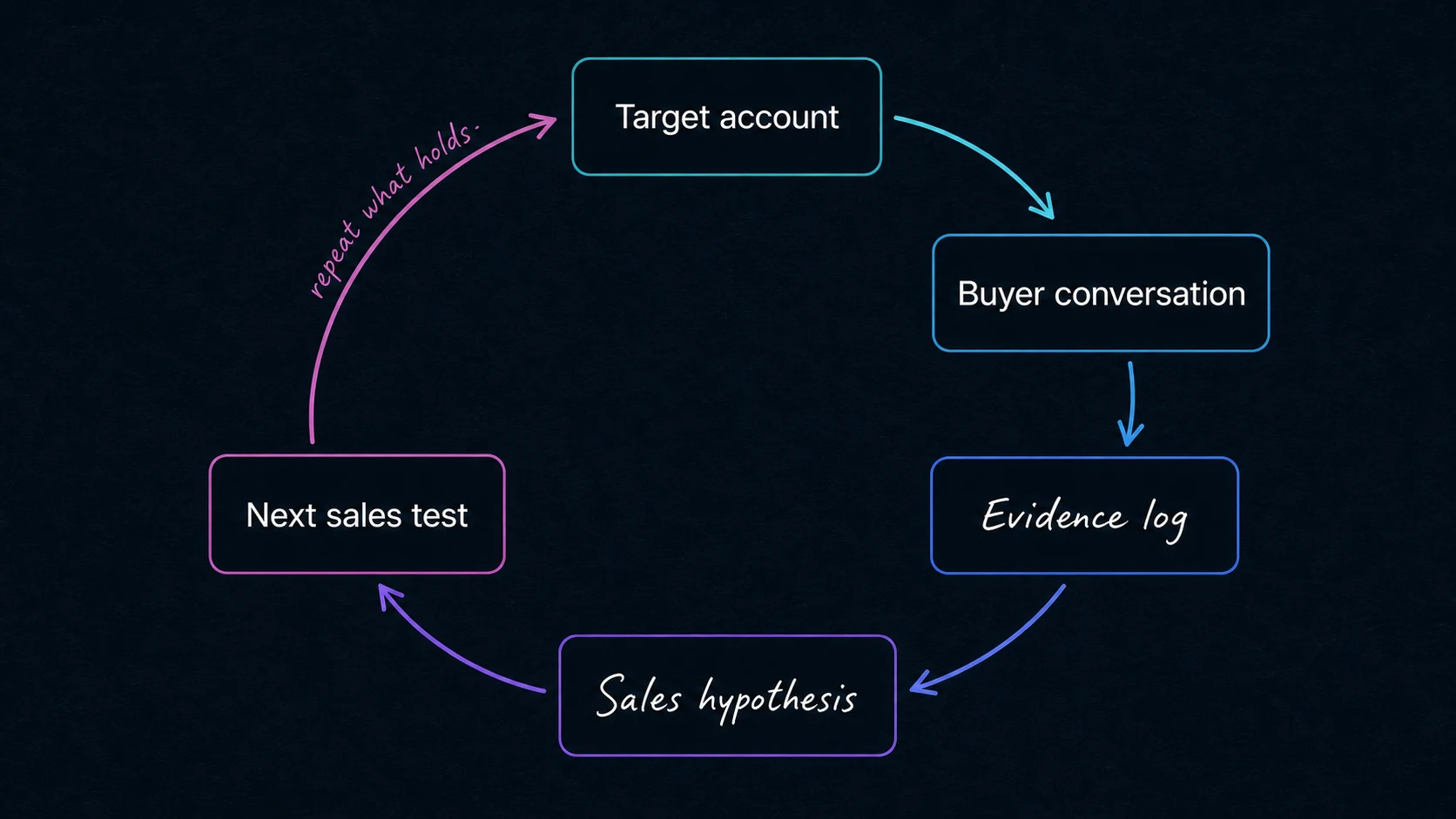
The First Round Review guide to founder-led sales shows how light stage hypotheses and explicit next steps can add structure without forcing a mature sales process onto an early motion. The useful discipline is to make each call change the next account, message, question, or qualification decision.
Weekly review should compare patterns across calls. Which trigger appears before serious conversations? Which problem language repeats? Where do deals stop? Which founder action was necessary to keep a deal alive? A repeatable motion emerges from repeated evidence, not repeated activity.
Document the minimum teachable playbook
Documentation should explain decisions. A script that says what to recite is less useful than a playbook that shows whom to contact, what to learn, how to qualify, and what must be true before a deal advances.
| Activity | Evidence to capture | Artifact to update |
|---|---|---|
| Target selection | Why this account may have the problem now | ICP and trigger notes |
| First conversation | Current workflow, pain, consequence, owner, timing | Problem and qualification notes |
| Demo or solution review | Which capability maps to the stated problem | Demo path and proof library |
| Commercial step | Budget path, stakeholders, scope boundary, next action | Stage criteria and proposal pattern |
| Win or loss review | Reason for decision, exception, founder-only intervention | Objection, loss, and exception log |
The minimum playbook should contain the ICP and triggers, buyer problem language, value proposition, qualification checks, sales pipeline stages and exit criteria, common objections, relevant proof, follow-up patterns, loss reasons, and offer boundaries. It should also mark founder-only exceptions such as unusual discounts, custom scope, or product commitments.
Connect this record to the company's go-to-market plan so sales evidence can change targeting, messaging, and execution priorities. HubSpot's guidance on scaling founder-led sales similarly recommends documenting the process and language, then training new sellers through direct observation. Keep the system light enough that the founder will actually maintain it.
Example: from scattered calls to a narrow hypothesis
Consider a hypothetical B2B SaaS company selling an incident-review tool to engineering leaders. The technical founder begins with calls across several unrelated segments. Some buyers like the product, but the calls do not reveal a consistent reason to act.
The founder starts logging buyer role, triggering event, current workaround, promised outcome, objection, next step, and loss reason. Across later conversations, a pattern appears among teams that recently added on-call headcount. Those teams describe coordination problems after incidents and have a clear owner for improving the review process.
The founder narrows account research around that trigger and updates discovery questions to test the pattern. Account research and list preparation move to an operator with explicit criteria. The founder keeps discovery because the problem language, product fit, and offer boundary are still forming. This is partial delegation: a clear task moves while the learning-heavy stage stays close to the founder.
Test whether the motion is ready to transfer

Transfer readiness is a question of teachability. A new seller should be able to understand what enters a stage, what action to take, what evidence to capture, and what must happen before the opportunity moves forward.
Use six checks:
- Recurring buyer and problem: Similar accounts describe a recognizable problem with a plausible reason to act.
- Consistent promise: The same core outcome earns attention without a different pitch for every account.
- Bounded offer: Standard scope, pricing logic, proof, and exceptions are visible.
- Explicit stages: Each stage has entry and exit criteria based on buyer action.
- Usable evidence: Calls, notes, losses, objections, and exceptions give a coach enough context to diagnose execution.
- Coached transfer: Another person can run a defined part of the motion while the founder observes where the playbook fails.
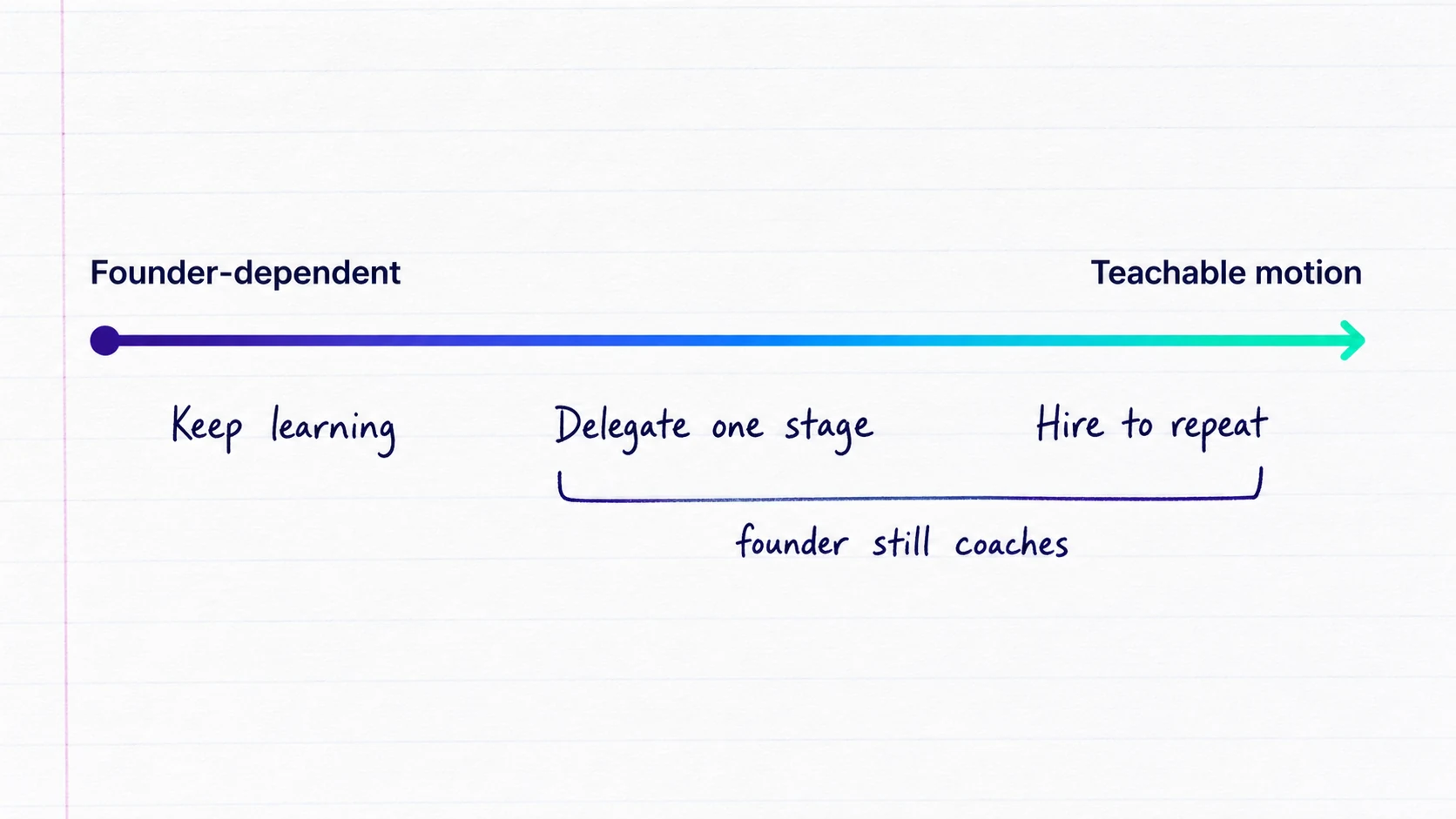
A coached trial is a useful transfer test. Start with standard accounts or one bounded stage. Review calls together. Separate a seller execution issue from a missing market assumption. Update the playbook when the seller encounters a situation the founder handled through memory or authority.
Knak co-founder Pierce Ujjainwalla describes the company's founder-led sales transition as proving that a non-founder could sell, followed later by problems when hiring expanded without enough playbooks, training, territories, or quotas. That is one company's experience, not a universal sequence, but it highlights the difference between one successful transfer and a prepared team model.
The motion is not ready when every deal needs a different buyer, promise, scope, or founder intervention. Keep learning, or delegate only the stable portion. Hiring should make the next role smaller than “figure out how to sell this.”
Decide what to delegate and who to hire
Choose the role from the current bottleneck. Deal complexity, channel, founder skill, and available demand all change the answer.
| Current bottleneck | Delegate first | Founder keeps | Possible role |
|---|---|---|---|
| Finding enough right-fit accounts | Research and list preparation | ICP changes and account exceptions | GTM operator or research support |
| Starting enough qualified conversations | Prospecting execution and follow-up | Message changes and discovery | SDR or founder associate |
| Running qualified deals | Selected standard deals under coaching | Strategic deals, pricing exceptions, product commitments | Early account executive |
| Process is inconsistent | Call review, CRM hygiene, and stage instrumentation | Sales hypotheses and coaching | Advisor or RevOps support |
| Buyer and problem remain unstable | Nothing material yet | Full discovery and market learning | No sales hire yet |
A GTM engineer can help when data flows, research systems, or workflow execution constrain an otherwise clear motion. That role does not replace founder discovery when the buyer and problem remain unstable.
Common failure modes
Warm-network wins can prove willingness to pay without proving a repeatable acquisition path. Founder authority, deep product knowledge, personal discounts, or custom scope may close a deal that another seller cannot reproduce.
Other failures come from hiring a senior sales leader to discover the basic motion, building heavy tooling before stages are clear, failing to record calls, and treating every exception as standard process. These choices hide uncertainty instead of reducing it.
Complete founder withdrawal creates another risk. A first hire still needs coaching, fast answers, and direct access to the reasoning behind the playbook. Keep strategic deals, pricing exceptions, product commitments, message changes, and market feedback close until their logic can be taught.
FAQ
What is founder-led sales?
Founder-led sales is the phase in which a founder directly runs enough of the sales motion to learn who buys, which problem has urgency, what earns a next step, and how deals advance. Its output is a documented motion another person can be taught to run.
How long should founder-led sales last?
It should last until the relevant parts of the motion are stable enough to teach and inspect. Use recurring evidence about the buyer, problem, offer, qualification, stages, and scope instead of a fixed month, customer count, or revenue milestone.
What makes a founder-led sales motion repeatable?
A motion becomes repeatable when similar buyers arrive with a recurring problem, respond to a consistent promise, pass comparable qualification checks, move through explicit stages, and buy within understood scope boundaries. Exceptions should be visible rather than hidden inside founder improvisation.
When should a founder hire the first salesperson?
Hire when capacity is the constraint, the role has a clear boundary, and the founder can coach against recorded calls, stage criteria, and deal evidence. The hire should receive a defined execution problem, not an open request to discover how the company sells.
What should be documented before the handoff?
Document the ICP and trigger, problem language, value proposition, qualification checks, stage exits, common objections, proof, follow-up patterns, loss reasons, and founder-only exceptions. Pair the playbook with call evidence so a new seller can see how the rules were formed.
Should the founder stop selling after hiring?
No. The founder can hand off standard execution while retaining strategic deals, pricing exceptions, product commitments, coaching, and direct market feedback. Founder involvement should narrow as the motion becomes teachable, but customer contact should not disappear after the first hire.
Build the record before the role
Write down the motion while you are still close to the buyer. Then define the smallest role that can execute a clear part of it.
Get practical GTM notes in your inbox.