


How to build a B2B demand generation strategy
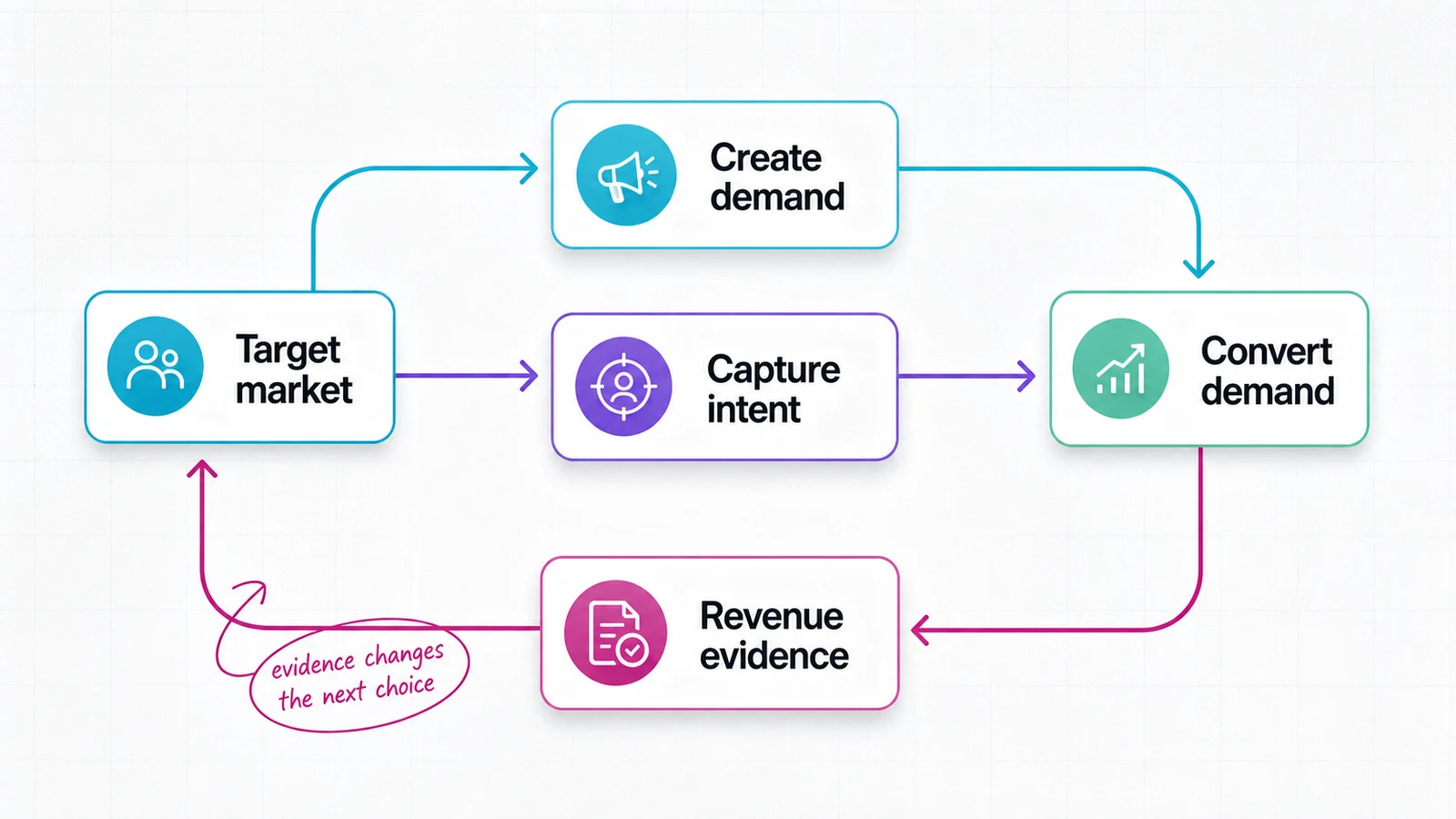
A B2B demand generation strategy defines how a company creates interest in a buying problem, captures active intent, converts qualified demand, and learns from revenue outcomes. It connects market choice, message, distribution, sales acceptance, and measurement.
That scope is wider than lead capture. A form can collect contact details from someone who has little urgency or buying authority. Demand generation asks whether the right market recognizes the problem, trusts the company, and has a credible path into a sales conversation.
Salesforce's demand generation overview also separates broad demand creation from the narrower task of collecting leads. The useful implication is simple: a campaign cannot repair an unclear market or weak buying problem.
Demand generation is broader than lead capture
Demand generation should influence a market before, during, and after a conversion event. Some buyers learn without identifying themselves. Others arrive with active intent and need a direct route to sales. Existing customers and lost opportunities also produce evidence that should change future choices.
Lead generation handles one part of that system. It captures a person and creates a record. The record still needs context, qualification, ownership, and a next action. A team that optimizes only for lead count can increase activity while lowering pipeline quality.
The strategic question is not, "How do we collect more names?" It is, "How do we make a specific market understand a costly problem and choose a useful next step?"
The four-part demand system
A practical demand program has four connected jobs.
| Job | Main question | Useful evidence |
|---|---|---|
| Create | Does the market recognize the problem and remember our point of view? | Direct traffic, branded search, engaged target accounts, qualitative response |
| Capture | Can an active buyer find and choose the right next step? | High-intent visits, demo requests, relevant replies, resource use |
| Convert | Does declared demand become an accepted sales conversation? | Acceptance rate, qualified meetings, opportunities, stage progression |
| Learn | What did sales and customers reveal about the market decision? | Win reasons, loss reasons, objections, deal quality, revenue |
These jobs need one shared market definition. The ideal customer profile sets company-level fit. Positioning explains why the category and offer deserve attention. The value proposition connects the problem to an outcome the buyer values.
If those inputs conflict, adding channels creates more inconsistent signals.
Start with one market and one buying problem
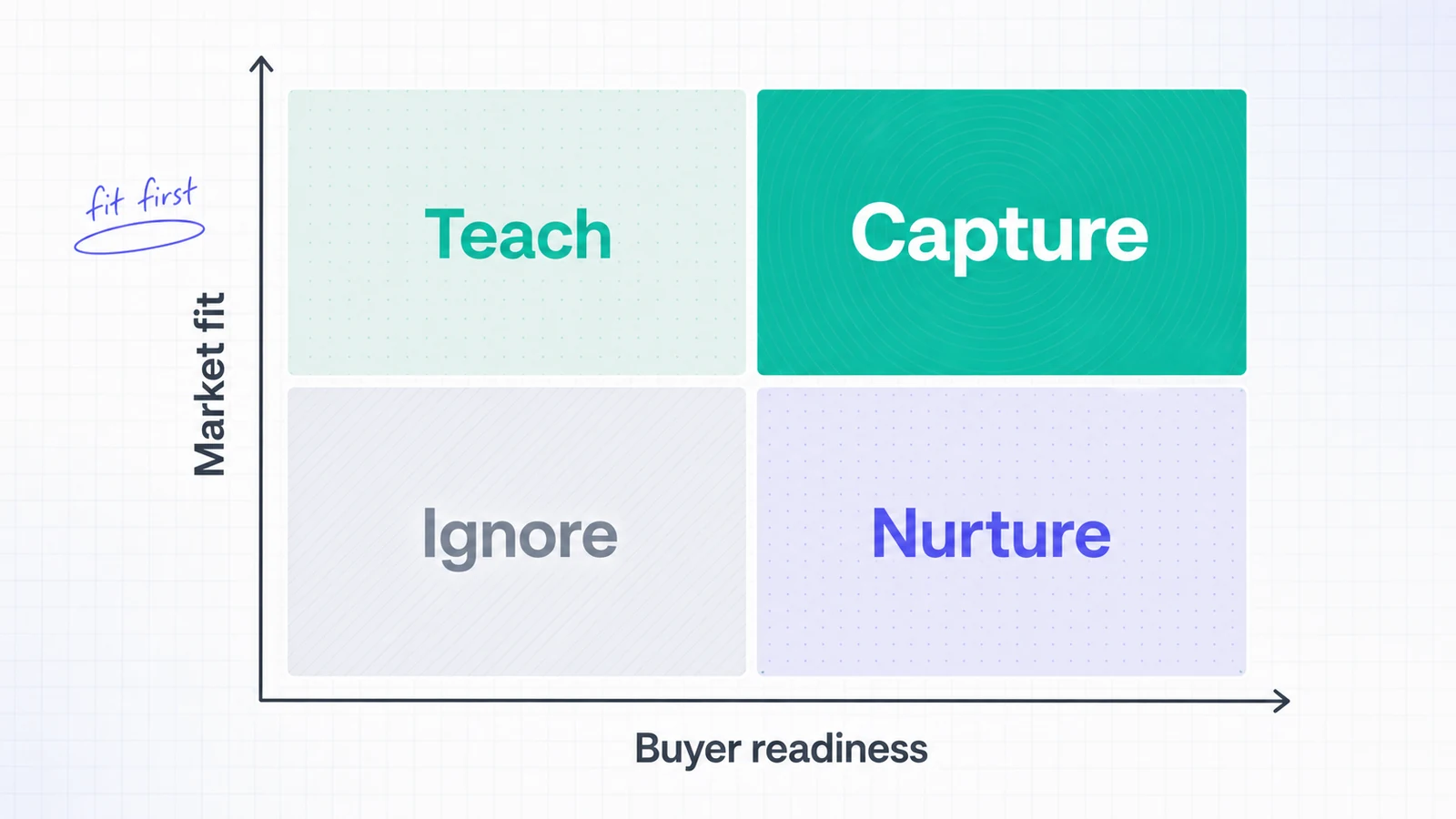
Choose a market narrow enough to recognize repeated conditions. Industry and company size may help, but operating details often matter more. Consider the current process, technology, team structure, trigger, constraint, and cost of delay.
Then choose one buying problem. It should be specific enough that a buyer can recognize it and important enough to fund. "Improve growth" is too broad. "Reduce the time required to route high-intent product accounts to the right seller" gives the team a clearer research and content target.
Write the market decision in one page:
- Which companies qualify?
- Which conditions disqualify them?
- Which role first feels the problem?
- Which other roles shape the decision?
- What changes if the problem remains unresolved?
- What evidence would show that the market choice is wrong?
This page becomes the filter for topics, distribution, capture offers, and sales follow-up. It should also agree with the broader go-to-market strategy.
Choose formats by buyer question
Format should follow the question, available expertise, and distribution path. A benchmark can guide the mix, but it cannot select the first format for every company.
Content Marketing Institute's 2025 B2B research, produced with MarketingProfs, surveyed 980 B2B marketers, mostly in North America. Among respondents who used each format, 58% rated video as producing their best results. Customer stories followed at 53%. E-books or white papers and research reports each reached 45%, while short articles reached 43%.

These are self-reported assessments across B2B content marketing. They do not prove that video should lead every SaaS program. They show that a useful mix can include explanation, customer evidence, and original research.
Match the format to the buyer question:
- Use a short article for a narrow definition or comparison.
- Use a guide when the reader must make several connected decisions.
- Use a customer story when risk and proof block action.
- Use a live session when the problem needs discussion or diagnosis.
- Use a calculator or template when the buyer needs to apply the idea.
One strong recurring format is usually better than five neglected channels.
Build the strategy in seven steps
1. Set one commercial outcome
Choose an outcome the company can inspect, such as qualified pipeline from a defined segment. Do not make impressions, downloads, or MQLs the final objective.
2. Map buyer questions
List what the buyer asks while recognizing the problem, comparing approaches, reducing risk, and preparing internal approval. Each topic should answer a real decision, not merely contain a keyword.
3. Select creation and capture paths
Creation reaches buyers who are not actively shopping. Capture helps active buyers move. Search-led guides, operator posts, partner sessions, customer proof, comparison pages, and direct consultation can play different roles.
4. Define the next step
Give each page one proportionate action. An early-stage reader may subscribe or use a template. A high-intent reader may request an assessment. Avoid forcing every visitor into the same demo form.
5. Set the sales acceptance contract
Define which signals create a record, which details sales receives, who accepts it, and how quickly the next action occurs. Clarify the difference between an MQL and a sales-qualified lead for your company.
6. Build a weekly review
Inspect topic response, target-account activity, qualified conversations, objections, opportunities, and progression. Decide whether to change the audience, message, offer, format, distribution, or handoff.
7. Expand only after evidence
Add a channel when the current message earns credible response from the selected market. Expansion before that point makes diagnosis harder.
Define the marketing-to-sales contract
A handoff needs more than a score. The seller should know the account, person, observed action, likely problem, relevant context, and expected response.
The contract should state:
- Which accounts and roles qualify
- Which actions indicate active intent
- Which actions are informative but insufficient
- Which records should be suppressed
- Who accepts or rejects each record
- Which rejection reasons are allowed
- How evidence returns to marketing
This contract protects both sides. Marketing gets specific feedback instead of a vague quality complaint. Sales receives fewer records with stronger context. The sales pipeline becomes the shared outcome surface.
Measure market response, pipeline, and revenue
Use a measurement ladder rather than one dashboard total.
Market response: target-account reach, repeat engagement, direct traffic, branded search, and qualitative replies.
Demand capture: high-intent visits, suitable conversions, relevant inbound conversations, and accepted records.
Pipeline: qualified meetings, opportunities, progression, deal quality, and time between key stages.
Revenue evidence: wins, losses, expansion, sales-cycle patterns, and recurring objections.
6sense's 2025 buyer research reports that many B2B buyers form preferences before contacting sellers. The study spans regions and industries, so it should not become a universal benchmark. It does reinforce the need to create useful market understanding before a buyer declares intent.
Review the ladder by segment and source. A channel can create many conversions while producing weak opportunities. Another can reach fewer people and produce stronger buying conversations.

A focused SaaS example
Consider a SaaS company that helps revenue teams route product and intent signals. It chooses B2B software companies with a defined sales team and a visible handoff problem.
The creation program explains signal definitions, routing failures, ownership rules, and response timing. Customer stories show how teams reduced missed high-intent accounts. Search pages capture buyers looking for routing and scoring guidance. A practical assessment becomes the high-intent next step.
Sales accepts a record only when the account fits, the person holds a relevant role, and the action suggests a current problem. Weekly reviews compare accepted conversations, objections, opportunities, and losses. The next content choice comes from those findings.
That is a demand strategy because each activity supports the same market decision and commercial outcome.
Common mistakes
Starting with channels: The team launches a podcast, newsletter, webinar, and paid campaign before choosing the market problem.
Gating every useful asset: Buyers cannot learn without exchanging contact details, which reduces trust and fills the database with low-intent records.
Treating MQL volume as success: The score rises while sales acceptance and pipeline quality fall.
Using one message for every buyer state: Educational visitors receive demo pressure, while active buyers struggle to find a direct path.
Skipping sales evidence: Marketing reports engagement without learning why opportunities advance or fail.
Adding channels too quickly: More distribution variables make a weak market or message harder to diagnose.
Frequently asked questions
What is the difference between demand generation and lead generation?
Demand generation creates and captures interest across a market. Lead generation records contact information. Lead capture can support demand generation, but it does not replace market education, sales acceptance, or revenue learning.
What is the first step in a B2B demand generation strategy?
Choose one market and one buying problem. Define qualifying conditions, exclusions, buyer roles, the cost of delay, and evidence that would disprove the choice.
Which demand generation channels should a SaaS company start with?
Start with one creation path and one capture path that match buyer behavior and team capability. A search-led guide plus a direct assessment may be enough for the first program.
How long does B2B demand generation take?
Timing depends on market awareness, sales complexity, distribution access, and purchase frequency. Set early evidence checks, but judge commercial impact across the actual sales cycle.
Who should own demand generation?
One leader should own the commercial outcome. Marketing, sales, and customer teams still need explicit responsibilities for creation, capture, acceptance, and evidence return.
Build the smallest complete system
A useful strategy does not need every channel. It needs one market, one buying problem, a credible point of view, an accessible capture path, a sales contract, and a recurring evidence review.
Book a GTM consultation to map those decisions for your company and turn them into a focused demand program.