


Demand generation
Demand generation is the work of creating and capturing informed market interest in a company's problem, category, point of view, and product. In B2B SaaS, it connects market education, positioning, content, distribution, events, community, campaigns, and revenue feedback.
Demand generation is broader than collecting leads. A person can understand and prefer a company without filling out a form. The motion should help the right market recognize a problem and consider a credible way to solve it.
Why it matters
Buyers cannot evaluate a product they do not understand or remember. Demand generation helps a company shape awareness before a formal sales conversation begins.
It can create future demand by teaching the market, and capture active demand through demos, trials, events, search, and inbound sales.
For startups, demand work also tests whether the market responds to the problem, language, and proof. That feedback can improve content, offers, channels, and the buyer persona.
How it works

The motion begins with a specific market problem and a clear audience. The company develops useful education, a distinct point of view, and proof that earns attention.
Distribution brings that material to buyers through search, social, newsletters, partnerships, paid media, events, communities, and sales conversations.
Channel use and reported effectiveness are not the same. In Content Marketing Institute and MarketingProfs' 2025 outlook, in-person events and webinars led reported distribution effectiveness at 52 and 51 percent. Email and organic social followed at 42 percent, corporate blogs at 41 percent, and email newsletters at 37 percent. The survey covered 980 B2B marketers, mostly in North America, and records reported results rather than audited channel ROI.
Engagement signals show what the market notices. Some people continue learning, some enter the sales funnel, and some become an MQL or direct sales conversation.
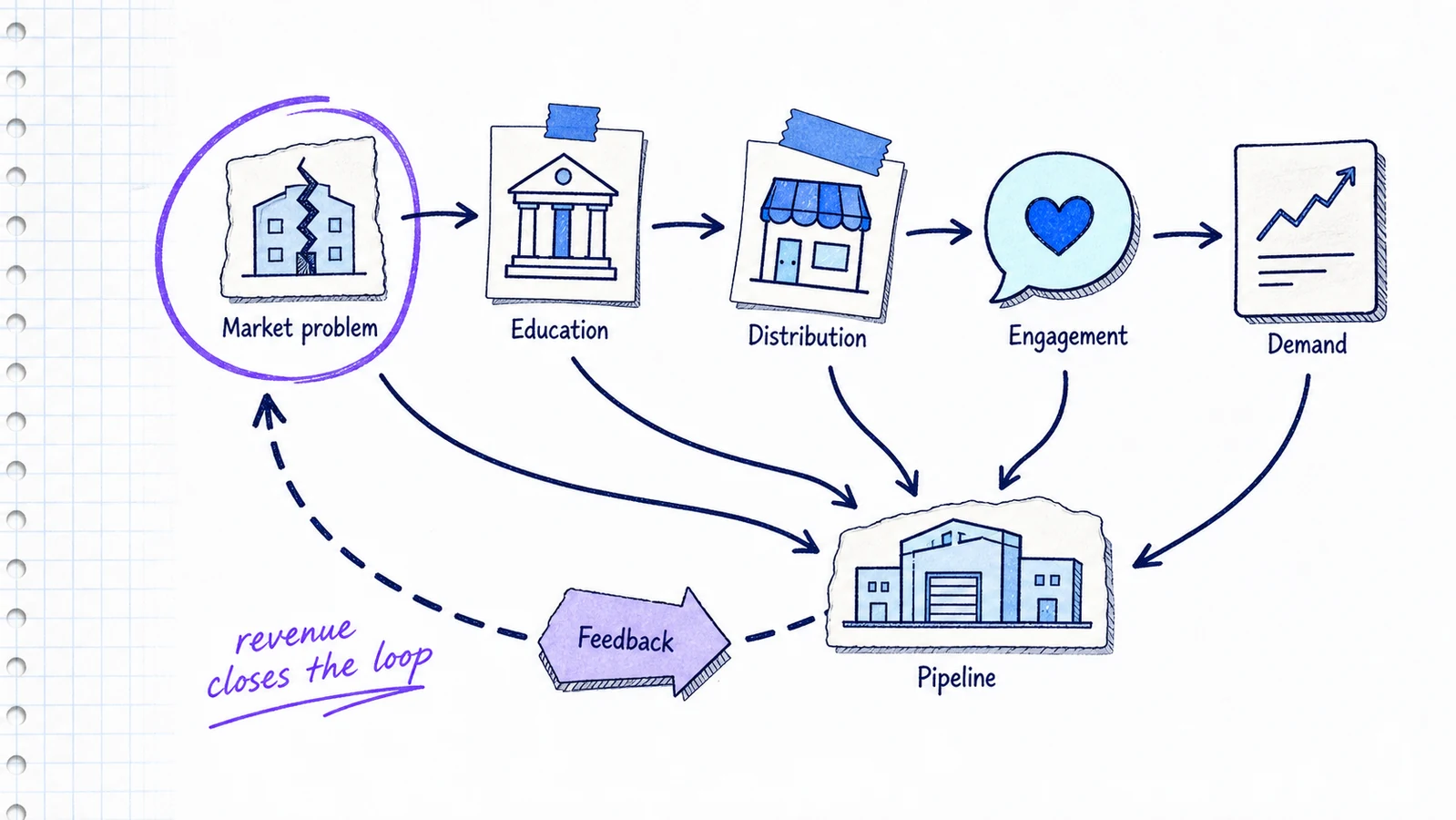
Revenue feedback closes the loop. The team should connect campaigns and content with qualified pipeline, conversion, customer quality, and market learning.
Demand generation may include lead generation, but capturing contact information is one mechanism, not the full outcome.
SaaS example
Imagine a startup selling AI workflow governance. Buyers may understand automation but lack language for the risks created by uncontrolled agents.
The company can publish operator guides, workflow audits, examples, events, and benchmarks that make the problem easier to see. A practical assessment or demo captures buyers who want to examine their own system.
Sales feedback then shows which problems create urgency and which content attracts accounts that never become qualified.
Common mistakes
The first mistake is measuring success only through form fills.
The second mistake is publishing broad content with no connection to the target buyer or product category.
The third mistake is separating brand activity from pipeline evidence entirely.
The fourth mistake is calling short-term lead capture a complete demand strategy.
How we see it
Demand generation should make the market more prepared to buy and make the company easier to remember when timing changes. The strongest program creates understanding first, then gives interested buyers a useful path forward.
Measurement should connect market activity to account movement, pipeline creation, and revenue over time. Reach is an input, but it is not proof that demand has been created among the buyers the business can serve.