


SQL
SQL means sales qualified lead. It is a person or account that sales has reviewed and confirmed as sufficiently relevant, ready, and actionable for a defined sales next step.
An SQL usually has stronger evidence than an MQL. Marketing engagement may start the process, but sales confirms whether the account, problem, timing, stakeholder, and next action justify active pursuit.
Why it matters
The SQL stage protects sales time and improves pipeline definitions. It prevents every response, demo request, or booked meeting from becoming an opportunity before the team understands what exists.
A hand raise and a booked meeting are not interchangeable with sales qualification. Chili Piper's 2025 demo form benchmark analyzed nearly four million 2024 submissions across its mostly B2B customer base. It found that 14.1% were disqualified and 66.7% of the qualified group booked a meeting. On a common base, that is about 57.3 qualified booked meetings per 100 form submissions. The benchmark stops at booking and does not establish opportunity acceptance or revenue.
It also gives marketing and sales a measurable handoff. Teams can track MQL-to-SQL conversion, SQL-to-opportunity conversion, disqualification reasons, and which sources create customers.
For an SDR or BDR, the SQL definition clarifies what information must be confirmed before passing the conversation to an account executive.
How it works

Each company needs its own criteria, but SQL qualification usually covers five areas.
First, fit: the account and buyer match the target market.
Second, problem: there is a relevant pain, goal, or workflow the product can address.
Third, timing: the problem has enough urgency or an identifiable decision window.
Fourth, authority and stakeholders: the team understands who owns, influences, uses, or approves the purchase.
Fifth, next step: the buyer has agreed to a meaningful action such as discovery, evaluation, technical review, or a scoped demo.
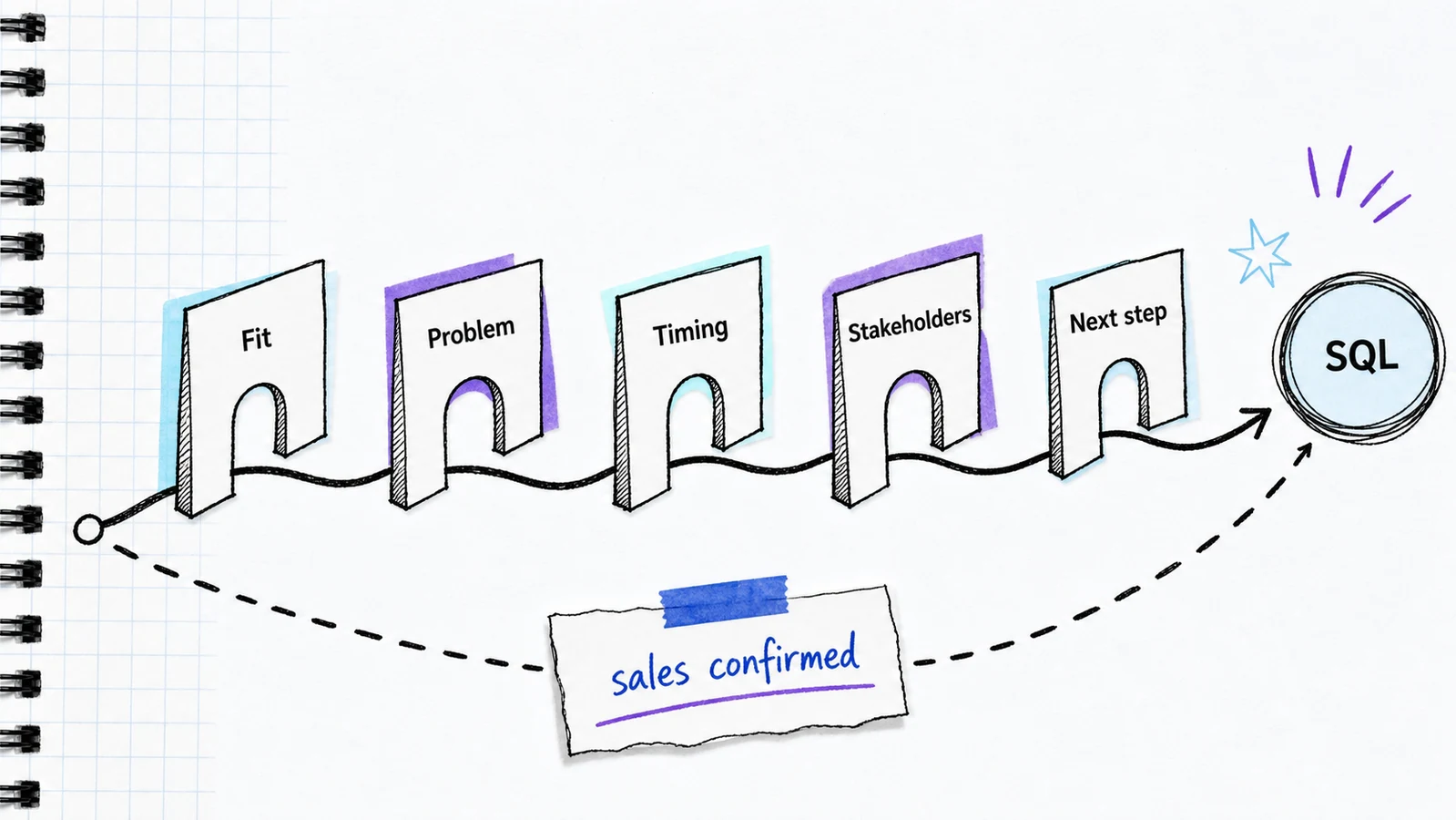
Some companies create the SQL before an opportunity; others use SQL and opportunity at the same point. The definitions must be explicit so reporting remains comparable.
That consistency keeps pipeline reporting usable.
SaaS example
Imagine a prospect asking for a demo of a data-enrichment platform. The company fits the ICP, but the requester is collecting tools for a future project with no owner or timeline.
That may remain an MQL or nurture lead. If sales confirms active CRM cleanup, an executive deadline, required integrations, and a discovery meeting with the owner, the lead may become an SQL and enter the sales pipeline.
Common mistakes
The first mistake is treating every booked meeting as an SQL.
The second mistake is requiring so much information that good buyers are delayed unnecessarily.
The third mistake is changing the definition by rep or region without documenting it.
The fourth mistake is creating opportunities before a real buyer action exists.
How we see it
An SQL should represent sales-confirmed progress. It is useful when the label improves ownership, follow-up, and pipeline quality rather than decorating a CRM stage.
The handoff needs a clock as well as a definition. Once a lead qualifies, the owner, next action, and expected response time should be explicit. Otherwise, sound qualification can still produce slow follow-up and misleading reports. Review rejected SQLs regularly to identify weak criteria, unclear ownership, or avoidable qualification gaps. Record the reason.