


Before a GTM agent changes your ICP, check the comparison
I would ask a GTM agent to show the accounts that did not book a meeting before accepting its next segment recommendation.
The meeting list shows who converted. It does not show who had a chance to convert, who received outreach, or who qualified afterward.
That distinction deserves attention after Sculpt. In its October 8 essay, Clay describes agents proposing strategy changes for human approval. Its keynote example uses a fictional company. That is a product demonstration, not evidence that a particular segment will outperform for your company.
The useful question is what an operator should inspect before accepting the recommendation. Clicking approve does not establish that the underlying comparison is sound.
Start with the population behind the meetings
Consider a hypothetical campaign where most meetings come from healthcare companies. An agent proposes increasing that segment's priority.
First, inspect the campaign population. Perhaps healthcare companies also received most of the outreach. Perhaps their contact records were more complete. Perhaps another segment was excluded before the campaign began.
Each possibility changes what the meeting list can support.
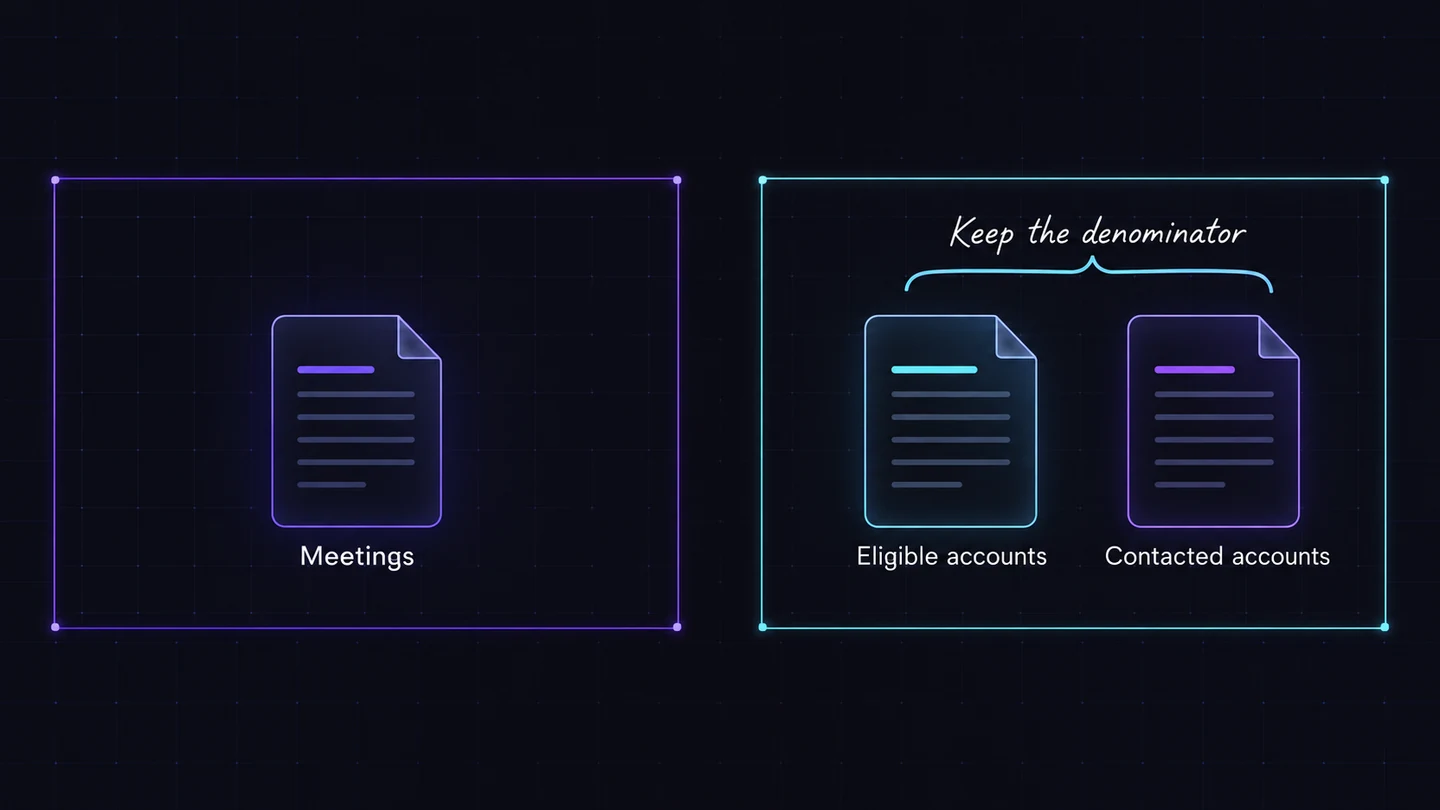
Keep three populations available: accounts eligible under the original targeting rule, accounts actually contacted, and accounts that produced meetings. Retain the reason an eligible account was skipped. A missing email address is different from a deliberate exclusion.
Then inspect what happened after the meeting. A conversation with the wrong buyer should not carry the same interpretation as a qualified opportunity.
Your ICP and buyer persona describe different boundaries. An apparent segment advantage could reflect better contact selection rather than stronger account fit.
This does not mean the recommendation is wrong. It means the evidence has not yet separated those explanations.
Keep unsuccessful outcomes in the comparison
A learning process needs records of rejected meetings, disqualifications, unanswered outreach, and accounts that never entered a sequence.
Those records should contain specific reasons where available. Leave unknowns labeled unknown. Do not ask an agent to invent a reason for silence.
Compare outcomes over a consistent observation period. A recently contacted account has had less time to respond than one contacted earlier.
Keep qualification criteria stable across the comparison, too. If one seller accepts every meeting while another requires a named buying initiative, their totals describe different decisions.
These definitions belong alongside your go-to-market metrics. They should not be reconstructed after an attractive pattern appears.
I would also retain the campaign's exclusions. A segment can look promising precisely because the campaign selected only its easiest accounts.
Turn the recommendation into a bounded test
Before changing the durable targeting rule, state what the proposed change is meant to improve.
For the hypothetical healthcare recommendation, that could be qualified opportunities from a defined account population. Meetings remain an intermediate observation.
Choose a bounded comparison that your team can execute and inspect. Hold the offer and qualification criteria stable where possible. Record differences you cannot control, including seller assignment, outreach timing, and data availability.
Do not call the comparison randomized unless assignment was actually randomized. Do not claim causation from a convenient before-and-after result.
Specify the decision before reviewing the outcome: what would justify expansion, what would justify rejection, and what would require more evidence?
A deadline can end the evaluation without forcing an acceptance. Insufficient evidence is a valid result.
Keep any broader ICP change separate from the experimental campaign. The test should not silently rewrite every audience while the team is still evaluating it.
The same discipline applies to signal-based selling. A signal can justify investigation without proving that every matching account deserves the same treatment.
Preserve the recommendation and the decision
Save the proposal, its supporting records, the rule version being challenged, the reviewer, and the reason for accepting, rejecting, or deferring it.
Retain rejected recommendations. Otherwise, future reviews lose the reasons a plausible change was previously declined.
Clay's workflow documentation describes version-bound run records and published versions for live triggers. That establishes execution traceability. It does not establish that a proposed segment change caused better commercial outcomes.
Our suggested decision record sits above that execution history. It connects an observed pattern to an explicit business decision.

Assign ownership through RevOps: who defines qualification, who reviews the comparison, and who can authorize a durable targeting change?
Begin with the next recommendation already waiting for approval. Ask for the original population, the contacted population, unsuccessful outcomes, and the proposed test.
If those records are missing, keep the recommendation open. Give the agent a specific evidence request before giving it a larger audience.