


Account-based marketing strategy for B2B SaaS
An account-based marketing strategy selects named companies, maps their buying groups, and coordinates marketing and sales around account-specific evidence. It gives valuable accounts different research, messaging, and attention than the broader market.
ABM is not a list of logos receiving personalized ads. It changes who receives scarce resources, why each account qualifies, who owns the next action, and how progress is measured.
Salesforce's ABM guide describes the category around selected high-value accounts and coordinated engagement. The strategic test is whether a company can turn that idea into explicit account decisions.
Check whether ABM fits before building it
ABM usually fits when a limited set of accounts could materially affect revenue and each purchase involves several people. Longer sales cycles, higher contract values, complex adoption, and concentrated markets can justify deeper account research.
It may be premature when the company lacks:
- A stable ideal customer profile
- A repeatable buying problem
- Credible positioning
- Reliable account and contact data
- Clear sales ownership
- Enough account value to support extra attention
ABM cannot compensate for uncertainty about the market. If every closed customer looks different, named-account personalization can hide that uncertainty rather than resolve it.
Compare the expected account value with the cost of research, coordination, content, outreach, and sales time. The program needs an economic reason for treating selected accounts differently.
The six parts of an account-based strategy
A complete strategy makes six decisions.
| Decision | Required answer |
|---|---|
| Objective | Which commercial outcome should selected accounts produce? |
| Accounts | Which companies qualify, and which conditions exclude them? |
| Tiers | How much research and attention does each account receive? |
| Buying groups | Which roles influence the problem, decision, approval, and adoption? |
| Orchestration | Who acts when evidence changes? |
| Measurement | How will account progression connect to pipeline and revenue? |
These decisions should live in one account plan. Marketing and sales may own different actions, but they should reference the same account facts and outcome.
Demandbase's ABM introduction emphasizes account selection and coordinated activity. A smaller SaaS team can apply those principles with a CRM, clear fields, and disciplined review before buying a specialist platform.
Select accounts from fit and evidence
Start with market segmentation, then apply account-level filters. A useful selection model combines five inputs.
Fit: Does the company match the firmographic, operating, technical, and geographic conditions associated with success?
Commercial potential: Is the likely contract and expansion value high enough to justify the selected treatment?
Problem evidence: Is there a verified condition that makes the buying problem plausible now?
Access: Does the team have a relationship, partner path, known contact, or credible route into the account?
Risk: Are there disqualifiers such as unsupported requirements, poor adoption conditions, procurement barriers, or an active competitor contract?
Do not let brand recognition replace evidence. A famous account can consume disproportionate attention while a less visible company has stronger fit and timing.
Define the scoring rules before reviewing logos. Keep the raw inputs visible so a person can challenge the score. If an account enters because of intent data, record the signal, source, date, and expected implication.
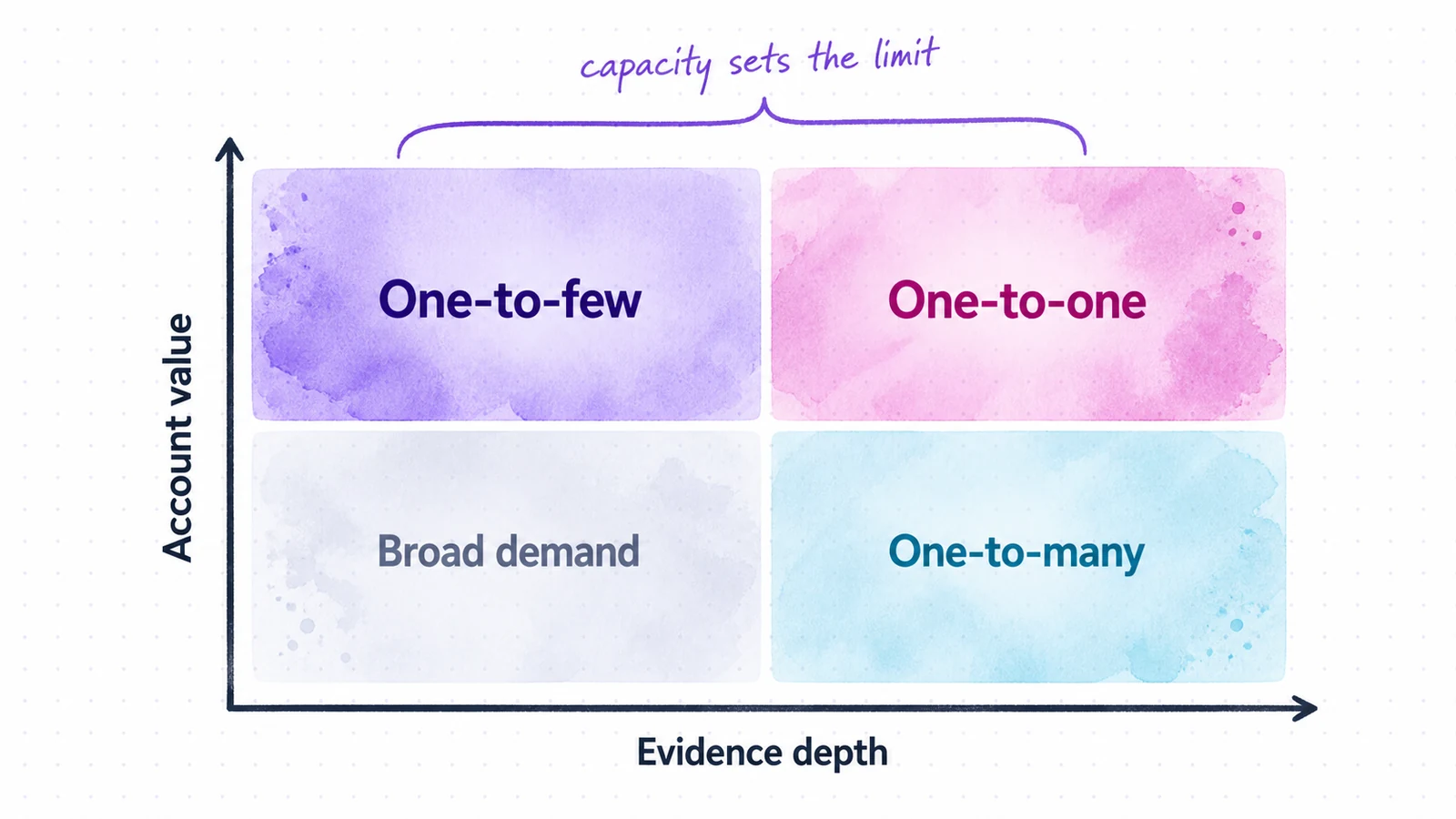
Tier accounts by value and evidence depth
Tiers allocate effort. They should not become status labels.
| Tier | Suitable condition | Treatment |
|---|---|---|
| One-to-one | High value and strong account evidence | Deep research, account-specific plan, coordinated role coverage |
| One-to-few | Similar high-fit accounts sharing a problem | Segment research, common narrative, selective account adaptation |
| One-to-many | Broader fit with lighter evidence | Scaled programs with account-aware routing and prioritization |
| Broad demand | Fit or timing remains uncertain | Market education and accessible capture paths |
An account can move between treatments when evidence changes. A one-to-many account with a strategic hiring trigger and active buying-group engagement may deserve deeper research. A one-to-one account with weak fit should leave the list.
Set a capacity limit for every tier. If the team cannot maintain role coverage and next actions, the tier contains too many accounts.
Map the buying group, not one contact
A B2B purchase may include a problem owner, functional leader, technical evaluator, finance reviewer, procurement contact, executive sponsor, and future users. The exact roles depend on the product and account.
For each role, record:
- Known person and title
- Likely influence on the decision
- Current problem or concern
- Evidence already observed
- Missing information
- Relevant value proposition
- Next useful action
The buyer persona helps explain role-level priorities. The account map adds the real people, relationships, and evidence inside one company.
Do not create a message for every title by changing the greeting and job name. Adapt the claim to the role's decision. A technical evaluator may need integration proof. A finance reviewer may need cost and risk clarity. An executive sponsor may need the commercial consequence.
Influence begins before seller contact
ABM cannot begin when a form fill appears. Account learning, category education, peer discussion, and internal consensus often precede the first seller conversation.
The 6sense 2025 B2B Buyer Experience Report surveyed nearly 4,000 B2B buyers across North America, EMEA, and APAC. The reported average point of first seller contact moved from 69% of the purchase process in 2024 to 61% in 2025.

That eight-point movement describes two annual study results. It does not establish a continuing trend or prove that earlier outreach causes better performance. It does suggest that sellers may enter earlier while buyers still complete substantial research first.
The same report says 94% of respondents ranked vendors before seller engagement, and 77% reported buying from the first vendor contacted. Those findings are self-reported and span industries. For an ABM team, the practical response is to build useful account presence and internal buying-group relevance before requesting a meeting.
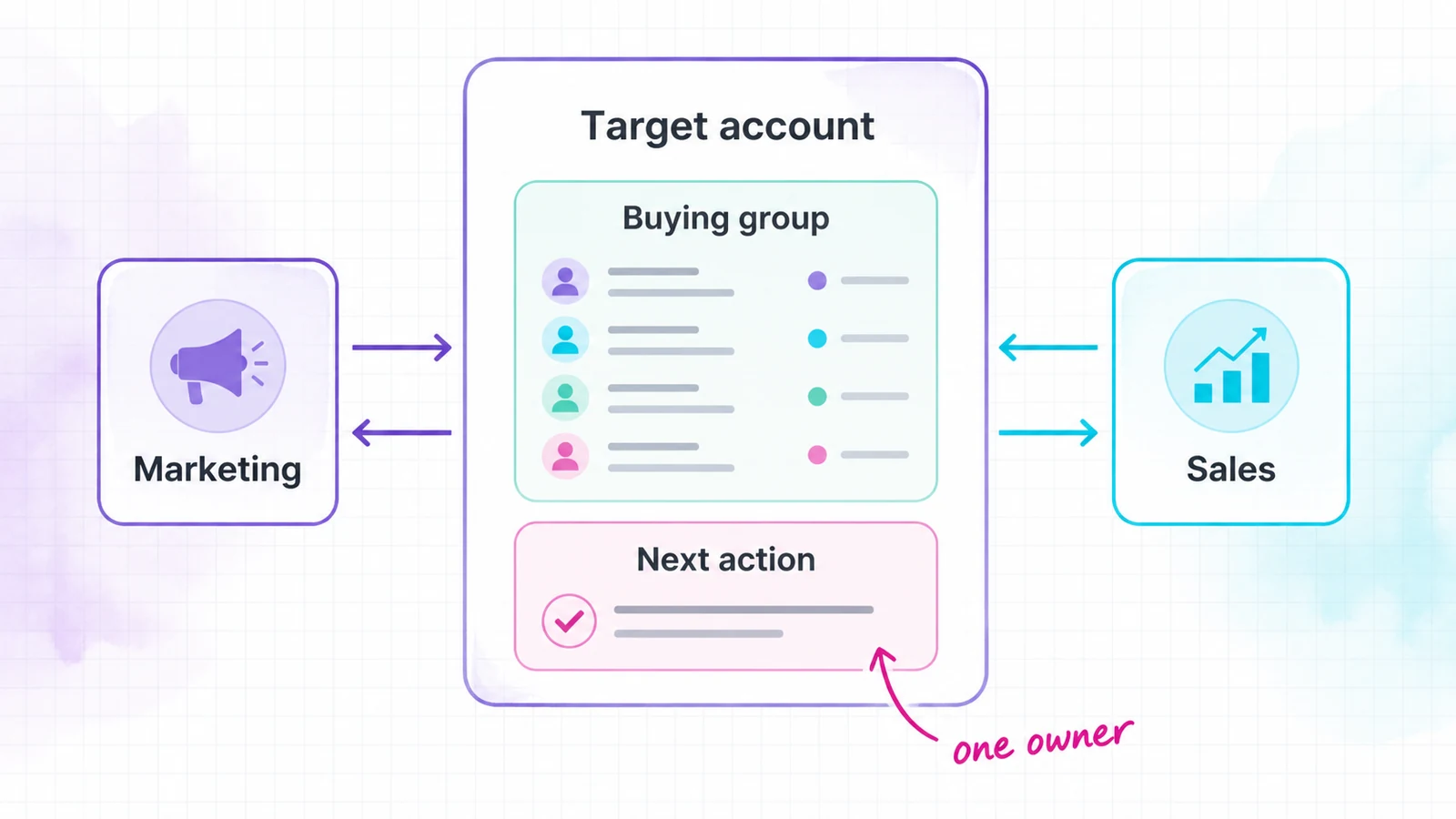
Coordinate around one account record
Every selected account needs one visible owner and one current next action. Marketing, sales, partnerships, and leadership can contribute, but conflicting messages and duplicate contact reduce trust.
The shared record should contain:
- Selection reason and tier
- Account objective
- Buying-group coverage
- Current evidence and source
- Active message or offer
- Recent actions across channels
- Suppression and relationship notes
- Named owner and next review date
HubSpot's ABM guide emphasizes sales and marketing alignment. Alignment becomes concrete when both teams can see why the account qualifies and what should happen next.
RevOps can help define fields, ownership, routing, and reporting. It should not own every account decision. Commercial leaders still need to choose the objective, segment, and resource level.

Run a bounded small-team pilot
A small team should avoid launching ABM across every attractive account. Start with one segment, one buying problem, and a limited set that fits available capacity.
Use this pilot sequence:
- Define the commercial objective and exit conditions.
- Select accounts using documented fit and evidence.
- Assign tiers and capacity limits.
- Map buying roles and coverage gaps.
- Choose one account narrative and role-specific proof.
- Set channel roles, owners, and suppression rules.
- Review account progression each week.
- Decide which assumptions to retain, change, or reject.
The pilot should have a fixed review window tied to the actual sales cycle. Early response can reveal message or data problems, but revenue evaluation needs enough time for opportunities to progress.
Measure progression, pipeline, and revenue
ABM measurement should move through three levels.
Account readiness: account data quality, buying-group coverage, verified evidence, and relationship access.
Commercial progression: qualified conversations, active opportunities, stage movement, stakeholder participation, and next-step completion.
Revenue: pipeline value, win rate, sales-cycle duration, contract quality, retention, and expansion for selected accounts.
Engagement is supporting evidence, not the objective. Ad impressions, page visits, and event attendance matter only when they improve an account decision or commercial outcome.
Compare results by tier and selection reason. If high-engagement accounts do not enter the sales pipeline, inspect fit, buying-group coverage, message, and next-step quality.
Common mistakes
Choosing logos before criteria: Account selection becomes political and difficult to challenge.
Personalizing without evidence: The message mentions company facts but never connects them to a relevant consequence.
Targeting one contact: The team mistakes an individual response for account consensus.
Hiding ownership: Several people contact the account while no one owns progression.
Treating every account equally: Research depth exceeds capacity and quality declines.
Reporting engagement as revenue: The dashboard looks active while opportunities remain unchanged.
Frequently asked questions
What is the difference between ABM and demand generation?
Demand generation addresses a market and creates accessible paths for buyers. ABM assigns selected accounts different research, coordination, and resource levels. A company can use both when their roles are explicit.
How do I know whether my SaaS company is ready for ABM?
You need a stable ICP, meaningful account value, a repeatable buying problem, reliable account data, clear ownership, and enough capacity for deeper account treatment.
How many accounts should an ABM pilot include?
Use capacity, not a universal benchmark. The team must maintain account evidence, buying-group coverage, coordinated actions, and recurring reviews for every selected account.
Do I need an ABM platform to begin?
No. A small pilot can use existing CRM records, documented selection rules, account plans, and clear owners. Add specialist software when volume or coordination complexity justifies it.
Which ABM metrics should I track first?
Start with account-data quality, buying-group coverage, qualified conversations, opportunity creation, stage progression, and pipeline. Add revenue measures as the cohort matures.
Make account selection earn its cost
ABM becomes useful when selected accounts receive better decisions, not merely more activity. Define why each account qualifies, what evidence changes priority, who owns the next action, and how progression reaches revenue.
Book a GTM consultation to design the account model, tier rules, buying-group coverage, and pilot cadence for your company.