


Sales discovery
Sales discovery is a structured conversation, or series of conversations, used to understand a buyer's current process, desired outcome, business impact, constraints, stakeholders, and decision path.
The output is shared evidence. The seller should know what the buyer wants to change, why the change matters, what could block it, who needs to participate, and which next step would test the fit.
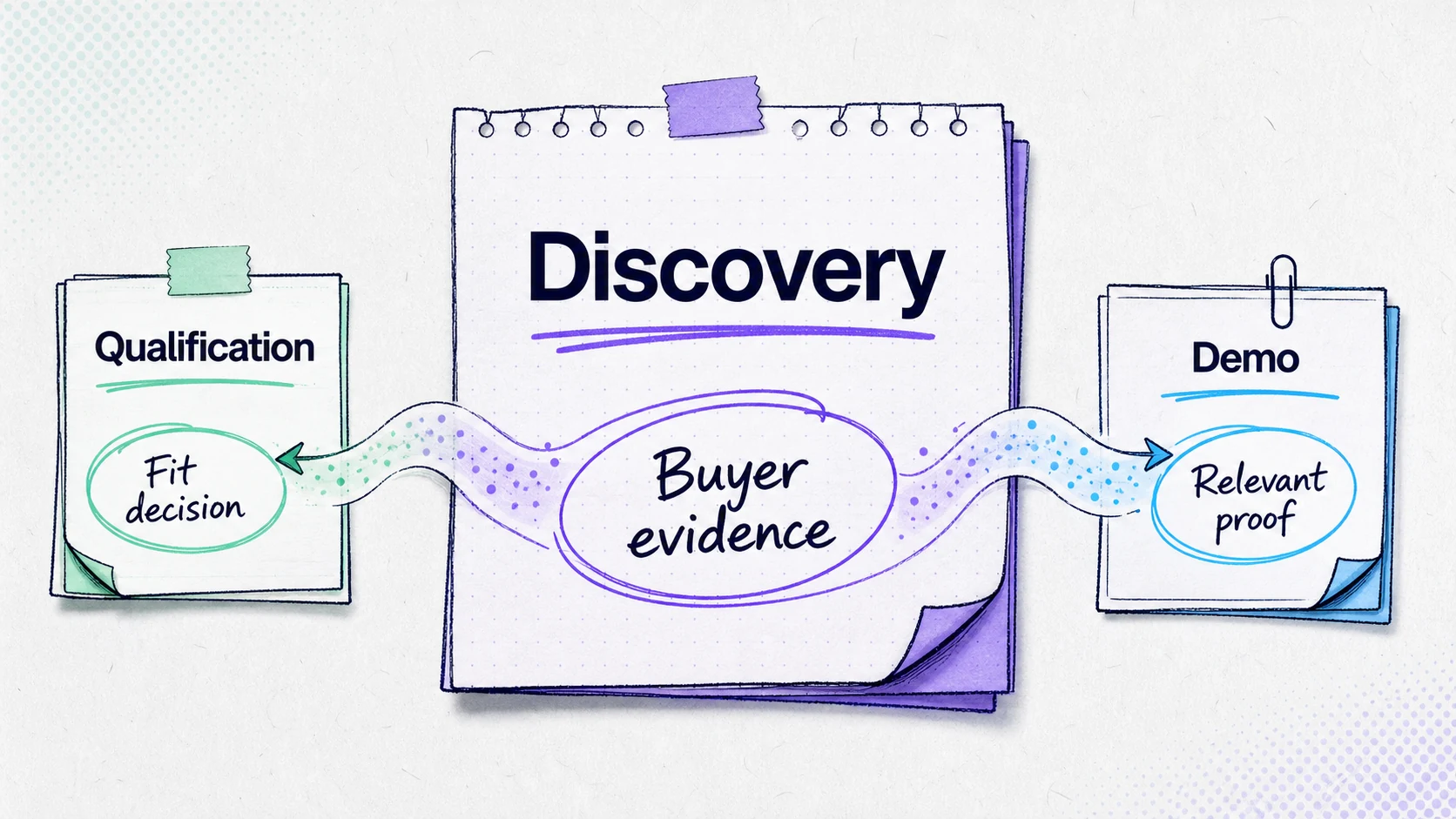
Discovery is connected to qualification and demos, but each has a different job. Qualification decides whether the opportunity deserves further investment. A demo shows relevant product behavior. Discovery supplies the buyer context that makes both decisions useful.
Why it matters
Weak discovery creates generic selling. The seller repeats a standard value proposition, shows too many features, and advances an opportunity without clear buyer evidence.
Strong discovery helps an account executive decide what to investigate, what proof to provide, and which stakeholder should join next. It also improves the sales pipeline because stage movement can be tied to confirmed buyer actions instead of seller confidence.
Discovery can also reveal that the opportunity should stop. A company may fit the ICP, while the current problem has little impact, no owner, or no workable decision path. Learning that early protects time on both sides.
How it works
Preparation comes first. The seller should research facts that are already available, including the company's model, market, team structure, and likely use case. Discovery time should not be spent asking the buyer to repeat public information.
The conversation then moves through a small set of evidence areas:
- Current process: what happens now, who owns it, and which systems are involved
- Desired outcome: what the buyer wants to change
- Impact: the cost, risk, delay, or missed result tied to the current state
- Constraints: technical, financial, organizational, or timing limits
- Decision path: stakeholders, proof requirements, approvals, and timing
- Next step: the smallest useful action both sides agree to take
These are not a script. A useful follow-up question depends on the buyer's previous answer. Complex SaaS deals may need several discovery conversations as technical, security, finance, and executive stakeholders enter.
Qualification sits inside this work as a narrower decision about fit and viability. A demo is different again. It should show the workflows and evidence connected to what discovery uncovered, not tour every product screen.

SaaS example
An AE sells a data enrichment product to a RevOps manager. The manager says the team needs better contact data. That statement is a starting point, not enough evidence for a proposal.
The AE learns that incomplete CRM records force SDRs to research accounts manually, delaying each outbound sales sequence. The team traces where records become incomplete, estimates the operational cost, identifies security requirements, and agrees to test enrichment quality on a real account sample.
Qualification determines whether the problem, account, and buying path justify continued work. The later demo focuses on the exact enrichment workflow, match quality, field controls, and audit requirements the buyer raised.
Common mistakes
The first mistake is running discovery as an interrogation. A long question list can collect facts without creating a shared understanding.
The second is pitching after the first pain statement. Symptoms need context, impact, and ownership before they can guide a solution.
The third is using discovery and qualification as synonyms. Discovery builds the evidence. Qualification uses part of that evidence to make a fit decision.
The fourth is calling a generic demo discovery. Product screens cannot replace an honest account of the buyer's process and constraints.
How we see it
Discovery is complete enough when both sides can explain the current state, the desired change, the consequence of doing nothing, the decision path, and the next proof required.
The goal is not to ask impressive questions. It is to reduce uncertainty without forcing the buyer into the seller's script. Good discovery can advance a deal, reshape it, or stop it. Each outcome is useful when it reflects better evidence.