


Account-based marketing
Account-based marketing, or ABM, is a B2B strategy that concentrates marketing and sales resources on a selected group of valuable accounts. The team chooses the accounts, maps the people involved in each purchase, coordinates relevant engagement, and measures progress at the account level.
The account is the planning unit. Individual contacts still matter, but their activity is interpreted within the company, buying process, and commercial opportunity around them.
Why it matters
Broad demand generation helps a company create and capture interest across a market. ABM makes a narrower allocation decision. It asks which accounts deserve deeper research, coordinated attention, and a higher cost of engagement.
That choice can fit a SaaS company with large contracts, a limited market, and several people involved in each purchase. It is less useful when deal value is low, buying is simple, or the target list is too large for meaningful account work.
An ICP helps define the kind of company likely to fit. ABM turns that market definition into a named account portfolio and a plan for working it.
How it works
First, the team selects accounts using fit, potential value, strategic relevance, timing, and current relationship. A list built from company size alone is too weak.
Second, it maps the buying committee. A buyer persona describes a recurring type of buyer. Account mapping identifies the actual people, roles, priorities, and missing relationships inside a specific company.
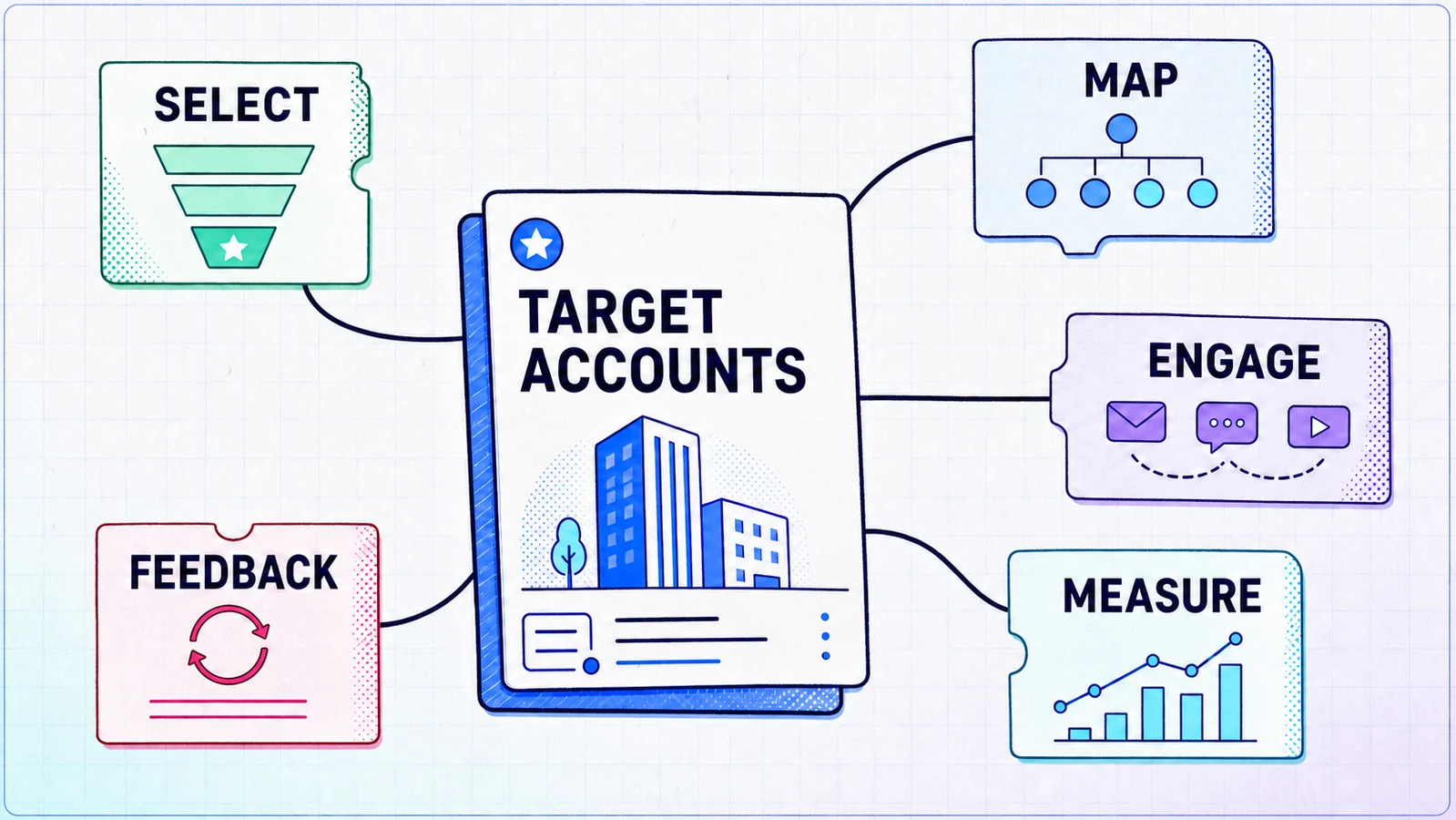
Third, marketing and sales agree on the account plan. They decide which problem to lead with, what evidence each role needs, which channels make sense, and who owns the next action.
Fourth, the team watches account evidence. Content engagement, seller conversations, product activity, and intent data can change the plan. None of those signals confirms that an account will buy.
Finally, the team measures coverage and commercial movement at the account level. Useful measures include engaged roles, meetings with relevant stakeholders, opportunities created, deal progression, and revenue. RevOps should keep the account definitions and ownership rules consistent.
ABM can run at different depths. A few strategic accounts may receive individual plans. Similar accounts may share a segment play. A larger portfolio may use common rules with lighter personalization.
SaaS example
Consider a security SaaS company selling six-figure contracts to regulated businesses. It selects 40 accounts where compliance pressure, technical fit, and contract value support deeper work.
For each account, the team maps security, IT, finance, and executive roles. Marketing develops evidence for the concerns each role carries. Sales records what it learns from conversations. The account plan changes when new stakeholders appear, an integration concern surfaces, or a budget owner asks for a business case.
The goal is not to send a custom email to everyone. The goal is to coordinate the evidence and actions needed to move a specific account into a qualified sales pipeline.

Common mistakes
Calling personalized outbound ABM is the most common mistake. Personalization is one possible tactic, while ABM includes selection, role coverage, coordination, and measurement.
Another mistake is choosing too many accounts. When every company is a target account, the team cannot apply deeper research or attention.
Teams also overreact to isolated engagement signals, let sales and marketing work from different account lists, or measure clicks without checking whether the right people and opportunities moved.
How we see it
ABM should be treated as a resource-allocation model. The account earns concentrated effort because its value, fit, and buying complexity justify the cost.
The strongest account plans remain editable. New evidence should change the people involved, the message, or the next action. If the plan cannot absorb what sales learns, the company has built a campaign list rather than an account-based motion.