


Bookings vs billings
Bookings are the value of accepted customer commitments recorded during a period. Billings are the value of invoices issued during that period. They can describe the same contract, but they record different events.
Neither metric is the same as recognized revenue or cash collected. Revenue is recorded as the company earns it by delivering the service. Collections record when the customer actually pays.
Why the distinction matters
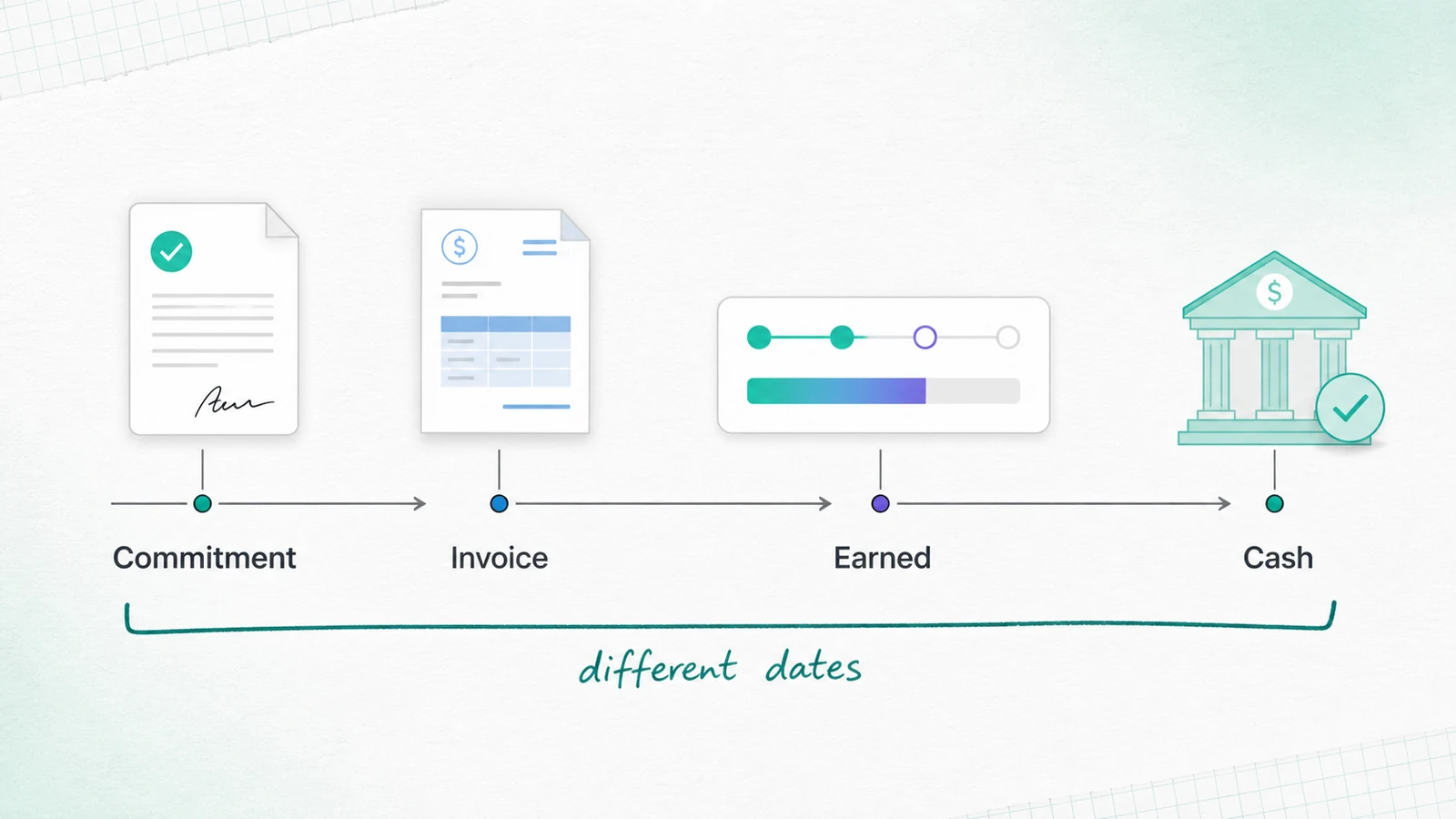
A SaaS company can sign a large annual contract today, invoice it monthly, recognize revenue as service is delivered, and receive cash after each invoice. Sales, finance, and leadership may therefore report different numbers for the same customer without any ledger being wrong.
Bookings help a team inspect commercial commitments and the output of its sales pipeline. Billings show what the company has invoiced. Recognized revenue belongs to accounting. Collections help finance understand cash movement.
Collapsing these records creates avoidable reporting errors. A strong bookings month does not guarantee the same amount was invoiced or collected. High billings do not mean the entire amount has been earned as revenue.
How bookings and billings move through a SaaS contract
Start with the signed agreement. If it meets the company's booking policy, the accepted contract value enters bookings on the booking date.
The billing schedule decides when invoices are issued. An annual commitment may be billed upfront, quarterly, or monthly. Each invoice enters billings when it is created, regardless of whether the customer has paid it.
Revenue follows delivery. If a customer buys 12 months of service, the company may recognize the recurring portion across those 12 months under its accounting policy. Cash follows the payment event and may arrive before, on, or after an invoice's due date.
The exact policy needs written rules for contract changes, cancellation clauses, usage charges, currencies, and one-time services. Bookings are especially sensitive to policy choices because they are an operating measure rather than a standard accounting line.

SaaS example
Suppose a customer signs a 12-month software contract worth $24,000 and receives monthly invoices of $2,000.
The company may record a $24,000 booking when the agreement is accepted. It then records $2,000 in billings each month. The recurring service may contribute $2,000 of recognized revenue each month as delivery occurs. Cash appears when each invoice is paid.
ACV can express the annualized contract value, while ARR and MRR normalize recurring revenue at annual and monthly periods. Those metrics help compare contracts, but they do not replace the booking, invoice, revenue, or cash records.
Common mistakes
One mistake is calling every signed proposal a booking before acceptance conditions are met.
Another is treating an invoice as collected cash. An issued invoice can remain unpaid.
A third is using bookings as recognized revenue. A commitment can cover service that has not yet been delivered.
The clean approach is to define each metric, assign its event date, and reconcile the handoffs between systems. The goal is not to choose one number as the truth. It is to know what each number measures and why the timing differs.